

Did you know that over 80% of small business finance applications in Australia now lean toward one specific loan structure? When you're weighing up a chattel mortgage vs hire purchase for sole traders, the right choice depends more on your cash flow strategy than just the interest rate. It's common to feel uneasy about whether you actually own your new ute on day one or if the financier keeps the title until the very last cent is paid. We understand that navigating GST treatments and ownership rules can feel like a distraction from your actual trade.
You likely want a straightforward way to claim your GST and depreciation without getting tangled in complex tax reporting. This guide promises to clear the fog by showing you which finance option fits your 2026 tax situation best. We will break down the latest GST treatment rules, the $69,883 car depreciation limit, and how to secure fast approval so you can get your equipment on the road and start earning. By comparing these two popular paths, you can make a decision that protects your profit and simplifies your next BAS.
Key Takeaways
- Learn why a chattel mortgage allows GST-registered sole traders to claim the full GST amount on their next BAS, providing an immediate cash flow boost for your business.
- Discover the critical ownership differences, from holding the asset title immediately with a chattel mortgage to the gradual transition of equity in a hire purchase agreement.
- Compare how the choice of chattel mortgage vs hire purchase for sole traders affects your interest deductions and depreciation claims to maximise your 2026 tax return.
- Understand the benefits of low-doc and no-doc finance pathways specifically designed for contractors and new ABN holders in Melbourne’s western suburbs like Werribee and Melton.
Navigating Business Finance as an Australian Sole Trader in 2026
For a sole trader, a new ute or piece of machinery isn't just a purchase; it's an investment in your capacity to earn. In 2026, the distinction between personal credit and business asset finance has never been more critical. Many contractors are moving away from personal car loans because they lack the tax flexibility and higher borrowing limits found in commercial products. When evaluating a chattel mortgage vs hire purchase for sole traders, you aren't just looking for a low rate. You're looking for a structure that aligns with your BAS cycle and depreciation goals.
To qualify for these commercial products, the Australian Taxation Office (ATO) generally requires the asset to be used for business purposes at least 51% of the time. This threshold opens the door to the two main contenders: the Chattel mortgage and the Commercial Hire Purchase (CHP). While both allow you to get behind the wheel faster, their impact on your balance sheet is vastly different. Choosing between them requires a clear understanding of how you want to manage ownership and tax deductions over the coming years.
Why Your ABN Changes the Finance Game
Securing asset finance for self employed professionals is a different beast compared to a standard PAYG application. Lenders look at your ABN length and GST registration status rather than just a payslip. If you've been registered for GST for more than two years, you might even qualify for "Low Doc" or "No Doc" pathways. These options are perfect for tradies who have the cash flow but haven't finished their latest tax returns. In 2026, secured asset finance is often more accessible than unsecured business loans. Because the asset itself provides the lender with security, you can often access lower interest rates and more flexible repayment terms. Your GST status is a major factor here. It determines whether you can claim the full GST on the purchase price upfront or if you need to claim it over the life of the loan.
Asset Finance in Melbourne’s Western Growth Corridor
In booming areas like Tarneit, Truganina, and Werribee, the demand for reliable utes and heavy machinery is at an all-time high. Local contractors are increasingly prioritising cash flow over outright ownership. They understand that keeping cash in the business to cover materials and wages is often smarter than tying it up in a depreciating asset. This is where the debate of chattel mortgage vs hire purchase for sole traders becomes practical. Whether you're a new sub-contractor or an established builder, having a broker who understands the local industry landscape can be the difference between a "yes" and a "no." We focus on your industry experience to help bridge the gap between your ambition and the lender's requirements. Our expertise in Low Doc options means we can often secure approvals for local business owners who might be turned away by traditional big banks.
The Chattel Mortgage: Instant Ownership for Tradies and Contractors
A chattel mortgage operates similarly to a traditional home loan but for your business equipment. You take legal ownership of the asset at the moment of purchase, while the lender secures the loan by taking a "mortgage" over the item. This structure is a primary reason why the chattel mortgage vs hire purchase for sole traders debate often leans toward the mortgage option. Because you hold the title, selling or upgrading the asset later is often simpler, provided you clear the remaining finance. To protect their interest, the lender will record the asset on the Personal Property Securities Register (PPSR). This is a standard administrative step that we handle for you, ensuring the paperwork is compliant and your credit remains protected.
One of the most powerful advantages for GST-registered sole traders is the upfront tax benefit. If you're using cash-basis accounting, you can typically claim the entire GST component of the purchase price on your very next Business Activity Statement (BAS). This provides a significant cash flow injection early in the loan term. To keep your monthly repayments manageable, we can also structure your loan with a balloon payment. This residual amount is paid at the end of the term, allowing you to keep more cash in your pocket for daily operational costs. If you aren't sure which structure fits your cash flow, exploring your finance options with a specialist can provide the clarity you need.
Tax Benefits and Depreciation
With a chattel mortgage, you can generally claim both the interest on the loan repayments and the depreciation of the asset as tax deductions. For the 2026-27 income year, it's vital to remember the car limit for depreciation is capped at $69,883 for passenger vehicles. While the Australian Government has announced its intention to make the $20,000 instant asset write-off permanent from 1 July 2026, you should always verify the current status with your accountant. These benefits make it a highly effective choice for equipment finance for sole traders who want to lower their taxable income while growing their fleet.
Low Doc Chattel Mortgage Options
Many sole traders in Melbourne's west don't have two years of updated tax returns ready to show a bank. We specialise in Low Doc chattel mortgages that allow you to secure a new ute or van using alternative proof of income. If you've held your ABN for at least 12 months and are a property owner, you might even qualify for "No Doc" niche products for Tier 1 assets. Lenders in 2026 are increasingly looking at your ABN history and industry experience rather than just historical paperwork. This approach helps local contractors in Werribee and Melton get the tools they need without the traditional red tape of big-bank lending.
Commercial Hire Purchase (CHP): A Flexible Path to Asset Acquisition
While a chattel mortgage gives you the keys and the title on day one, Commercial Hire Purchase (CHP) follows a different path. Under this arrangement, the financier buys the asset and "hires" it back to you for a set term. You enjoy full operational use of the equipment to run your business, but the legal title stays with the lender until you've made the final payment. This distinction is a cornerstone of the chattel mortgage vs hire purchase for sole traders debate. It offers a structured way to eventually own the asset without the immediate administrative burden of holding the title yourself during the finance term.
CHP is a staple for those seeking self employed truck finance or funding for heavy machinery. Lenders often prefer this structure for specialised "yellow goods" or older assets because their ownership of the title provides an extra layer of security. For an owner-driver or a contractor in Melbourne's west, this can mean accessing finance for equipment that might not fit the strict criteria of a standard chattel mortgage. Once you've paid the final instalment and any agreed balloon payment, the financier transfers the title to you, completing the purchase.
The Mechanics of Hire Purchase
At the end of your term, you'll usually pay a nominal "Option to Purchase" fee to officially transfer the title into your name. Even though you don't legally own the asset during the hire period, you still record the asset and the corresponding liability on your balance sheet. This allows you to track your equity as you pay down the loan. Many lenders provide highly competitive interest rates for CHP agreements on heavy equipment because these assets tend to have strong resale values, making the lender's "ownership" during the term very secure.
GST and Hire Purchase in 2026
The GST treatment for CHP has evolved significantly. Since the 2012 tax law changes, GST is generally applied to the purchase price, the interest, and the fees associated with the hire. This differs from a chattel mortgage where you claim the GST on the purchase price upfront. If you aren't registered for GST, CHP can be a very attractive option. It allows you to spread the GST cost over the life of the loan rather than dealing with a large upfront tax component you can't claim back. This makes it a practical choice for smaller sole traders who operate below the $75,000 GST registration threshold and don't need the immediate BAS credit.
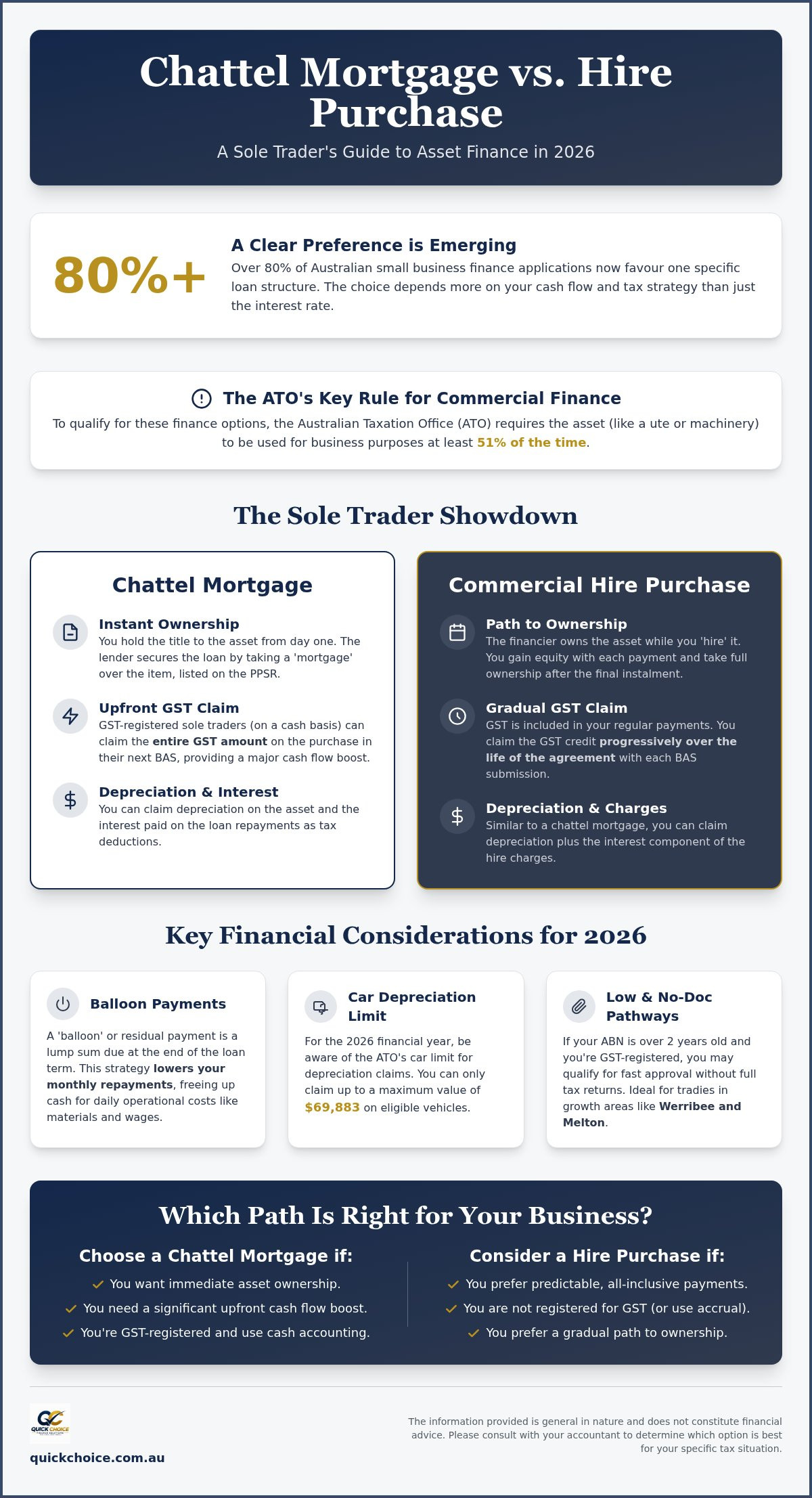
The Sole Trader Showdown: GST, Tax, and Cash Flow Compared
When you're a sole trader, your vehicle often serves two masters: your job site and your family. This personal versus business use split is exactly why the choice of chattel mortgage vs hire purchase for sole traders is so personal. While a large company might look at a fleet as a pure line item, you're looking at your primary tool of trade. The main showdown happens at the Business Activity Statement (BAS) level. With a chattel mortgage, a GST-registered sole trader can typically claim the full GST on the purchase price upfront. In contrast, hire purchase agreements generally spread that GST claim over the term of the loan. This upfront injection of cash from a chattel mortgage can be a lifesaver for a new ABN holder looking to fund their next project.
Your annual tax return also feels the impact. Both structures allow you to claim the interest component and depreciation as deductions, but the 2026 car limit for depreciation is a firm ceiling at $69,883. If you buy a luxury ute for $90,000, you can only depreciate it up to that $69,883 limit regardless of your finance type. Selling the asset mid-term is usually more fluid with a chattel mortgage because the title is already in your name. You simply pay out the remaining balance and the lender removes their interest from the PPSR. With a hire purchase, the financier technically owns the asset, making a mid-term trade-in slightly more paperwork-intensive as you coordinate with the lender to transfer the "hire" interest.
Matching the Finance to Your Cash Flow
Most local contractors find that business vehicle finance australia leans heavily toward the chattel mortgage model. It’s often easier for your accountant to justify to the ATO because the ownership is clear-cut from the start. If you’re opting for a Low Doc path, an "Accountant’s Letter" verifying your taxable income can often replace months of bank statements. Managing a balloon payment at the end of the term is another strategic move. You can choose to pay it out in a lump sum or refinance the residual to keep the asset working for you without a massive cash hit to your savings.
Ownership vs Possession
There is a psychological win in holding the title from day one. Many tradies prefer knowing the ute is "theirs" even if the bank has a mortgage over it. If you default on payments, the lender can still repossess the asset under both structures, but the process of discharging the security is more direct with a chattel mortgage once that final cent is paid. In a hire purchase, you're waiting for that final "Option to Purchase" fee to be processed before the asset is legally yours. If you're ready to see which structure fits your ABN best, apply for a finance pre-assessment today to protect your credit score while you shop.
Making the Right Choice with Quick Choice Asset Finance
Deciding between a chattel mortgage vs hire purchase for sole traders is a significant step toward growing your business. For contractors in Werribee, Melton, and Tarneit, the right structure can mean the difference between struggling with cash flow and having the capital to take on bigger contracts. We act as the bridge between your ambition and the specialised lenders who understand the unique needs of the self-employed. Unlike traditional banks that often rely on rigid algorithms, we look at the strength of your ABN and your industry experience. This approach allows us to secure commercial asset finance for complex cases where a standard tax return might not tell the whole story.
Protecting your credit score is our priority. Our pre-assessment process allows us to determine your eligibility without leaving multiple "hard" enquiries on your credit file. This is crucial for sole traders who may need to apply for other forms of credit in the future. By accessing a wide panel of non-bank lenders, we find flexible Low Doc policies that cater to those who haven't yet finalised their most recent tax returns. We take the time to explain the practical benefits of each option, ensuring you feel confident and supported throughout the entire journey.
Our Local Expertise in Melbourne’s West
The construction and logistics boom in suburbs like Laverton and Hoppers Crossing requires a finance partner who understands the local landscape. We know that a tradie in the western suburbs needs their gear on the road quickly to keep up with the pace of development. For example, we recently helped a contractor in Rockbank navigate the choice between a chattel mortgage and CHP for a new excavator. By analysing their GST registration and long-term ownership goals, we secured a structure that maximised their tax deductions while keeping monthly repayments sustainable. This local insight ensures the equipment you finance today supports your growth through 2026 and beyond.
Ready to Organise Your Finance?
Our streamlined process is designed to value your time. We move from initial assessment to final settlement in three clear steps:
- Assessment: We review your ABN history and asset requirements to find the best lender match.
- Quote: You receive a transparent breakdown of rates, repayments, and any balloon options.
- Settlement: We handle the paperwork and PPSR registration so you can get to work.
Secure the Assets Your Trade Demands
Choosing between a chattel mortgage vs hire purchase for sole traders doesn't have to be a source of stress. Whether you prioritise the immediate GST refund of a chattel mortgage or the structured ownership path of hire purchase, your decision should always protect your monthly cash flow. It's important that your finance structure aligns with current tax rules like the $69,883 car depreciation limit. Having a clear strategy now ensures a smoother tax season later. We're here to make that process straightforward.
At Quick Choice, we specialise in asset finance for Melbourne tradies who need results without the red tape. We provide access to over 40 Australian lenders, including non-bank specialists with flexible Low Doc and No Doc ABN loan policies. You don't need to navigate these complex tax treatments alone. Get a fast, professional quote for your next business asset and let us handle the heavy lifting while you focus on the job at hand. We're here to help you build a stronger future for your business.
Frequently Asked Questions
Which is better for a sole trader: chattel mortgage or hire purchase?
The best choice depends on your GST registration status and how you prefer to manage your cash flow. Most Australian contractors choose a chattel mortgage because it allows for immediate ownership and an upfront GST claim. If you aren't registered for GST, a hire purchase might be more suitable as it can spread the GST cost over the life of the loan. We recommend looking at your specific 2026 tax goals before deciding.
Can I claim the full GST upfront with a chattel mortgage?
Yes, if you are registered for GST and use cash-basis accounting, you can typically claim the entire GST amount on your next Business Activity Statement. This is a primary factor when weighing up a chattel mortgage vs hire purchase for sole traders. By receiving this refund early, you can reinvest that capital back into your business operations or use it to reduce your loan principal.
Do I need a tax return to qualify for a chattel mortgage in 2026?
You don't always need recent tax returns to secure finance. Low Doc and No Doc loan options are specifically designed for ABN holders who may not have their 2025 or 2026 paperwork finalised. If you have held your ABN for at least 12 months and own property, many specialised lenders will assess your application based on your credit history and a simple declaration of income.
What is the maximum loan term for sole trader asset finance?
Most lenders offer terms ranging from 1 to 7 years for business vehicles and machinery. A five-year term is the most common choice for tradies as it balances affordable monthly repayments with the useful life of the asset. Choosing a longer term can lower your regular commitments, but it may result in paying more interest over the total life of the loan.
Can I get a chattel mortgage if my business is not registered for GST?
Yes, you can still access a chattel mortgage if you aren't registered for GST. However, you won't be able to claim the GST component of the purchase price back from the ATO. For businesses with a turnover below the $75,000 threshold, the decision on a chattel mortgage vs hire purchase for sole traders often shifts toward hire purchase to avoid a large upfront tax hit that can't be recovered.
How does a balloon payment affect my sole trader tax deductions?
A balloon payment reduces your monthly repayment amount, but it doesn't change your total tax deductions. You can still claim the full interest component of the loan and the depreciation of the asset up to the $69,883 car limit. The balloon simply defers a portion of the principal repayment until the end of the term, which helps keep more cash in your business for daily expenses.
Is hire purchase still a popular option for Australian small businesses?
Hire purchase remains a strategic choice for specific scenarios, particularly for heavy machinery or specialised "yellow goods." While chattel mortgages dominate the vehicle finance market, hire purchase is often favoured by businesses that aren't GST-registered or those acquiring older assets. Lenders often provide competitive rates for this structure because they maintain legal title to the asset until the final payment is made.
Can I finance a used vehicle from a private seller as a sole trader?
Yes, we can arrange finance for vehicles purchased from private sellers. This process usually requires an independent valuation or inspection to ensure the asset provides adequate security for the lender. While dealer sales are often faster to process, private sales can offer better value for money, and we can guide you through the specific paperwork required to clear the title and settle the loan.


