Why are you waiting for your accountant to finish last year's tax return when the A$20,000 instant asset write-off deadline is fast approaching on 30 June? You know that securing the right equipment is vital for growth, yet the traditional bank application process often feels like it was designed to hold you back. It's exhausting to deal with endless paperwork or fear a rejection because your most recent financials aren't ready. This is where asset finance for self employed specialists can change the trajectory of your business by prioritising your cash flow over perfect paperwork.
We understand that as an Australian sole trader or contractor, your time is your most valuable asset. You need a finance structure that works with your specific situation, not against it. This guide provides a clear roadmap to help you secure the vehicles or machinery you need with minimal fuss. We'll show you how to leverage Low Doc options to get fast approval for a new ute or excavator while ensuring your setup is tax-effective for the 2026 financial year.
Key Takeaways
- Learn how asset finance for self employed professionals works as a secured facility, specifically designed for ABN holders and independent contractors.
- Compare the benefits of Chattel Mortgages, Hire Purchase, and Leasing to ensure your finance structure aligns with your business goals and the asset's useful life.
- Demystify the Low Doc approval process and discover how to secure funding without up-to-date tax returns by using alternative proof of income.
- Follow a practical four-step roadmap to calculate your budget and obtain a pre-approval before you head to the dealership or auction.
- Understand how local specialist support in Melbourne's West can streamline your application, allowing you to stay on site while we handle the legwork.
What is Asset Finance for Self Employed Professionals?
Asset finance isn't just a simple loan; it's a strategic partnership between your business and its equipment. At its core, this is a form of asset-based lending where the item you're purchasing serves as the primary security for the debt. This structure is particularly powerful for ABN holders and independent contractors who need to grow without risking their personal property.
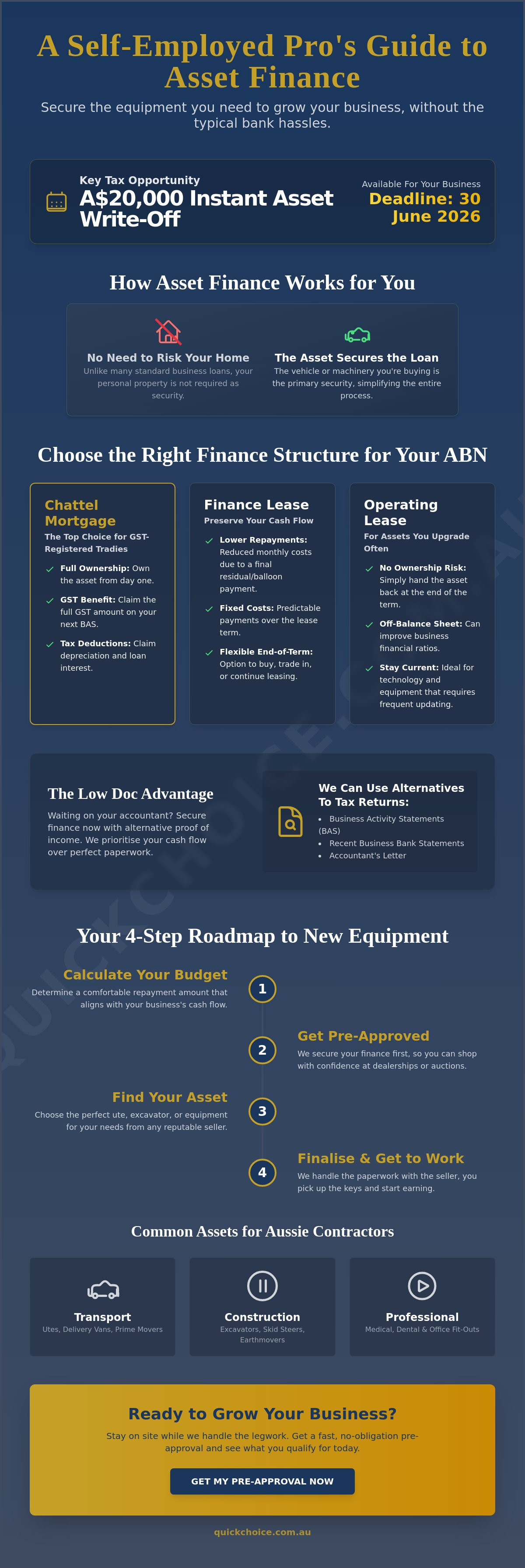
Traditional banks often treat self-employed individuals like standard retail customers, but asset finance for self employed professionals acknowledges that your equipment is a revenue-generating tool. In 2026, market conditions have made this even more attractive. With the RBA cash rate at 4.35% as of May 2026, preserving your cash reserves for operational costs is often smarter than paying for a vehicle upfront. Quick Choice specialises in this niche, helping local operators secure the gear they need while the A$20,000 Instant Asset Write-Off (IAWO) threshold remains available until June 30, 2026.
Why Sole Traders Prefer Asset Finance Over Standard Business Loans
Most standard business loans require you to provide residential property as security. Asset finance removes that hurdle. Because the vehicle or machine itself secures the loan, the approval process is significantly faster. You can keep your working capital for daily operations and quarterly GST obligations instead of tying it up in a depreciating asset. It's about maintaining a healthy cash flow while your new asset pays for itself through the daily work it completes. This approach provides a safety net that traditional commercial term loans simply don't offer.
Common Assets Financed by Australian Contractors
The variety of equipment we help finance reflects the diverse nature of the Australian workforce. Whether you're an owner-driver in Melbourne's West or a specialist contractor, the right equipment is your bread and butter. We frequently help our clients secure:
- Transport: Light and heavy vehicles including utes, delivery vans, and prime movers.
- Construction: Earthmoving machinery, excavators, and skid steers for local tradies.
- Professional: Medical, dental, and specialised office fit-out equipment for independent practitioners and consultants.
Securing these assets through a tailored finance structure ensures you're ready for the 2026 tax season with a clear plan for depreciation and interest deductions.
Choosing the Right Finance Structure for Your ABN
Selecting the correct structure for your asset finance for self employed application is just as important as the asset itself. You need to align your monthly repayments with your business's cash flow cycles while maximising your tax position for the 2026 financial year. A critical step is matching the finance term to the asset's "useful life." For example, a heavy-duty excavator might warrant a five-year term, whereas a delivery van might be better suited to a three-year arrangement. For a deeper dive into these options, CPA Australia's Business Funding Guide provides an excellent framework for understanding secured business facilities.
Chattel Mortgage: The Go-To for GST-Registered Tradies
If you're registered for GST, a Chattel Mortgage is often the most effective choice. Under this structure, you own the asset from the moment of purchase, which allows you to claim the full GST amount on your next Business Activity Statement (BAS). With the current Instant Asset Write-Off threshold set at A$20,000 for the 2025-26 financial year, this structure is highly popular for earthmoving equipment in growth hubs like Tarneit and Melton. You can generally claim both the interest on the loan and the depreciation of the asset as tax deductions. It's a powerful way to reduce your taxable income before the threshold is scheduled to revert to A$1,000 on 1 July 2026.
Finance Lease vs. Operating Lease: Which Fits Your Cash Flow?
Leasing offers a different path by prioritising lower monthly repayments. A finance lease typically includes a "residual value" or balloon payment at the end of the term. This reduces your immediate overheads, which is ideal if you're managing tight margins. Operating leases are slightly different; they're often used for technology or assets you plan to upgrade frequently. This can keep the equipment "off-balance-sheet," potentially improving your business's financial ratios. If you're unsure which path fits your specific ABN setup, our team at Quick Choice can help you compare these structures side-by-side.
Your GST registration status and annual turnover will ultimately dictate which structure is most beneficial. Because tax laws can change, always consult your accountant to ensure your chosen finance plan aligns with your 2026 tax strategy. Making the right choice now ensures your equipment remains a boost to your bottom line, not a burden on your cash flow.
Low Doc vs. Full Doc: Navigating the Approval Process
Choosing between Low Doc and Full Doc finance often comes down to how quickly you need your equipment and how up-to-date your books are. Many people assume "Low Doc" means "No Doc," but that isn't the case in 2026. Lenders still need to verify your business's health, though they do so without requiring two years of certified tax returns. This pathway is the primary choice for asset finance for self employed professionals who have the cash flow to support a loan but haven't yet finalised their most recent financial statements with an accountant.
Lenders generally view these applications through two lenses: asset-backed or income-backed. If you've been in business for over two years and own a home, you're often seen as asset-backed, which can streamline your approval. If you're a newer operator, perhaps only in business for six months, the process is more rigorous. While most lenders prefer a 12 to 24 month ABN history, specialist lenders will consider shorter periods if you have significant industry experience or a substantial deposit. It's about proving you're a low-risk partner despite a shorter trading history.
Minimum Requirements for Low Doc Asset Finance
To qualify for a Low Doc facility, you typically need an active ABN that has been registered for at least 12 months. Being GST-registered is often a prerequisite for higher borrowing limits. Lenders will look for a clean credit history, as this acts as a proxy for your reliability. In the 2026 lending environment, a "Self-Declared Income" form is a standard requirement. You'll state your annual earnings, and the lender may verify this against your Business Activity Statements (BAS) or a simple letter from your accountant to confirm you can comfortably manage the repayments.
When to Opt for Full Doc Finance
Full Doc finance is the right path if your priority is securing the absolute lowest interest rate. By providing complete transparency through your 2025 and 2026 tax returns, you give lenders the confidence to offer their most competitive pricing. This is also necessary for large-scale machinery acquisitions that exceed standard Low Doc limits. If your 2025/26 BAS shows a high-growth trajectory, using that full documentation can help you negotiate better terms for a larger fleet expansion. It's a methodical way to ensure your finance costs remain as low as possible while your business scales.
4 Steps to Organise Your Asset Finance in 2026
Moving from the research phase to actually getting your equipment on site requires a methodical approach. In 2026, the speed of loan processing has become a critical factor for business success. Following a structured path ensures you don't miss out on the right machinery or get stuck with a finance deal that hinders your growth. Our role is to guide you through this process so you can focus on your trade while we manage the numbers.
Step 1: Determine your budget. Start by looking at your "after-tax" monthly cash flow rather than just your gross turnover. This ensures you can comfortably meet repayments while still covering your GST and superannuation obligations. Step 2: Get a Pre-Approval. Before you even look at a dealership, secure a pre-approval. This confirms exactly how much you can borrow and at what rate, giving you a clear boundary for your search. Step 3: Source the asset. Decide whether a private sale, dealer purchase, or auction fits your needs and timeline. Step 4: Finalise and settle. Once you've found the asset, your broker handles the invoice verification and coordinates the settlement to fund the purchase directly with the seller.
The Power of Pre-Approval for Self-Employed Buyers
Walking into a dealership in Hoppers Crossing or Melton with a pre-approval changes the entire dynamic of the sale. It allows you to negotiate like a "cash buyer" because the dealer knows the funds are ready to go. You'll avoid the common trap of high-interest "in-house" dealer finance, which often carries hidden fees or rigid terms that don't suit a contractor's fluctuating income. Most importantly, a single pre-approval through a specialist protects your credit score. Instead of multiple "hard hits" from various lenders as you shop around, we manage the inquiry process to ensure your credit file remains healthy for future growth.
Sourcing Assets: New vs. Used Equipment
Supply chain stabilisations in 2026 have led to a surge in high-quality used asset financing. While new equipment offers the latest technology, used machinery can provide significant value if it's within lender age restrictions. Most lenders prefer assets to be less than 10 to 12 years old at the end of the finance term. If you're buying privately, a PPSR (Personal Property Securities Register) check is mandatory to ensure there's no existing debt on the item. This due diligence prevents you from accidentally inheriting someone else's financial liabilities.
If you're ready to see what your business can afford, get a pre-approval today and start shopping with confidence. Our team ensures your asset finance for self employed application is handled with the precision and speed your business deserves.
Why Quick Choice is the Preferred Broker for Melbourne's West
Being on-site is where you make your money. You don't have time to sit in a bank branch explaining your ABN history to a lender who doesn't understand the difference between a skid steer and a telehandler. Quick Choice is embedded in the industrial heart of Melbourne's West. We work alongside operators in the Truganina, Tarneit, and Werribee hubs, providing the local expertise that faceless national lenders simply can't match. Our "Reliable Specialist Guide" approach means we take the entire workload off your plate while you stay focused on your daily operations.
Quick Choice maintains a broad panel of over 40 lenders, which is a significant advantage in the 2026 credit market. This variety allows us to find competitive asset finance for self employed options even for "New ABN" holders who have been trading for less than two years. We know which lenders are currently favouring transport assets and which ones are more flexible with earthmoving machinery. By streamlining the application process and presenting your business in the best possible light, we aim to get your approval sorted and your new gear on the road faster than traditional channels.
Supporting Local Contractors from Rockbank to Caroline Springs
Local contractors from Rockbank to Caroline Springs face unique pressures in Melbourne's rapidly developing growth corridors. You need equipment that is reliable and ready to work as soon as the contract starts. We offer a high-touch service that prioritises face-to-face communication over automated chatbots. This personal connection allows us to understand the nuances of your cash flow and GST obligations.
We recently assisted a sole trader in Melton who needed to upgrade their earthmoving fleet to keep up with a major infrastructure project. Their bank had stalled the application for weeks, requesting outdated tax returns. Our team stepped in and utilised a Low Doc structure that focused on their recent Business Activity Statements. We secured the necessary funding for two new excavators in under 48 hours, ensuring their business didn't miss a single day of billable work on site.
Ready to Secure Your Next Business Asset?
Navigating the complex 2026 lending criteria shouldn't be your second job. Whether you're looking for a new work vehicle or heavy machinery, we handle the fine print so you don't have to. The Quick Choice promise is built on transparency, speed, and solutions that are tailored to your specific ABN setup. We're here to remove the obstacles between you and the resources you need to succeed. If you're ready to take the next step, you can organise a quick chat with our asset finance team today to discuss your options.
Power Your Business Forward with Specialist Asset Finance
Securing the right equipment shouldn't be a source of stress. By choosing the correct structure like a Chattel Mortgage and leveraging the A$20,000 instant asset write-off before the June 2026 deadline, you're making a strategic investment in your future. You now have a clear roadmap to navigate the approval process, from understanding Low Doc requirements to finalising your pre-approval. Specialist asset finance for self employed is about giving you the freedom to grow without the traditional bank red tape.
As specialists in Melbourne's Western Suburbs, we pride ourselves on delivering fast 24-48 hour approvals that keep your business moving. We understand the local landscape and the unique needs of ABN holders across Truganina, Melton, and beyond. You don't have to manage the complex 2026 lending environment alone. Our team is ready to do the legwork so you can stay focused on the job at hand.
Speak to a Quick Choice Asset Finance Specialist Today and discover how simple your next acquisition can be. We're here to help you build a stronger, more efficient business with confidence.
Frequently Asked Questions
Can I get asset finance if I've only just started my ABN?
Yes, you can secure asset finance with a new ABN, though your options are more specialised. While many traditional banks require two years of trading history, certain lenders offer products for businesses trading for as little as six months. You'll generally need to demonstrate significant industry experience or provide a larger deposit to offset the risk. This pathway is a common way for new contractors to get their first work vehicle on the road.
What is the maximum age for a used truck or machine I can finance?
Most lenders prefer that a used truck or machine is no older than 12 to 15 years at the end of the finance term. For instance, if you purchase a seven-year-old excavator on a five-year term, it fits within the acceptable age limit. Financing older assets is possible through niche lenders, but you might find the interest rates are higher or the loan term is shorter to reflect the asset's depreciating value.
Do I need a deposit for self-employed asset finance in 2026?
You don't always need a deposit to secure asset finance for self employed operators. Many lenders offer 100% finance to ABN holders who have a clean credit history or own residential property. However, contributing a 10% to 20% deposit can often help you secure a more competitive interest rate. It also reduces your monthly repayments and the total interest paid over the life of the loan.
How does the 'Instant Asset Write-Off' work for my 2026 tax return?
For the 2025-26 financial year, the Instant Asset Write-Off allows you to immediately deduct the full cost of eligible assets up to A$20,000. To qualify, the asset must be first used or installed ready for use by 30 June 2026. This is a vital tool for reducing your taxable income before the threshold is scheduled to revert to A$1,000 on 1 July 2026. It's a significant benefit for small businesses with turnover under A$10 million.
What documents do I need for a Low Doc asset loan?
Low Doc loans typically require an active ABN for at least 12 months, GST registration, and a clean credit file. Instead of full tax returns, you'll provide a self-declared income statement. Lenders may also ask for your most recent Business Activity Statements (BAS) or a brief letter from your accountant. This streamlined approach allows for much faster approvals, often within 24 to 48 hours, getting you back to work with minimal delay.
Can I finance an asset purchased from a private seller?
Yes, you can finance equipment or vehicles purchased from a private seller. The process involves a few extra steps, such as a PPSR check to ensure the asset has no outstanding debt and a physical inspection to verify its condition. Once these checks are complete, the lender pays the private seller directly. This ensures the transaction is secure for both parties and the title transfers correctly to your business without any legal complications.
What happens to my finance if I decide to upgrade my equipment early?
If you decide to upgrade early, you'll need to request a payout figure from your lender to close the existing loan. This figure includes the remaining principal and may include an early termination fee. You can then trade in the asset or sell it privately to cover this amount. Any equity left over can be used as a deposit for your next piece of equipment, helping you keep your fleet modern and efficient.
Is asset finance available for bad credit self-employed applicants?
Asset finance is available for self-employed applicants with a less-than-perfect credit history through specialist non-conforming lenders. While interest rates are typically higher to reflect the increased risk, these loans allow you to acquire the tools you need to generate income. Successfully managing these repayments is also an effective way to repair your credit score over time, making future financing easier to obtain as your business grows.