

In 2026, the real cost of your next work vehicle isn't the interest rate you're quoted; it's the cash flow you sacrifice by choosing the wrong structure. When you're self-employed, securing business vehicle finance australia shouldn't feel like a cross-examination by a big bank. You've likely felt the sting of red tape or the anxiety of being asked for two years of tax returns when you're just trying to grow your operations. It's frustrating when the system seems designed for employees rather than the independent professionals actually building the country.
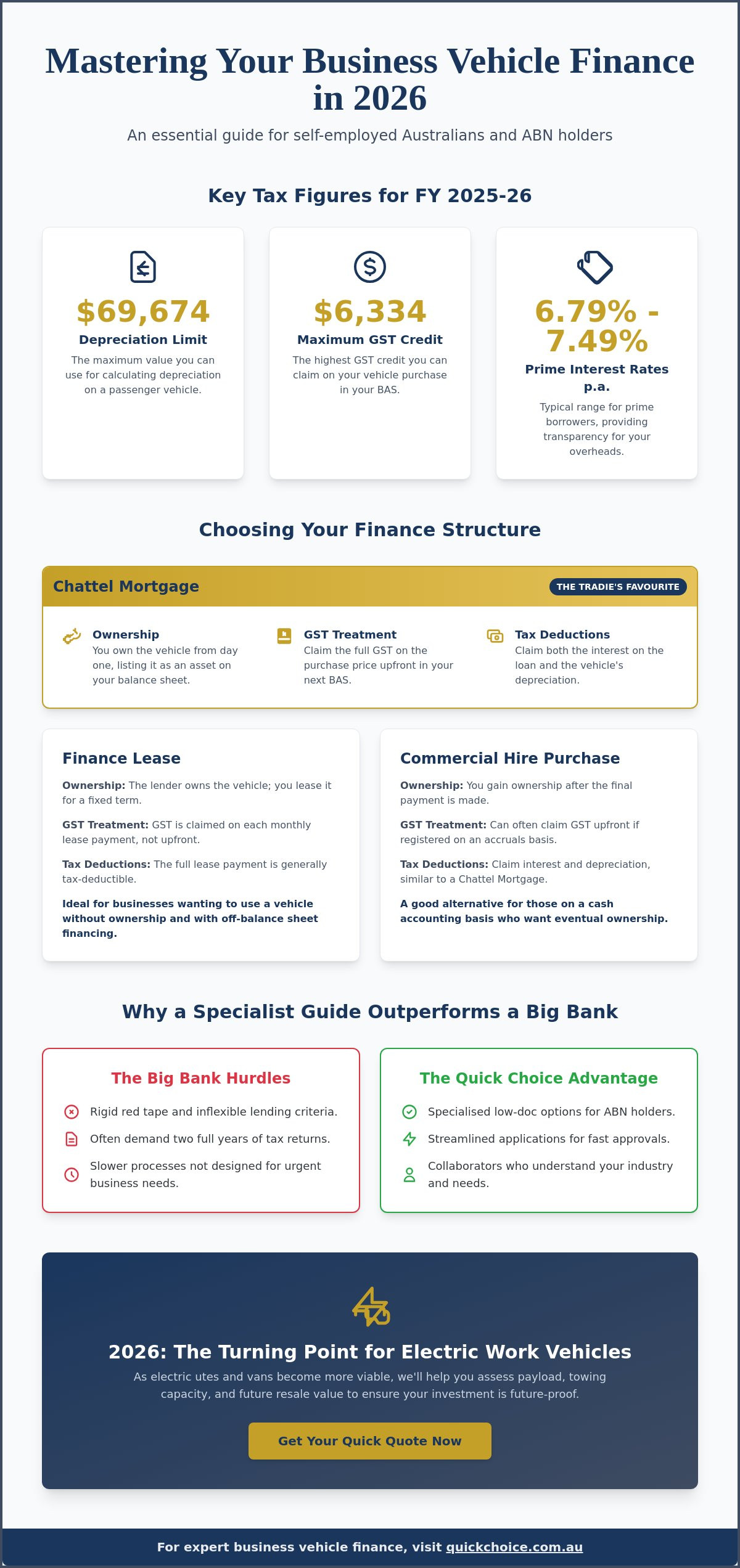
We're here to change that experience. This guide will help you master the complexities of the current market and discover how to secure the best deal for your ABN this year. You'll learn how to structure your finance for maximum tax effectiveness, including how to navigate the $69,674 depreciation limit and the $6,334 maximum GST credit claim for the 2025-26 financial year. We'll also walk through low-doc options and balloon payment strategies that lead to fast approvals and clear monthly repayments, ensuring you stay focused on the work that matters.
Key Takeaways
- Compare the pros and cons of chattel mortgages, leases, and hire purchases to choose a structure that matches your business cash flow.
- Explore why 2026 is a turning point for business vehicle finance australia as electric utes and vans become viable options for local trades and professionals.
- Learn how to assess a vehicle’s payload and towing capacity alongside its projected resale value to protect your bottom line.
- Streamline your application process by identifying the exact ABN requirements and documentation needed for a fast approval.
- Discover the practical advantages of working with a specialist guide who understands the niche requirements of self-employed Australians.
Navigating Business Vehicle Finance in Australia for 2026
Securing the right wheels for your ABN isn't just about picking a reliable ute or a spacious van. In 2026, the strategy behind your business vehicle finance australia determines your company's agility and tax position for years to come. This year stands out as a pivotal period for fleet upgrades. Shifting tax incentives and a maturing market for electric work vehicles mean the decisions you make today carry more weight than they did even two years ago. For self-employed professionals, this finance is a dedicated commercial tool designed to help you grow without draining your essential working capital.
Your choice of finance structure directly impacts your balance sheet. A well-organised agreement can improve your debt-to-income ratio, making it easier to secure other types of business credit later. Conversely, a poorly structured loan can tie up your borrowing power and limit your ability to respond to new opportunities. We focus on helping you find that balance, ensuring your vehicle remains an asset rather than a liability that weighs down your monthly cash flow.
Commercial vs. Personal Finance: What is the Difference?
The distinction between consumer loans and commercial finance is significant. While personal loans are for private use, commercial finance is built for vehicles used for business purposes more than 50% of the time. This threshold is the gateway to substantial benefits. Unlike personal loans, commercial structures allow GST-registered businesses to claim the GST component of the vehicle's purchase price as an input tax credit. For the 2025-26 financial year, this credit is capped at $6,334. Most self-employed Australians prefer a Chattel Mortgage because it provides immediate ownership and allows for flexible balloon payments to keep monthly costs low.
Commercial lending often provides more competitive interest rates than personal credit because the vehicle serves as security for the loan. Lenders view business assets differently than consumer goods, often offering terms ranging from one to seven years to suit your specific contract lengths or project cycles.
The 2026 Australian Economic Landscape for Small Business
The current economic environment requires a calculated approach to debt. With interest rates for prime borrowers starting from approximately 6.79% p.a. to 7.49% p.a., the cost of borrowing is a transparent factor in your overheads. Future-proofing your business means selecting transport that won't become a financial burden if market conditions shift. This is where a specialist guide becomes invaluable. Rather than facing the rigid red tape of a big bank, working with a specialist allows you to navigate the nuances of low-doc applications and niche industry requirements. We act as your collaborator, translating complex lending criteria into a straightforward path that gets you back on the road with total confidence.
Choosing the Right Finance Structure: Chattel Mortgage vs. Leasing
Selecting a vehicle is the fun part, but choosing the right structure for your business vehicle finance australia is what protects your profit margins. The Australian market offers three primary paths: the Chattel Mortgage, the Finance Lease, and the Commercial Hire Purchase. Each handles ownership and tax differently. Understanding these nuances helps you avoid the common trap of choosing a structure that clashes with your business's accounting method or cash flow cycle.
Ownership is the fundamental difference between these options. With some structures, you own the asset from the moment you drive off the lot; with others, you're essentially renting the vehicle with an option to buy it later. How you handle GST also shifts based on your choice. Some structures allow you to claim the GST upfront, while others spread that credit across the life of the loan. Getting this right ensures your vehicle remains a helpful tool for growth rather than a source of tax-time stress.
The Chattel Mortgage: The Tradie’s Favourite
Most self-employed Australians gravitate toward the Chattel Mortgage for one simple reason: you own the vehicle from day one. Because the vehicle belongs to your business, you can generally claim the GST on the purchase price as an upfront input tax credit in your next BAS. This provides a significant cash flow injection right when you've just made a major investment. You're also able to claim both the interest on the loan and the vehicle's depreciation as tax deductions. It’s a transparent, effective way to manage a business asset for those who plan to keep their vehicle for the long haul.
Finance Leasing and Hire Purchase Options
If you prefer to upgrade your fleet every three or four years to maintain a modern image or reduce maintenance costs, a Finance Lease might be the smarter choice. In this arrangement, the lender retains ownership, and you pay for the use of the vehicle through monthly rentals. GST is charged on each monthly payment rather than being claimed upfront. A Commercial Hire Purchase acts as a middle ground; you don't own the vehicle until the final payment is made, which can suit businesses with specific balance sheet requirements. For a deeper look at these options, our Commercial Asset Finance Guide provides an exhaustive breakdown for self-employed professionals.
Regardless of the structure, balloon payments are a powerful tool for managing monthly cash flow. By deferring a percentage of the loan, often up to 40%, to the end of the term, you significantly lower your ongoing repayments. This keeps more money in your pocket for materials, marketing, or staff. Gaining a clear overview of Business Vehicle Finance in Australia is the first step toward making a decision that serves your long-term goals. If you're unsure which path fits your ABN best, you can reach out to our specialists to explore a tailored solution.
Selecting the Ideal Workhorse for Your ABN
Choosing the right vehicle is about more than just the badge on the grille. It's a strategic investment in your daily productivity. In 2026, the Australian market offers more variety than ever, ranging from traditional diesel powerhouses to the sophisticated new wave of electric utes. When you're seeking business vehicle finance australia, keep in mind that lenders evaluate the asset just as closely as they evaluate your credit history. A vehicle known for high resale value and reliability often helps you secure more favourable terms because the lender views it as lower-risk security.
Don't just look at the tech in the cabin. For a busy professional, payload and towing capacity are the metrics that actually matter. If you're towing a heavy trailer or loading up with materials, exceeding the Gross Vehicle Mass (GVM) isn't just a safety risk; it can actually void your insurance and breach your finance agreement. 2026 has seen electric utes and vans truly hit their stride in the local market. With Fringe Benefits Tax (FBT) exemptions for eligible electric vehicles and significantly lower running costs, they've become a genuine alternative for urban couriers and tradespeople looking to lower their long-term overheads.
Utes, Vans, and Light Trucks: Matching Vehicle to Trade
Carpenters and electricians working across Melbourne’s western suburbs need setups that match their specific workflow. A secure van might be the better choice for a courier in Sunshine to protect cargo, while a high-clearance ute with a custom canopy remains the gold standard for onsite work in growing areas like Truganina. Your vehicle acts as a mobile billboard for your business. A well-maintained workhorse tells your clients you're professional and reliable before you even step out of the cabin. Many buying decisions in 2026 are still guided by depreciation rules, so choosing a vehicle that fits within the current $69,674 limit can simplify your tax planning.
Financing Used Vehicles: What You Need to Know
Opting for a used vehicle is an excellent way to preserve capital for other areas of your business. However, you should be aware of the age restrictions most lenders enforce. Generally, lenders prefer the vehicle to be no older than seven years at the start of the loan, or to be no older than 12 years by the time the loan term ends. This Complete Guide To Business Car Finance provides a detailed look at how eligibility can shift depending on the vehicle's age and condition.
Buying through a dealership is usually the fastest path to approval because the paperwork is already standardised for lenders. If you find the perfect deal through a private sale, expect to provide a bit more documentation. You'll likely need a clear PPSR certificate and potentially a formal valuation to finalise your business vehicle finance australia. While it requires a few extra steps, the savings on a quality second-hand asset can significantly boost your business's bottom line.
The Application Roadmap: From ABN to Approval
Getting your finance approved doesn't have to be a battle with bureaucracy. When you're ready to secure business vehicle finance australia, following a clear, methodical path ensures you don't hit unexpected roadblocks. Most lenders generally require your ABN to have a minimum trading history of 6 to 12 months to be eligible for standard commercial products. If you've just started out, don't worry; there are still pathways available, but having those initial months of active trading under your belt significantly opens up your options and improves your interest rates.
The process moves quickly once you have your foundations in place. We've simplified the journey into five actionable steps:
- Step 1: Confirm your ABN is active and meets the minimum trading period for your preferred lender.
- Step 2: Gather your identification and basic financial records. This might include recent bank statements or, for full-doc loans, two years of tax returns.
- Step 3: Consult with a specialist broker. We compare lenders outside the Big Four to find structures that the major banks often overlook for self-employed applicants.
- Step 4: Secure a pre-approval. This gives you a clear budget and puts you in a much stronger position when negotiating the final price at the dealership.
- Step 5: Finalise the tax invoice and settle the finance. Once the documents are signed, the funds are transferred, and you can pick up your new workhorse.
No-Doc and Low-Doc Options for Busy Business Owners
We understand that as a contractor or sole trader, your time is best spent on the tools, not chasing your accountant for paperwork. You can often qualify for finance without providing full tax returns or Business Activity Statements (BAS). These "low-doc" pathways rely on your credit history and a declaration of income rather than a mountain of evidence. To see if this fits your situation, read our guide on No Doc Business Vehicle Finance: How to Qualify in 2026. Maintaining a clean credit history is the primary requirement here, as it gives lenders the confidence to approve your application swiftly.
Common Application Pitfalls to Avoid
A single mistake on your application can cause delays or even a rejection. One major pitfall is applying to too many lenders at once; every "hard pull" on your credit report can lower your score and make you look desperate to lenders. It's also vital to be precise with your business income. Guessing your figures can lead to inconsistencies that trigger a manual review. Finally, ensure the vehicle you choose matches the lender's criteria. Some lenders will reject applications for vehicles that are too old or have excessive kilometres, regardless of how strong your business financials are. To avoid these traps and get back on the road sooner, you can apply for asset finance online with our specialist team today.
Why Local Specialist Guidance Outperforms Big Banks
Large retail banks are often built to serve employees with simple payslips. When you're self-employed, your financial situation is rarely that linear. Choosing a specialist for your business vehicle finance australia means working with a partner who understands how to read a profit and loss statement and how to value the grit of a growing enterprise. While a big bank might see a sole trader as a risk, we see a professional with an asset that needs to get to work. We bridge the gap between your ABN and the capital you need to scale.
Working with a specialist gives you access to a much broader panel of lenders. The "Big Four" have rigid, one-size-fits-all criteria that often result in frustrating delays or outright rejections for contractors. We navigate a diverse range of commercial lenders who specialise in asset finance for the self-employed. These lenders often provide more flexible terms and competitive rates because they understand the specific lifecycle of business vehicles. We act as your reliable specialist guide, doing the heavy lifting and paperwork so you can stay on the tools and keep your projects moving forward.
Supporting the Western Melbourne Growth Corridor
Our roots are firmly planted in Melbourne’s west. We have a deep commitment to the business owners driving the growth in Truganina, Tarneit, and Melton. This local knowledge is a practical advantage for you. We understand the "real world" value of your business because we see the local projects you're working on and the infrastructure you're helping to build. We don't just look at numbers on a screen; we understand the local economy and the specific challenges faced by trades and transport businesses in our region. If you're based in the west, we invite you to call us for a personalised consultation to discuss your fleet requirements.
Taking the Next Step with Quick Choice
Starting your finance journey with a specialist is about more than just getting a loan; it's about building a relationship with a collaborator who cares about your success. We've designed our process to be supportive and straightforward, removing the obstacles that usually make commercial lending feel like a chore. You deserve a finance structure that supports your cash flow rather than hindering it. Whether you're looking for your first ute or expanding a fleet of vans, we provide the expert guidance needed to secure a deal that fits your ABN. Reach out to the team today for a no-obligation finance assessment and see how easy getting back on the road can be.
Secure Your Commercial Future on the Road
Mastering the complexities of business vehicle finance australia is the key to maintaining a healthy balance sheet while growing your operations. By selecting a structure that matches your specific tax needs and choosing a vehicle that serves as a reliable workhorse, you're investing in your business's long-term resilience. You don't need to navigate the rigid requirements of the big banks alone. Whether you're a tradie in Truganina or a courier in Melton, the right finance structure keeps your cash flow agile and your focus on the job at hand.
Our team acts as your specialist brokerage, specifically designed for the self-employed. We combine deep expertise in Melbourne’s Western Suburbs with access to a wide panel of commercial lenders to find the bespoke solution you deserve. We handle the heavy lifting so you can keep your focus where it belongs: on your clients and your craft. Let Quick Choice organise your business vehicle finance today and experience a streamlined path to your next upgrade. It's time to get your ABN behind the wheel with total confidence.
Frequently Asked Questions
Can I get business vehicle finance if I have a new ABN?
Yes, you can secure finance with a new ABN, though your options are typically more tailored. Most lenders prefer a trading history of at least 6 to 12 months for standard commercial products. If your business is newer than this, we can explore specialised low-doc pathways that focus on your personal credit score and industry experience rather than years of established tax returns.
What is a balloon payment and should I include one in my loan?
A balloon payment is a pre-determined lump sum paid at the end of your loan term which significantly reduces your ongoing monthly repayments. In 2026, balloon payments of up to 40% are available to help self-employed professionals manage their monthly cash flow. This strategy is excellent for keeping overheads low, provided you plan to refinance, sell the vehicle, or pay out the balance at the end of the term.
Is business vehicle finance tax deductible for sole traders?
Yes, sole traders can generally claim the interest on the loan and the vehicle's depreciation as tax deductions. For the 2025-26 financial year, the maximum value you can use for depreciation purposes is $69,674. You must maintain an accurate logbook to justify the percentage of business use, as only the business portion of these expenses is deductible.
Do I need to be GST registered to get a business car loan?
You don't need to be GST registered to apply for business vehicle finance australia, but you must have an active ABN. Registration is only required if you wish to claim the GST on the purchase price as an input tax credit, which is capped at $6,334 for the 2025-26 period. If you aren't registered, the GST is simply included in the total amount you finance.
What is the difference between a chattel mortgage and a novated lease?
A chattel mortgage is a commercial loan where your business owns the vehicle immediately, while a novated lease is a three-way agreement between you, your employer, and a financier. Chattel mortgages are usually the preferred choice for ABN holders because they offer more control and upfront tax benefits. Novated leases are more common for employees looking to package a vehicle as part of their salary.
How long does the approval process typically take with a broker?
The approval process generally takes between 24 and 48 hours once we have received your completed application and supporting documents. Because we work with a wide panel of lenders, we can bypass much of the traditional bank red tape that often slows down self-employed applicants. This speed ensures you can secure your vehicle and get back to work without unnecessary delays.
Can I finance a used vehicle from a private seller through my business?
You can finance a private sale, though it requires more documentation than buying from a dealership. Lenders will typically require a clear PPSR certificate and a formal valuation to confirm the vehicle's worth. Most lenders also enforce age restrictions, usually preferring that a vehicle is no older than seven years at the start of the finance term to ensure it remains a viable asset.
What happens if my business use of the vehicle drops below 50%?
If your business usage falls below 50%, the vehicle may no longer qualify for certain commercial finance structures. Lenders provide business vehicle finance australia on the condition that the asset is used primarily for income-producing purposes. Additionally, the Australian Taxation Office requires you to reduce your claims for interest and depreciation proportionally to reflect the actual business use recorded in your logbook.


