
The biggest myth in Australian business is that you need two years of tax returns to put a new ute or excavator on the road. You likely know the frustration of having work lined up but lacking the machinery to deliver. Many founders assume that equipment finance for new business no trading history is an impossible ask, leading to a fear of rejection from the big banks. It's a common hurdle, especially when you're trying to manage tight cash flow during those critical first months of operation.
This guide promises to demystify the process of getting a fresh ABN approved for the assets you need to grow. We'll explore how to leverage your industry experience, explain the current A$20,000 instant asset write-off rules, and show you exactly how to bypass the traditional big-bank "no" to get your business moving. We'll walk through the path to approval so you can preserve your working capital and secure the reliable vehicles or machines your startup requires. By matching your specific situation to the right specialised lender, you can turn your new ABN into a powerful tool for growth.
Key Takeaways
- Learn why preserving your working capital is critical in the 2026 economy and how asset finance serves as a hedge against inflation.
- Discover how to secure equipment finance for new business no trading history by matching your industry experience to specialised lenders instead of traditional banks.
- Understand the tax advantages of a Chattel Mortgage, including how to utilise the A$20,000 Instant Asset Write-off for the 2025-2026 financial year.
- Follow a step by step process to build a bulletproof application that highlights your revenue projections and contract wins to reassure lenders.
- Find out how to bypass the need for property security by partnering with a specialist who understands the unique needs of self-employed founders.
Navigating Startup Asset Finance in Australia: Why Cash is No Longer King
Starting a business in 2026 requires a different financial toolkit than previous decades. While old-school advice suggests buying only what you can afford with cash, modern founders recognise that sinking every dollar into a vehicle or machine can starve a business before it finds its feet. Securing equipment finance for new business no trading history allows you to keep your cash reserves for operational costs like wages, marketing, and emergency repairs. It's about maintaining agility during the first 24 months of trading when cash flow is most volatile.
In the current Australian economy, inflation makes stagnant cash lose value while the cost of machinery continues to rise. Financing acts as a hedge; you lock in the equipment at today's prices and pay for it with future dollars. This strategic shift is rooted in the principles of asset-based lending, where the value of the equipment itself provides the security for the loan. Instead of viewing a new truck or excavator as a massive upfront expense, successful founders see it as a revenue generator that pays for itself through the work it completes.
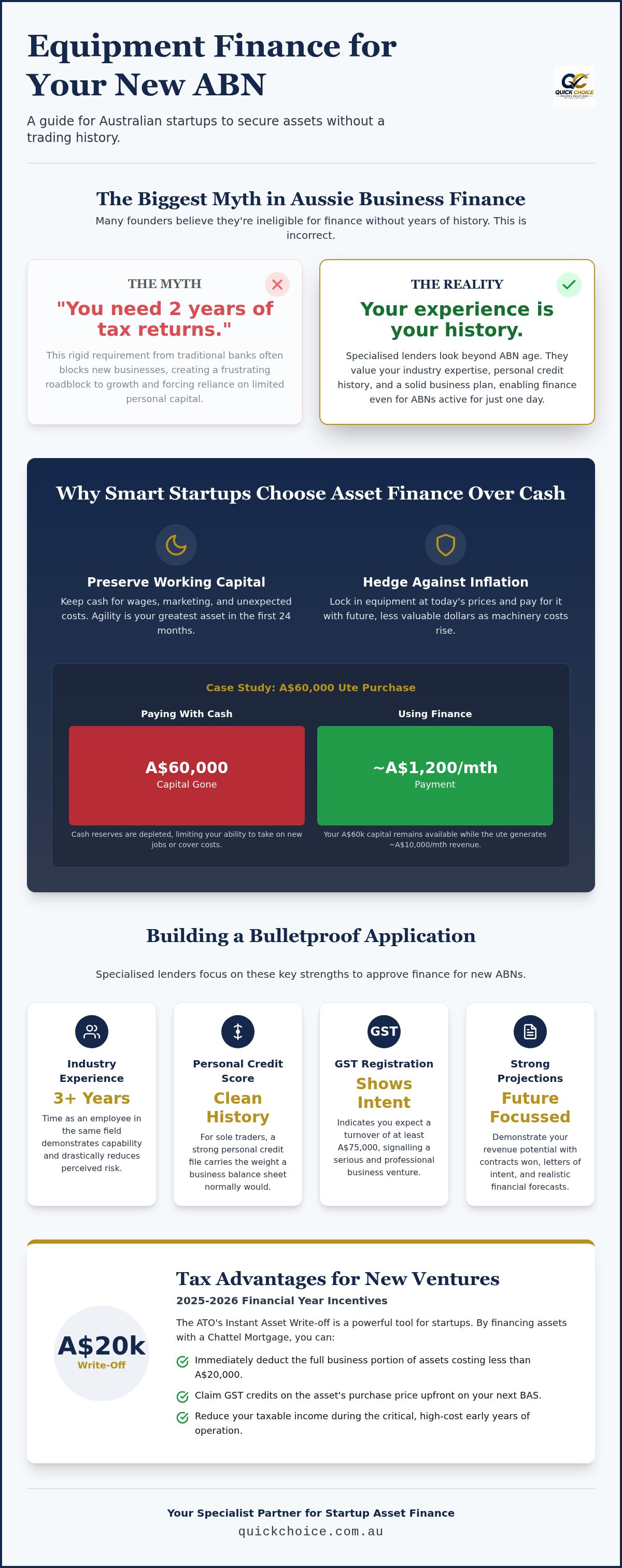
Traditional banks often fail startups because they rely on rigid, outdated algorithms. They typically demand two years of tax returns and proof of consistent profit, which is impossible for a brand-new venture. This is where specialised brokers step in. We focus on your industry experience and the potential of your business plan rather than just your ABN's age. We understand that a lack of trading history doesn't mean a lack of capability.
The Opportunity Cost of Sinking Capital into Equipment
Agility is the greatest asset for a new business. If you spend A$60,000 cash on a new truck, that money is gone and cannot be used for anything else. If you finance it, you might only pay A$1,200 a month while the truck helps you earn A$10,000. Consider a subbie in Tarneit who needs a new ute. By financing the vehicle, they keep their capital for bulk-buying materials or hiring an apprentice. This ensures they can take on larger contracts that would otherwise be out of reach because they didn't have the cash to start the job.
2026 Tax Incentives: Making the Most of Government Schemes
For the 2025-2026 financial year, the Australian Taxation Office (ATO) allows eligible small businesses to immediately deduct the full cost of qualifying assets valued under A$20,000. For assets above this threshold, asset finance allows you to manage depreciation schedules effectively while claiming GST credits upfront. This is particularly useful for equipment finance for new business no trading history, as it reduces your taxable income during those high-cost early years. You should always consult a specialist broker before the end of the financial year to ensure your finance structure is optimised for these specific startup incentives.
The New ABN Hurdle: Decoding Lender Criteria for Australian Startups
Lenders see a new ABN as a blank slate, which they often equate with high risk. Because your business lacks a track record of revenue or tax returns, traditional banks struggle to predict your ability to meet repayments. This is why equipment finance for new business no trading history is frequently declined at the branch level. However, being categorised as high-risk doesn't mean you're ineligible; it simply means you need to look beyond the big four banks to specialised lenders who understand the startup lifecycle.
You'll often hear the "12-month myth" claiming you must trade for a full year before seeking finance. While many lenders prefer a 12 to 24-month history, others will consider applications from an ABN that's been active for only a single day. Your profile becomes significantly more attractive if you've registered for GST. This shows a level of professional intent and suggests you're expecting a turnover of at least A$75,000. For sole traders, your personal credit score carries the weight that a business balance sheet normally would. A clean credit history can often compensate for a lack of trading years.
The Power of Industry Experience
One of the most effective ways to bypass ABN age requirements is to demonstrate deep roots in your field. If you've spent three or more years as an employee in the same industry before starting your own venture, lenders view you as a safe pair of hands. A qualified plumber starting their own firm is a much lower risk than someone entering a completely new industry. We help you document this track record, showing that while the entity is new, the expertise behind it is seasoned. If you're unsure how your background stacks up, a specialist asset finance broker can help position your experience to the right lender.
Low Doc vs. Full Doc: Which Path for Your Startup?
In 2026, Low Doc options are the lifeline for startups. This path allows you to secure funding without providing two years of profit and loss statements. Instead, lenders might look at personal bank statements or a simple declaration of income. When considering leasing or buying vehicles and equipment, the choice between Low Doc and Full Doc usually comes down to what paperwork you have ready. If your business data is scarce, maintaining a pristine personal credit score is vital. It acts as the primary anchor for the lender's trust, proving you manage your financial obligations reliably even without a mountain of business paperwork.
Choosing the Right Finance Structure: Chattel Mortgage vs Leasing for New Businesses
Selecting the right contract is just as important as finding a lender willing to provide equipment finance for new business no trading history. The structure you choose dictates your monthly cash outflow, your tax position, and who technically owns the asset during the term. For most Australian startups, the choice boils down to how you want to manage your balance sheet and GST obligations. It's about finding the balance between long term cost and immediate monthly affordability.
Matching the finance term to the useful life of the asset is a critical step that many founders overlook. You don't want to be paying for a laptop over five years if it becomes obsolete in three. Conversely, financing a heavy-duty trailer over too short a period can put unnecessary strain on your weekly cash flow. A well-structured agreement ensures the equipment pays for itself as it works, rather than becoming a weight around the business's neck.
Chattel Mortgage: The Tradie’s Favourite
This is the most common choice for sole traders and contractors across Australia. A Chattel Mortgage is a commercial loan where the business takes ownership of the equipment from day one, using the asset itself as security for the financier. Because you own the asset immediately, you can generally claim the full GST amount on the purchase price in your next Business Activity Statement (BAS). This provides an immediate cash injection that can be vital for a new venture. It also allows for flexible repayment structures that can be tailored to seasonal income, which is common in industries like agriculture or landscaping.
Leasing and Hire Purchase: Flexibility and Ownership
If your startup is technology-heavy or requires a fleet of vehicles that you plan to upgrade every few years, an operating lease might be more suitable. Unlike a mortgage, a lease often results in lower monthly payments because you're effectively paying for the asset's use rather than its total value. At the end of the term, you can choose to upgrade to the latest model, which keeps your business at the cutting edge without the burden of disposing of old equipment. This is a popular path for businesses that want to avoid the risks of equipment obsolescence.
For those who want eventual ownership but need to keep monthly costs at a minimum, the "Balloon Payment" strategy is a lifesaver. By deferring a percentage of the loan amount to the very end of the term, you significantly reduce your regular repayments. This helps you survive the initial lean months of a startup. When comparing the total cost of ownership over a five-year term, a Hire Purchase or Chattel Mortgage usually costs less in interest than a lease, but the higher monthly commitment can be a hurdle. We help you weigh these options to ensure your equipment finance for new business no trading history supports your growth rather than hindering it.
How to Secure Approval: Building a Bulletproof Application in Western Melbourne
Securing equipment finance for new business no trading history requires more than just filling out a form. It is about presenting a narrative that makes a lender feel secure in your ability to repay. Because you lack a business track record, the lender will scrutinise your personal character and your preparation. Following a structured approach ensures you don't leave your approval to chance.
Your first step is to organise your foundational documents. This includes your ABN, GST registration details, and clear copies of your personal identification. Next, you should prepare a simple business plan. It doesn't need to be a hundred pages long. A concise document outlining your services, target market, and projected revenue for the next 12 months is often enough to satisfy a specialist lender. You also need a formal quote for the asset from a reputable Australian supplier. Lenders are much more comfortable financing a machine or vehicle when they know exactly what it is and where it is coming from.
Cleaning up your personal finances is equally vital. When business data is scarce, your personal bank statements serve as the primary evidence of your financial discipline. Ensure you have no missed credit card payments or overdrawn accounts in the months leading up to your application. Finally, you should partner with a broker who understands the nuances of the self-employed market. A specialist knows which lenders have an appetite for startups and can help you avoid the "no" that often comes from generalist bank staff.
The Startup Dossier: What to Include
A letter of intent from a future client can be a total deal-maker for a new business. If you can show a lender that you already have work lined up once the equipment arrives, you significantly reduce their perceived risk. We also recommend showing evidence of a deposit. Providing even a 10% or 20% deposit reduces the Loan-to-Value Ratio (LVR), making the application much more attractive. Don't forget to include a professional resume that highlights your relevant industry expertise. This reinforces the idea that while the ABN is new, the operator is a seasoned professional.
Local Insights for Werribee and Melton Founders
Local knowledge of the Western Melbourne industrial landscape matters. Lenders often have a higher appetite for growth sectors like logistics and construction, which are booming in areas like Truganina and Rockbank. A broker who can meet you on-site in Hoppers Crossing or Melton understands the specific challenges you face. They can advocate for your business by highlighting local demand for your services. If you want to move quickly, you can get started with a specialist broker who knows the Western suburbs inside out and can help you build a bulletproof application.
Quick Choice: Your Specialist Partner for Startup Asset Finance
Finding a lender willing to offer equipment finance for new business no trading history can feel like an uphill battle. At Quick Choice, we act as the bridge between your ambitious goals and the capital required to reach them. We specialise in supporting the self-employed, from sole traders in Tarneit to growing teams in Truganina. Our team understands that your business is more than just a date on an ABN certificate. It's a venture built on your expertise and hard work, and we believe your financing should reflect that potential.
Many traditional lenders require you to put up your family home as security before they'll even look at a startup application. We do things differently. We focus on securing finance against the asset itself, removing the need for property security in many cases. This preserves your personal assets and keeps your business's financial structure clean and manageable. Our process is designed for speed; we know that a missed opportunity because of slow funding can be devastating for a new business. We move from your initial enquiry to settlement in record time, ensuring you get the keys to your new machine or vehicle when you need them.
Our deep roots in Western Melbourne, specifically around suburbs like Melton and Truganina, give us a unique perspective on the local economy. We see the growth in logistics, construction, and trades first-hand. This local expertise allows us to position your application in a way that resonates with lenders who are looking to invest in the future of the region. We don't just see a spreadsheet; we see a local founder ready to contribute to the community.
Beyond the Big Banks: Accessing a Wider Panel
The advantage of working with Quick Choice lies in our extensive panel of boutique and non-bank lenders. These entities often have a higher appetite for risk and a deeper understanding of specific industries than the big four banks. Whether you need a prime mover for a new logistics contract or specialised medical gear for a private practice, we tailor a solution that fits your specific asset. We don't just submit an application; we advocate for your business. We highlight your industry experience and revenue projections to ensure you receive the most competitive rate possible for your equipment finance for new business no trading history.
Take the Next Step for Your Business
It's always a smart move to organise a pre-approval before you start shopping for your new asset. This gives you a clear budget and puts you in a stronger negotiating position with suppliers. You can walk into a dealership or showroom with the confidence that your funding is already secured. We invite you to start a no-obligation conversation with our expert team to explore your options. We'll provide a clear, supportive path forward that removes the stress from the financing process. Organise your startup asset finance with Quick Choice today and take the next step toward growing your Australian business.
Scale Your Startup with Confidence
Securing the right tools shouldn't be a roadblock to your business goals. You've seen that preserving cash flow is vital in the 2026 economy and that your industry experience is often more valuable to a lender than the age of your ABN. By choosing a structure like a Chattel Mortgage, you can claim GST upfront and keep your capital working where it matters most. It's about making strategic choices today that protect your liquidity for tomorrow.
Obtaining equipment finance for new business no trading history is entirely possible when you have a specialist guide to navigate the lender landscape. We've simplified the process for founders across Western Melbourne and beyond, focusing on fast approvals and personalised service that skips the big bank "no". As specialist self-employed finance brokers, we take pride in removing the obstacles that hold new ventures back. We understand the local market and the unique needs of those who work for themselves.
Ready to get moving? Secure your startup’s future with expert asset finance from Quick Choice today. Your ambition deserves the right support, and we're here to help you turn those growth plans into reality. Let's get your business on the road to success.
Frequently Asked Questions
Can I get asset finance with a new ABN under 12 months old?
Yes, you can get approved with a new ABN. While traditional banks often demand a two-year history, many specialist lenders provide equipment finance for new business no trading history. They look at your past employment in the same industry and your personal credit score. This approach allows you to secure the machinery you need to start generating revenue from day one without waiting for a 12-month milestone.
Do I need to be GST registered to qualify for startup equipment finance?
Registration for GST is not a legal requirement for finance, but it strengthens your application. It signals to lenders that your business is serious and expects an annual turnover of at least A$75,000. Many "Low Doc" products are specifically designed for GST-registered ABN holders. This status can often lead to faster approvals and more flexible terms during those initial months of trading.
What is the minimum deposit required for a startup asset loan?
Startups should generally prepare for a deposit between 10% and 30%. While some established businesses can access 100% financing, lenders usually require new founders to contribute some equity. This reduces the lender's Loan-to-Value Ratio (LVR) and demonstrates your commitment to the venture. A larger deposit can also be a strategic move to lower your monthly repayments and preserve your ongoing cash flow.
Is it possible to get finance for a used truck or machine as a startup?
You can certainly finance used trucks, trailers, or machinery. Lenders typically require that the asset is sold through a licensed dealer rather than a private seller to ensure its value is verified. There are usually age restrictions, often requiring the asset to be no older than 12 to 15 years at the end of the loan term. This provides a cost-effective way to get quality gear without the price tag of brand-new equipment.
How does a Chattel Mortgage benefit a new sole trader at tax time?
A Chattel Mortgage offers significant tax advantages for new sole traders. Because you own the asset from the start, you can generally claim the entire GST amount as an input tax credit in your next Business Activity Statement. This provides an immediate cash injection for your business. Additionally, you can claim depreciation and the interest component of your repayments as tax deductions, which is vital for equipment finance for new business no trading history.
Will my personal credit score affect my startup business loan approval?
Your personal credit score is one of the most important factors for startup approval. Since your business doesn't have a track record yet, lenders use your personal credit history to gauge how reliably you manage debt. A clean score shows you're a safe pair of hands. If your score is less than perfect, providing additional context or a larger deposit can sometimes help bridge the gap with certain specialised lenders.
Do I need to provide property as security for asset finance?
You usually don't need to provide real estate as security for asset finance. The loan is typically secured against the equipment or vehicle you're purchasing. This is known as asset-based lending and it's a major advantage for startups who want to keep their business and personal risks separate. It means you can grow your fleet or workshop without putting the family home on the line for the lender.
How long does the approval process take for new businesses?
The approval process is surprisingly fast and often takes between 24 and 48 hours. If you have your "Startup Dossier" ready, including your ABN details and a formal quote, a specialist broker can move things along quickly. Once you accept the offer, settlement usually occurs within another business day. This speed allows you to respond to new contract wins without being held back by slow bank bureaucracy.