
The secret to a successful finance application isn't having a 'perfect' credit file; it's knowing how to present your business story to the right lender at the right time. You've likely felt that familiar dread when preparing paperwork, worrying that one inconsistent month of income might trigger a rejection and bruise your credit score. It's a common frustration for self-employed professionals who feel the big banks just don't understand how a small business actually operates. Learning how to improve asset finance approval odds is about moving past that confusion and taking control of your financial narrative.
This guide provides the tactical steps and documentation secrets you need to secure equipment funding with total confidence. We'll explore the 'Low Doc' path for those with limited paperwork, explain why the 'Golden Triangle' of a business plan, clean credit, and property ownership is so powerful, and look at the 2026 ATO landscape. By the end of this article, you'll have a clear roadmap to get your next work vehicle or piece of machinery on the road without the typical stress.
Key Takeaways
- Understand why matching your specific risk profile to the right lender policy is the most critical factor in avoiding unnecessary rejections.
- Discover how to improve asset finance approval odds by mastering the 'Golden Triangle' of serviceability, asset quality, and borrower history.
- Explore the "Low Doc" pathway, designed specifically for self-employed professionals to secure equipment quickly without exhaustive tax returns.
- Identify immediate tactical steps, such as cleaning up bank statements and consolidating minor debts, to present a more reliable financial profile.
- Find out how choosing high-demand assets like utes or prime movers can fast-track your application, especially in Melbourne’s industrial growth hubs.
Understanding the Self-Employed Approval Gap in 2026
"Approval odds" aren't a lottery. They represent how closely your business profile aligns with a specific lender's internal policy. Traditional banks often look at a self-employed ABN and see risk where you see growth. They're built for the steady, predictable rhythm of PAYG earners. When your income fluctuates due to seasonal contracts or project-based payments, it can trigger red flags in a standard bank's automated system. This is why many independent contractors feel like they're hitting a brick wall when they approach their local branch.
The 2026 credit market requires a more nuanced approach. With the official cash rate holding at 4.35% as of July 2026, lenders have become more selective, yet specialised non-bank lenders are actively filling the gap. A rejection from a major bank doesn't mean your business is failing; it simply means you haven't found the right match. Understanding how to improve asset finance approval odds starts with recognising that your choice of lender is just as important as your financial history.
Unlike unsecured business loans that rely solely on your future cashflow, Asset-based lending uses the equipment itself as security. This significantly lowers the lender's risk. If things go wrong, they have a tangible asset to recover. This fundamental difference is why many sole traders find it easier to get a truck or a digger than a simple line of credit. It’s about shifting the focus from your personal income volatility to the value of the machinery you're putting to work.
The Myth of the Perfect Credit Score
You might have a credit score over 700 and still face a rejection. Lenders prioritise cashflow transparency over a single high number. If your bank statements show inconsistent deposits or frequent small debts, that high score loses its shine. Be careful with "rate shopping" too. Every time you apply, an enquiry hits your file. Too many enquiries in a short window suggest financial distress, which can quickly lower your odds. It's wise to check your Equifax or Illion business credit file yourself before you start the application process to ensure there are no surprises.
Why Asset Finance is Often Easier to Secure
The asset acts as a safety net, which reduces the lender's anxiety about your "worst-case" scenario. However, the type of gear you choose matters. Lenders love "readily realisable" assets like utes, trucks, and trailers because they're easy to sell if needed. Specialised tech or highly bespoke machinery is seen as higher risk because the secondary market is smaller. Asset-backed finance serves as a lower-risk entry point for new ABN holders who haven't yet built a long history of tax returns. Knowing how to improve asset finance approval odds involves selecting equipment that holds its value well over time.
The 'Golden Triangle' of a Strong Finance Application
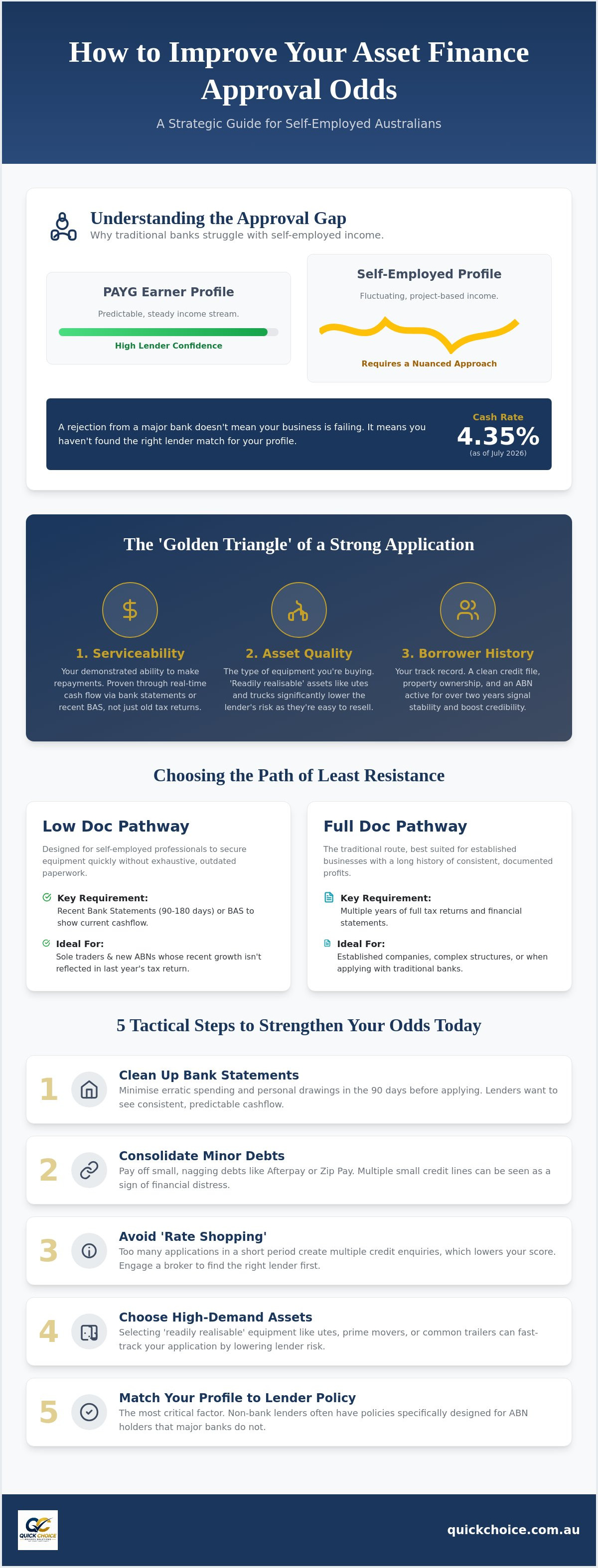
Securing funding is about more than just a healthy bank balance. Lenders evaluate your business through what experts call the 'Golden Triangle'. This framework consists of three specific pillars: Serviceability, Asset Quality, and Borrower History. Understanding how to improve asset finance approval odds requires looking at your application through these lenses simultaneously. If one pillar is slightly weak, a strong performance in the other two can often get the deal across the line.
Lenders are particularly fond of 'readily realisable' assets. This refers to equipment that is easy to sell on the secondary market, such as utes, vans, and prime movers. If you are applying for a standard work vehicle, your risk profile drops instantly compared to someone seeking a niche, specialised piece of machinery. Your ABN age also acts as a powerful multiplier. While some lenders offer options for new businesses, having an active ABN for over two years signals stability and significantly boosts your credibility. While international resources like the SBA loan programs provide a broad look at small business funding structures, the Australian market is uniquely focused on the 'usable life' of the asset you're buying.
Demonstrating Serviceability Without Tax Returns
You don't always need years of tax returns to prove you can afford a loan. Many specialised lenders now utilise the 'Bank Statement' method, where AI software scans your last 90 to 180 days of transactions to verify real-time cashflow. Providing recent Business Activity Statements (BAS) can also demonstrate current-year momentum that older tax returns might miss. To keep your profile sharp, manage your personal drawings carefully. If you're constantly draining the business account for personal expenses, it can make a profitable venture look 'tight' on paper. If you're unsure how your current cashflow looks to a lender, a quick chat with a specialist in self-employed finance can help you organise your files correctly.
Selecting the Right Asset for Approval
The age and condition of the equipment are often deal-breakers. A three-year-old Toyota HiLux is much easier to finance than a fifteen-year-old niche machine because the lender knows the Toyota holds its value. Most lenders prefer dealer sales over private ones because the paperwork is standardised and the asset's history is verified. If you do go private, expect a more rigorous inspection process. This strategic approach to asset selection is a proven way to learn how to improve asset finance approval odds before you even sign a contract. The 'usable life' of the gear will also dictate your loan term; lenders won't give you a five-year loan on a machine that will be obsolete in three.
Low Doc vs. Full Doc: Choosing the Path of Least Resistance
Documentation is often the biggest hurdle for sub-contractors. If you haven't finalised your 2025 tax returns yet, the "Low Doc" (Limited Documentation) pathway is your most effective tool. It allows you to secure funding based on your ABN history and a simple declaration of income rather than stacks of financial reports. While this path often carries a slightly higher interest rate to account for the lender's limited visibility, the trade-off is unmatched speed and a much higher degree of approval certainty. For a sole trader, getting the gear on-site today is often more valuable than waiting months for an accountant to finish your books.
Choosing between these paths is a strategic decision. At Quick Choice, we help subbies weigh up whether the interest savings of a Full Doc application are worth the potential delay in getting a new vehicle on the road. For many, the ability to start a new contract tomorrow with a reliable ute outweighs a small difference in the annual rate. Understanding the fundamentals of equipment acquisition, much like the principles found in SBA guidance on buying business assets, helps you make this choice with clarity. Learning how to improve asset finance approval odds often comes down to choosing the right documentation pathway for your current business stage.
The Low Doc Checklist for 2026
Lenders have specific "auto-approval" triggers for Low Doc loans. Most require an active ABN for at least 12 to 24 months. If you've hit that two-year mark, your options expand significantly. Being GST registered also signals that your business is operating at a professional level. However, the biggest "cheat code" for Low Doc is property ownership. If you own or are paying off a home, lenders view you as a much lower risk. This "homeowner" status is one of the most effective ways how to improve asset finance approval odds without providing full tax returns.
When to Pivot to Full Doc
There are times when the "path of least resistance" isn't the best financial move. If you're planning a large fleet expansion or have a complex company structure with multiple directors, a Full Doc application is usually necessary. This pathway unlocks the lowest commercial rates for those with strong financials. To succeed here, your Profit & Loss statement needs to be clean and easy for a credit officer to read. Avoid "creative" accounting that hides too much profit, as this can hurt your borrowing capacity. For a deeper dive into these requirements, check out our Asset Finance for Self Employed: The Ultimate 2026 Australian Guide.
5 Tactical Steps to Strengthen Your Odds Today
Improving your position doesn't always require a massive increase in turnover. Often, it’s the small, technical details in your application that tip the scales in your favour. If you're wondering how to improve asset finance approval odds, start by looking at your business through a credit officer's eyes. They want to see stability, foresight, and a clear plan for how the new asset will generate revenue. By taking these five tactical steps, you can transform a borderline application into a confident "yes".
- Step 1: Clean up your bank statements. Lenders typically scrutinise your last 90 days of transactions. Avoid "overdrawn" or "dishonour" fees during this window, as these suggest cashflow stress.
- Step 2: Consolidate small, nagging debts. That minor credit card or interest-free retail account might seem harmless, but it affects your debt-to-income ratio. Closing these accounts can boost your borrowing capacity.
- Step 3: Prepare a "Business Use" statement. Don't just tell the lender you need a truck. Explain that "this prime mover allows us to take on a new contract worth $X per month." This shifts the asset from a cost to an income-generator.
- Step 4: Consider a deposit. Putting skin in the game reduces the lender’s risk instantly. It shows you have the cash reserves to support the purchase.
- Step 5: Work with a specialist broker. A generalist bank manager uses a "one size fits all" checklist. A specialist knows which lenders have a specific appetite for your industry and equipment type.
The Power of a Strategic Deposit
A deposit of 10% to 20% can be a game-changer, especially for new ABN holders who lack a long trading history. If you don't have the cash upfront, consider using a trade-in as equity to reduce the total finance amount. A lower Loan to Value Ratio (LVR) reduces the lender's exposure and frequently unlocks more competitive interest rates. This is a simple but highly effective way how to improve asset finance approval odds while also lowering your monthly repayments.
Timing Your Application
The timing of your lodgement can be just as important as the data within it. Applying right after a successful BAS lodgement is highly effective because it provides fresh, verified proof of your business momentum. Conversely, try to avoid the "End of Financial Year" rush unless your books are absolutely spotless; credit teams are often overwhelmed and more likely to stick to rigid criteria during peak periods. To ensure you aren't tripping at the finish line, take a moment to review these 5 Mistakes to Avoid When Financing Business Equipment. When you're ready to see where you stand, you can get a free assessment of your approval odds with our specialist team.
Navigating the Asset Market in Melbourne’s West
Melbourne’s western suburbs are the engine room of Victoria’s industrial growth. If you're operating out of Truganina, Melton, or Hoppers Crossing, you're positioned in a logistics and manufacturing hub that lenders view with significant interest. This local activity works in your favour. Lenders are often more comfortable approving finance for transport and earthmoving gear when they see the equipment is servicing high-growth corridors. In fact, Melbourne's west accounted for 70% of the city's industrial gross take-up in the final quarter of 2025. This level of activity creates a constant, reliable demand for skilled sub-contractors with the right machinery.
Being a subbie in the West is unique. You need a partner who understands that your day starts at dawn on a job site, not in front of a computer screen. We act as the bridge between local tradies and national lenders, translating your site experience and contract history into a professional narrative that credit teams respect. Understanding how to improve asset finance approval odds in a competitive local market requires this specific, boots-on-the-ground perspective that generalist banks often lack. We know the difference between a fleet expansion in Derrimut and a new startup in Laverton North.
Specialist Support for Local Sub-Contractors
Major infrastructure projects and the rapid expansion of suburbs like Rockbank and Tarneit have triggered a surge in new business startups. If you've recently established a new ABN to work on Victorian transport upgrades, you might worry that your lack of trading history will hold you back. We specialise in navigating these "New ABN" challenges by focusing on the strength of your work contracts and the quality of the asset itself. We serve as a reliable specialist guide, helping you meet local requirements while positioning your business for long-term success.
Your Next Steps to Approval
Getting a clear answer shouldn't be a stressful or drawn-out ordeal. We've streamlined our process to respect your time and protect your credit file from unnecessary enquiries. You only need your ABN and basic identification to start a preliminary assessment with our team. Our no-obligation review process ensures you know exactly where you stand before any formal application is lodged with a lender. Knowing how to improve asset finance approval odds is ultimately about preparation and choosing a partner who knows your local area. To get moving, you can organise a quick chat with our Truganina team today and get the gear you need on the road.
Get Your Business Moving with the Right Finance Strategy
Mastering the technical side of your application is the most direct way to get your business moving. Whether you are leveraging the "Low Doc" pathway or cleaning up your bank statements to present a sharper profile, every tactical adjustment counts. You now have a clearer understanding of how to improve asset finance approval odds by aligning your business goals with the right lender appetite and selecting assets that hold their value.
At Quick Choice, we specialise in supporting the sub-contractors who drive Western Melbourne’s industrial growth. We provide access to over 30 "tradie-friendly" lenders and offer fast-tracked Low Doc options designed specifically for ABN holders who need to move quickly. You don't have to navigate the complex credit landscape alone when you have a specialist guide in your corner to help bridge the gap between your local work site and national finance providers.
Ready to take the next step? Boost your approval odds with a Quick Choice specialist today. Your next work vehicle or piece of machinery is closer than you think, and we are here to help you secure it with confidence.
Frequently Asked Questions
Can I get asset finance if I have only been self-employed for 6 months?
Yes, you can secure funding with a six-month-old ABN, although your options will be more limited compared to established businesses. Some specialised lenders offer "New ABN" products if you have significant industry experience or a signed contract for upcoming work. Providing a larger deposit can also help offset the perceived risk of a shorter trading history.
Does my personal credit score matter for a business equipment loan?
Your personal credit score remains a vital part of the assessment because it demonstrates your history of meeting financial obligations. While the loan is for your business, lenders view your personal credit health as a reflection of how you'll manage business debt. A clean personal file is one of the most effective ways how to improve asset finance approval odds.
What is the minimum deposit required to improve my approval odds?
A deposit of 10% to 20% is typically the minimum required to noticeably boost your application's strength. While "no deposit" options exist for established businesses with strong financials, putting cash down reduces the lender's exposure. This simple act can often turn a marginal application into a fast approval.
How does a Chattel Mortgage help with my business tax and cashflow?
A Chattel Mortgage allows you to take ownership of the asset immediately, which provides significant tax advantages. If you're GST registered, you can generally claim the full GST amount on your next Business Activity Statement. You can also claim the interest on the repayments and the depreciation of the equipment to reduce your taxable income.
Can I get approved for finance if I have outstanding ATO debt?
You can still get approved with ATO debt, provided you have a formalised payment plan in place and a history of sticking to it. Lenders are naturally nervous about tax debt, so being transparent from the start is essential. Showing that you're actively managing the debt helps prove your business is still viable and responsible.
What documents do I need for a Low Doc asset finance application?
For a Low Doc application, you typically only need an active ABN (usually for at least two years) and your driver's licence. Some lenders might also ask for your most recent Business Activity Statement or 90 days of bank statements to verify cashflow. This pathway is designed to be fast and requires far less paperwork than traditional loans.
Is it harder to get finance for used equipment than for new gear?
It is generally more challenging to finance used equipment because the lender needs to be certain of its value and remaining lifespan. Lenders prefer assets under five to seven years old; anything older might require an independent valuation or a higher interest rate. Choosing a well-known brand with high resale value is a smart way how to improve asset finance approval odds when buying used gear.
How long does the asset finance approval process usually take in 2026?
The approval process in 2026 is faster than ever, with many Low Doc applications being finalised within 24 to 48 hours. If you're going through a Full Doc process or have a complex company structure, expect it to take between three and five business days. Having your documents ready before you apply is the best way to ensure a quick turnaround.