What if the biggest risk to your business growth isn't a lack of work, but the cash you've got tied up in your machinery? While it feels safer to own your tools outright, draining your bank account to buy assets can leave you vulnerable when cash flow fluctuates. Securing equipment finance for sole traders shouldn't feel like a gamble or a mountain of paperwork. You've likely spent years building your reputation; you deserve a finance partner that understands the unique rhythm of being self-employed and the importance of keeping your capital fluid.
We understand that irregular income and a lack of traditional bank documentation can make applying for a loan feel daunting. This guide is designed to simplify that process and show you how to preserve your working capital while accessing the latest tools. You'll discover how to leverage the $20,000 instant asset write-off and find low doc options that don't require endless tax returns. We'll walk through the structures that work best for your trade, from chattel mortgages to finance leases, so you can get back on the job with the right gear and total peace of mind.
Key Takeaways
- Learn how to protect your business capital by choosing equipment finance for sole traders instead of using your personal savings.
- Compare popular finance structures like Chattel Mortgages to determine which option offers the best tax advantages for your specific trade.
- See why specialist brokers offer a distinct advantage over big banks when it comes to assessing irregular self-employed income.
- Identify the specific 'Low Doc' requirements that allow you to secure funding with minimal paperwork and no recent tax returns.
- Understand how to time your asset purchases to make the most of current tax benefits like the $20,000 instant asset write-off.
What is Equipment Finance for Sole Traders?
Equipment finance for sole traders is a business-specific credit facility where the asset you are purchasing, such as a backhoe, a delivery van, or a laser cutter, serves as the primary security for the loan. This means the lender holds a mortgage over the equipment itself rather than requiring you to put up your family home as collateral. It is a practical way to acquire the tools of your trade while keeping your personal assets separate from your business obligations. By using the equipment to secure the debt, you often gain access to more favourable interest rates compared to unsecured lending options.
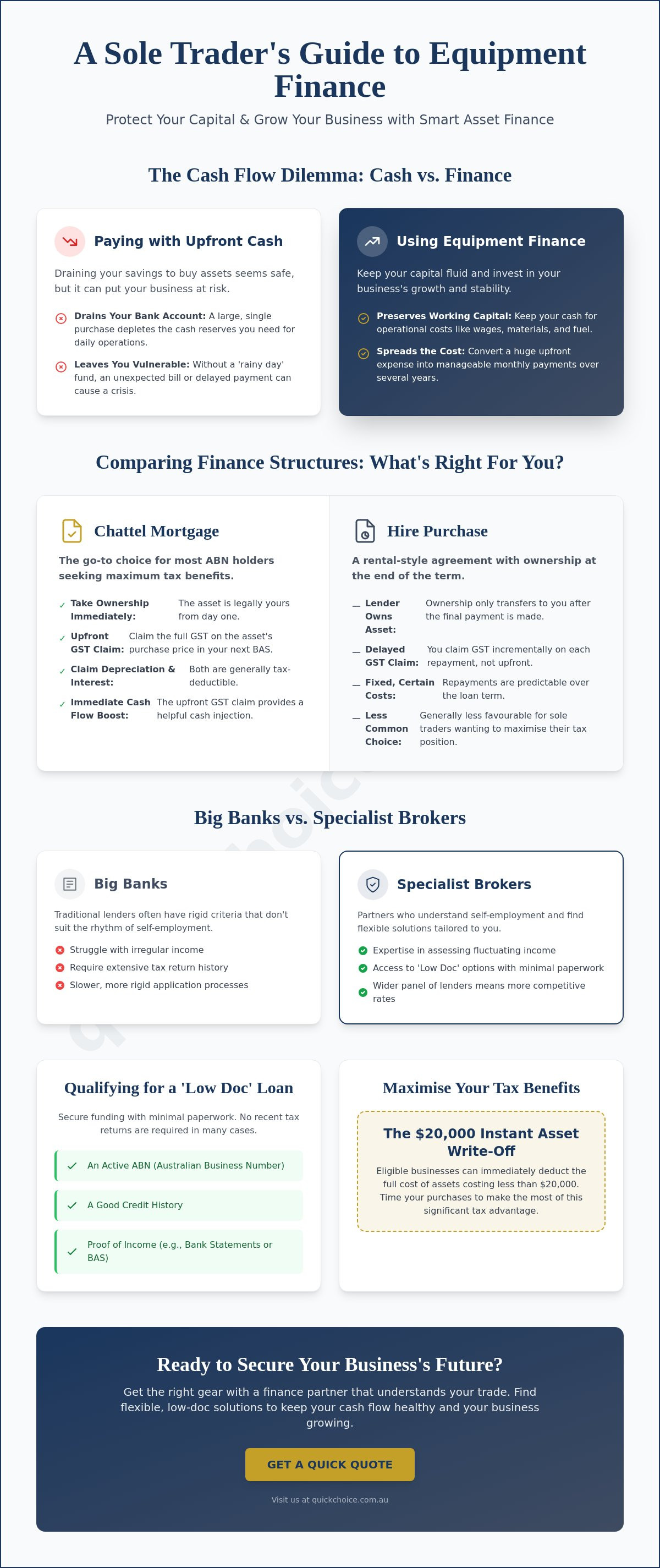
Many self-employed Australians choose finance over cash to maintain a "rainy day" fund. Paying $50,000 upfront for a new piece of kit might seem like a good way to avoid debt, but it leaves you with zero liquidity if a major contract is delayed or an unexpected bill arrives. Finance allows you to spread the cost over several years, ensuring that your bank balance remains healthy enough to handle the daily ebbs and flows of business life. It's about maintaining control over your cash flow rather than letting your equipment purchases dictate your financial stability.
The Strategic Advantage for Self-Employed Australians
Opting for commercial asset finance provides a significant boost to your business strategy. It preserves your working capital for operational costs like materials, fuel, and wages. From a tax perspective, the benefits are compelling. You can generally claim deductions for both the interest on the loan and the depreciation of the asset. Understanding what is a finance lease or a chattel mortgage is essential here, as each structure impacts your balance sheet differently. Furthermore, successfully managing a business-purpose loan builds a commercial credit profile, making it easier to secure larger amounts of funding as your business scales.
Common Equipment Funded in Melbourne’s West
The demand for new assets is particularly high across Melbourne’s western corridor. We see a wide variety of equipment being put to work in our local communities:
- Civil Construction: Contractors in Tarneit and Melton are frequently financing excavators and skid steers to keep pace with the region's massive infrastructure and housing boom.
- Healthcare: Practitioners are utilising medical equipment finance to kit out modern clinics in Caroline Springs with high-end diagnostic tools.
- Trades: Plumbers and electricians from Hoppers Crossing to Werribee often finance their work utes and specialised tool kits to ensure they stay reliable on the road.
Unlike a standard personal loan, equipment finance is designed for business growth. It recognises that the asset you're buying is an income-producing tool. While a personal loan is often a drain on your lifestyle, equipment finance is an investment that helps pay for itself through the extra work and efficiency it brings to your daily operations.
Comparing Finance Structures: Which Suits Your Business?
Selecting the right setup for equipment finance for sole traders is just as important as choosing the equipment itself. While a big bank might offer a generic product, the way your loan is structured dictates your tax deductions and how much GST you can claim back in your next BAS. Most self-employed Australians gravitate towards a Chattel Mortgage, but depending on your cash flow and accounting style, a Hire Purchase or Finance Lease might serve your business better. You can see how these compare against traditional NAB equipment finance options to understand the market standard for commercial products.
Chattel Mortgage vs. Hire Purchase
A Chattel Mortgage is the go-to choice for ABN holders because you take ownership of the asset from day one. For sole traders using the cash accounting method, this provides a significant advantage. You can generally claim the full GST amount on the purchase price in your next Business Activity Statement, even if you've only made one or two repayments. This creates an immediate cash injection back into your working capital. In contrast, a Hire Purchase involves the lender owning the equipment until your final payment is made. While it offers fixed costs and certainty, you don't get that same upfront GST benefit, making it a less common choice for those looking to maximise their initial tax position.
Finance leases and operating leases offer different paths for different assets. A finance lease is essentially a long-term rental where you have the option to buy the asset at the end of the term. Operating leases are better suited for high-tech gear or medical tools that become obsolete quickly. If you're a specialist consultant or run a clinic, you might prefer an operating lease so you can upgrade to the latest model every few years without the hassle of trying to sell old equipment in a secondary market.
Balloon Payments and Residual Values
A balloon payment is a lump sum you agree to pay at the very end of your loan term. By pushing a portion of the principal to the end, you significantly lower your monthly repayments. This is a strategic move for sole traders who want to keep their daily overheads low while they scale. However, you must calculate the right balloon percentage based on the asset’s expected lifespan. If you're financing a $117,394 piece of heavy machinery, which is the average amount requested for such equipment, you want to ensure the resale value at the end of five years will cover that final payment. If you're unsure which structure fits your current turnover, you can request a tailored quote to weigh up the pros and cons for your specific trade.
At the end of the term, you aren't always forced to pay the balloon in cash. Many sole traders choose to refinance the remaining amount into a new loan or sell the equipment to cover the debt. This flexibility allows you to keep your fleet modern and your tools sharp without a massive hit to your personal cash flow.
Big Banks vs Specialist Brokers: Finding the Right Fit
Securing equipment finance for sole traders often feels like trying to fit a square peg into a round hole when dealing with major banks. While the "Big Four" are household names, their internal lending criteria are frequently designed for large corporations or PAYG employees with predictable, steady pay slips. For a self-employed professional, an irregular income stream or a slightly out-of-date tax return can lead to an immediate rejection. A specialist broker, however, operates differently. We act as your advocate, comparing options across a panel of 30 or more lenders to find the one that actually understands your industry.
Speed is another critical factor where brokers tend to outpace traditional institutions. When a contract depends on you having a specific machine on-site by Monday, you cannot afford to wait three weeks for a bank's credit committee to meet. Brokers specialise in streamlined applications, often securing approvals for contractors in a fraction of the time. This efficiency ensures you don't miss out on lucrative opportunities just because your paperwork was stuck in a bank's centralised processing centre.
The Limitations of Traditional Bank Lending
Traditional lenders typically operate on rigid "Full Doc" policies. They often demand two full years of finalised tax returns and comprehensive financial statements before they even consider your application. This is a significant hurdle for many sole traders who may have only been trading for 12 to 18 months or whose latest tax returns are still with their accountant. Banks also show a strong bias toward property-backed security. They might ask to link your business loan to your family home, which is a risk many self-employed Australians are understandably reluctant to take. These long processing times and strict requirements can ultimately cost you a job or stall your business growth at a critical moment.
Why Quick Choice Specialises in the Self-Employed
We believe that your business potential is worth more than just what appears on a single year's tax return. Our expertise lies in identifying "Low Doc" and "No Doc" pathways that allow you to grow without the administrative headache. We have a deep understanding of industry-specific assets, such as bobcat finance Australia, ensuring we know the true value of the gear you're buying. This specialist knowledge helps us present your case to lenders in the best possible light.
For locals in Werribee and Taylors Lake, we provide a personalised service that big banks simply cannot match. We don't just look at a credit score; we look at your business plan, your contracts, and your professional experience. Our commitment is to find the lowest rate possible for your specific risk profile, removing the obstacles that stand between you and the equipment you need to succeed.
How to Qualify: Documentation and Low Doc Options
The biggest hurdle for many self-employed Australians isn't a lack of work; it's the fear of a paperwork mountain. Traditional lenders often demand years of finalised tax returns, which isn't always practical when you're busy on the tools. However, qualifying for equipment finance for sole traders is often far simpler than people realise. Most lenders primarily want to see that you have an active ABN, a valid driver's licence, and a way to demonstrate that your business is generating income. While a clean credit history is essential, the process is designed to be accessible for those who keep their records tidy.
Low Doc finance is the most popular pathway for our clients. This option allows you to secure funding using alternative proof of income, such as recent Business Activity Statements (BAS) or three months of bank statements. It's a perfect fit for sole traders who haven't yet finished their latest tax return but have a healthy, active business. Keep in mind that for certain heavy assets, such as excavators or dozers, earthmoving equipment finance requirements might involve a closer look at your industry experience to ensure the asset is a viable investment for your specific trade.
The 5-Step Application Process
We've refined the journey to get you back on the job as quickly as possible. Following these steps ensures a smooth approval:
- Step 1: Determine your budget and the specific asset you need to grow your revenue.
- Step 2: Organise your ABN details and ensure your GST registration is current if required.
- Step 3: Consult a specialist to compare lender policies across the market.
- Step 4: Submit your application with your basic ID and income evidence.
- Step 5: Receive approval and settle the funds so you can collect your new gear.
Finance for New ABN Holders and Startups
A common question we hear is whether you can get finance with a brand-new ABN. While most lenders prefer at least 12 months of trading history, it is possible to secure equipment finance for sole traders even with a one-day-old ABN. In these cases, lenders may look for a larger deposit or a "Director Guarantee" to mitigate the risk. If you're a new contractor, building a strong case involves showing proof of upcoming contracts or significant industry experience. If you're ready to see which low doc options you qualify for, check your eligibility online today and let us help you find a path forward.
Your credit file is your most valuable asset during this process. Lenders look for "clear" credit, meaning no active defaults or recent bankruptcies. If you've maintained a solid repayment history on your existing accounts, you'll find that many doors open quickly, often with fast-tracked approvals that get you behind the wheel of your new asset in just a few days.
Securing Your Business Future with Quick Choice
Choosing the right partner for your growth is just as critical as selecting the machinery itself. At Quick Choice, we've built our reputation on supporting the hard-working sole traders and tradies who keep Melbourne moving. We don't see you as just another application number in a database. Instead, we view ourselves as a collaborator in your success, dedicated to simplifying the complex world of asset finance so you can focus on the job at hand. When you secure equipment finance for sole traders through a specialist who knows your industry, you remove the guesswork and the stress often associated with business lending.
Our local expertise stretches across the western suburbs, from the industrial hubs of Truganina to the established precincts of Laverton. We understand the unique challenges faced by self-employed professionals in these areas, such as managing seasonal cash flow or navigating the transition from a solo operator to a small employer. By acting as a reliable specialist guide, we bridge the gap between your ambition and the resources needed to achieve it, ensuring the process remains straightforward and transparent from start to finish.
Tailored Solutions for Local Contractors
We've intentionally focused our efforts on the western suburbs community because we value the grit and determination of local contractors. Our "no-fuss" approach means we strip away the bank jargon and the unnecessary hurdles that often stall progress. We take pride in our clients' growth stories, having helped many professionals evolve from a one-man band with a single ute into a thriving business with a full fleet of specialised gear. This success is built on a foundation of trust and a deep understanding of how equipment finance for sole traders should be structured to support long-term stability rather than just a short-term fix.
Ready to Upgrade Your Equipment?
Timing is a vital element of any business investment. With current market conditions, acting while business vehicle finance Australia rates remain competitive can give you a significant edge over your competitors. Upgrading to more efficient, reliable equipment reduces your maintenance costs and increases your billable hours. Before you sign on the dotted line, we recommend a final check of your upcoming contracts and a quick review of your cash flow projections to ensure the repayments align with your growth trajectory.
Starting a conversation with our specialist team is the first step toward kitting out your business with the tools it deserves. We can provide a tailored quote that outlines your options clearly, and the best part is that this initial inquiry won't impact your credit score. Whether you are looking for a single piece of tech or a major machinery upgrade, we are here to ensure your business has a bright and well-equipped future.
Ready to Power Your Next Project?
Choosing the right asset finance structure is often the difference between a business that simply survives and one that truly thrives. You now understand how a Chattel Mortgage can unlock immediate tax benefits and why sidestepping the rigid "Full Doc" requirements of major banks can save you weeks of administrative stress. Navigating equipment finance for sole traders doesn't have to be a solo mission that keeps you off the job site and buried in paperwork.
Since 2017, we've been proudly serving Melbourne’s Western Suburbs, helping local professionals from the new builds in Aintree to the established industrial sites in Rockbank scale their operations with confidence. As specialists in Low Doc and No Doc finance, we provide you with direct access to more than 30 Australian lenders. This ensures you receive a bespoke solution that respects the unique rhythm of your self-employed income and protects your personal cash flow.
Speak with a self-employed finance specialist at Quick Choice today to discuss your next asset purchase. Your expertise is in your trade; our expertise is in making sure you have the tools to master it. Let's get your business moving toward a more profitable and well-equipped future.
Common Questions About Equipment Finance
Can I get equipment finance as a sole trader with a new ABN?
Yes, you can secure equipment finance for sole traders with a new ABN, although your options may differ from those of established businesses. While many traditional banks require at least 12 to 24 months of trading history, specialist lenders offer specific paths for startups and new contractors. You might need to provide a larger deposit or demonstrate significant prior industry experience to prove your business's viability from day one.
Do I need to provide my house as security for equipment finance?
You generally don't need to use your family home as security because the equipment itself serves as the primary collateral. This is a major benefit of asset finance; the lender holds a mortgage over the specific machine or vehicle you're purchasing. If you default, the lender's claim is usually limited to that asset, which keeps your personal property and family residence protected from business-related debt.
What is the difference between a chattel mortgage and a lease for a sole trader?
The main difference lies in ownership and tax treatment. With a chattel mortgage, you own the asset immediately and can often claim the full GST amount on your next BAS. In a finance lease, the lender owns the equipment and you pay to use it over a fixed term. Many self-employed Australians prefer the chattel mortgage structure for its immediate ownership and the ability to claim both depreciation and interest as tax deductions.
How much can I borrow for business equipment without full tax returns?
Borrowing limits for low doc finance vary between lenders but often reach up to $150,000 for established ABN holders. Instead of providing two years of tax returns, you'll use Business Activity Statements (BAS) or recent bank statements to prove your turnover. These limits are designed to help you acquire essential gear quickly without the administrative burden of preparing comprehensive financial statements through an accountant.
Is equipment finance interest tax-deductible for sole traders in 2026?
Yes, the interest component of your equipment finance repayments is typically tax-deductible as long as the asset is used for income-producing purposes. In 2026, you can also continue to claim depreciation on the equipment over its useful life. If the asset costs less than $20,000, you may be eligible for the instant asset write-off, which allows for an immediate deduction of the full cost in the year it's first used.
What happens if I want to upgrade my equipment before the loan term ends?
You can upgrade your equipment before your contract expires by paying out the existing loan or refinancing into a new agreement. This involves calculating a payout figure, which includes the remaining principal and any early termination fees. Many contractors choose this path to ensure they always have the most efficient tools, often using the trade-in value of their old machine to help settle the original debt.
Can I finance used or second-hand machinery as a self-employed contractor?
You can certainly finance second-hand machinery, though lenders often have specific rules regarding the age of the asset at the end of the loan term. For instance, a lender might require that a used tractor is no older than 15 years by the time the final payment is made. Financing used gear is a practical way for contractors to save on the initial purchase price while still acquiring reliable, high-performing equipment.
How long does the approval process typically take with a broker?
Approval for equipment finance for sole traders typically takes between 24 and 48 hours when working with a specialist broker. Because we understand which lenders have the fastest processing times and the most flexible policies for the self-employed, we can bypass the long queues at traditional banks. Once you've provided your basic ID and income evidence, we move quickly to get you an answer so you can get back to work.


