
Why are traditional banks still treating Australia’s 1.74 million self-employed workers like a high-risk gamble? You’ve likely felt the frustration of having a thriving business and a clear vision for growth, only to have the approval process for commercial asset finance grind to a halt because your tax records aren't "perfect" by their standards. It's exhausting to watch your cash reserves dwindle while you wait for the equipment you need to actually get on the job. We understand that for an independent professional, time is quite literally money.
Mastering your finance options is about more than just signing a loan agreement; it’s about using a strategic cash-flow tool to bypass those rigid banking barriers. We promise to help you navigate these complexities so you can secure the machinery or vehicles your business needs to scale in 2026 without the stress of upfront costs. This guide provides a clear look at current interest rates, the latest A$20,000 instant asset write-off rules, and the fast-tracked approval paths that get you back to work sooner.
Key Takeaways
- Understand how commercial asset finance works by using the equipment itself as security to preserve your business cash flow for growth.
- Identify the most tax-effective structure for your business, distinguishing between the ownership benefits of a chattel mortgage and the flexibility of leasing.
- Discover why non-bank lenders often provide more flexible approval criteria for self-employed professionals compared to traditional big banks.
- Prepare a high-impact application with our checklist, ensuring your ABN and credit profile are positioned for fast-tracked approval.
- Learn how bespoke financial guidance in Western Melbourne can help you secure the assets you need to scale your operations in 2026.
What is Commercial Asset Finance for the Self-Employed?
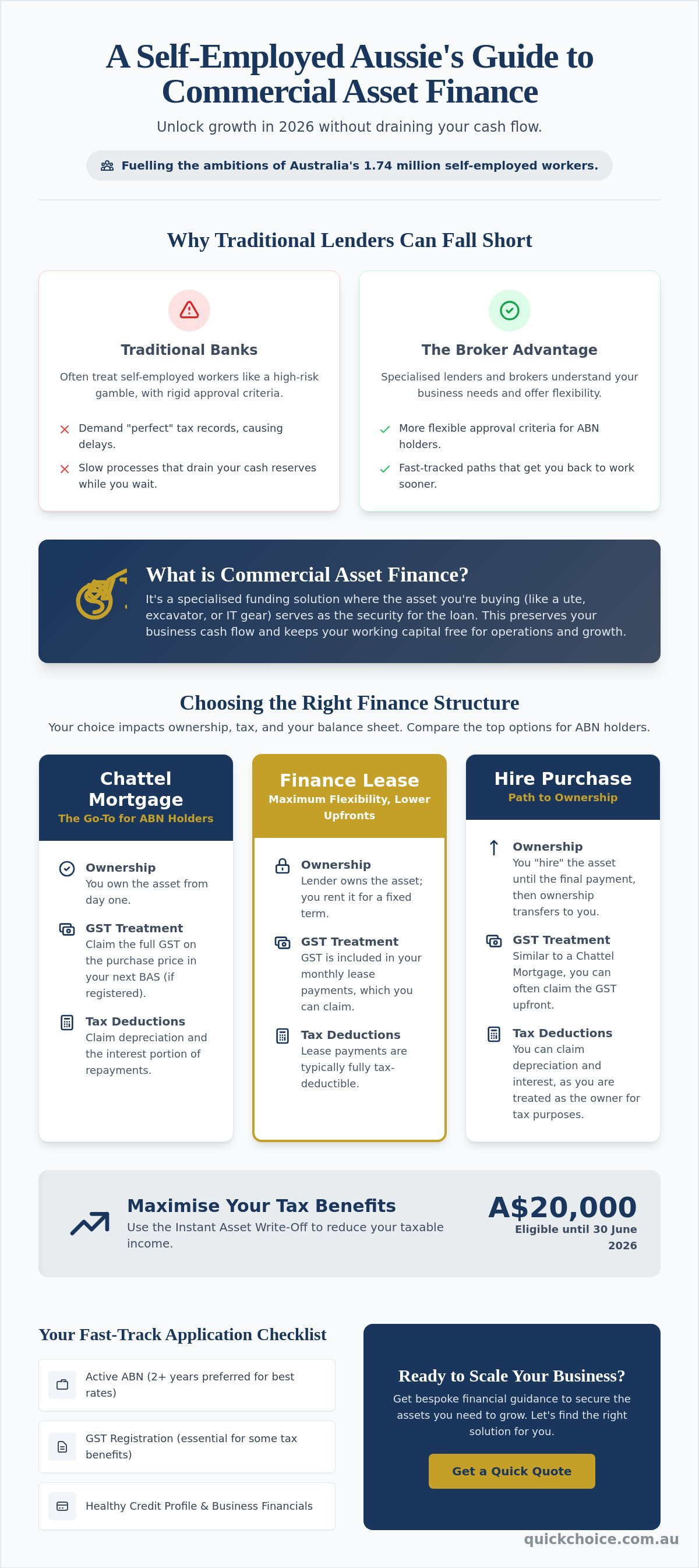
Building a business from the ground up requires more than just hard work; it requires the right tools at the right time. For many self-employed Australians, buying high-value equipment outright simply isn't an option because it drains the very cash reserves needed for daily operations. This is where commercial asset finance becomes essential. It's a specialized funding solution where the equipment or vehicle you are purchasing serves as the primary security for the loan. This structure is a fundamental form of Asset-based lending, which allows lenders to offer competitive terms because the asset itself has a clear resale value.
There's a significant difference between a standard consumer car loan and a commercial agreement. While consumer loans are built for personal use and governed by strict National Consumer Credit Protection (NCCP) laws, commercial finance is designed specifically for income-earning activities. It's the lifeblood of the 1.74 million self-employed individuals in Australia, providing a pathway to growth that doesn't involve risking the family home as collateral. By choosing this path, you improve your business cash flow and keep your working capital available for other needs, like hiring staff or managing seasonal dips in trade.
Common Assets Financed by Australian Tradies
Australian small businesses and subcontractors use commercial asset finance to acquire a diverse range of equipment. In the transport sector, this often includes heavy vehicles such as prime movers, trailers, and courier vans. Construction professionals frequently finance earthmoving gear like excavators, bobcats, and specialized power tools to keep their projects on schedule. Beyond the worksite, this finance is also used for office IT infrastructure, medical equipment like dental chairs, and even complete shop fit-outs for retail and hospitality businesses.
The Role of the ABN in Securing Finance
Your Australian Business Number (ABN) is your most valuable credential during the application process. Lenders use it to verify your business history and stability. Generally, if you've held an active ABN for at least two years, you'll have access to a wider range of lenders and more attractive interest rates. If you're a new ABN holder, you can still secure finance, though you might be asked to show more evidence of your previous industry experience or a larger deposit. Being registered for GST is also a major factor, as it's often a requirement for specific tax-effective structures like chattel mortgages, where you may be eligible to claim back the GST on the asset's purchase price in your next BAS.
Choosing the Right Structure: Chattel Mortgage, Leasing, or Hire Purchase?
Selecting the right commercial asset finance structure is a decision that impacts your tax position and balance sheet for years. It isn't a one-size-fits-all scenario. In 2026, the Australian tax landscape offers specific advantages for those who choose wisely, particularly as small businesses look to maximise their deductions. Each structure handles ownership, GST, and monthly repayments differently, making it vital to align your choice with your specific business goals.
Chattel Mortgage: The Go-To for ABN Holders
This is currently the most popular choice for ABN holders and sole traders. You own the asset from day one, which means the asset appears on your balance sheet as a business asset. Because you hold the title, you can typically claim the GST on the purchase price as an input tax credit in your next Business Activity Statement (BAS). The Australian government has extended the A$20,000 instant asset write-off threshold until 30 June 2026. This allows you to immediately deduct the full cost of eligible assets under that value, which is a powerful way to reduce your taxable income. For more expensive equipment, you continue to benefit from depreciation and interest deductions over the life of the loan. Most chattel mortgages also allow for a balloon payment at the end, which reduces your monthly repayments and keeps more cash in your pocket for daily operations.
Finance Leasing vs. Commercial Hire Purchase (CHP)
A finance lease is often preferred by businesses that want to keep their upfront costs as low as possible. You don't technically own the asset during the term; the lender does. You pay for the use of the equipment, and at the end of the term, you can choose to make a residual payment to own it, trade it in, or simply hand it back. This is an excellent strategy for high-use technology or courier vans that depreciate quickly, as it avoids the risk of being stuck with an obsolete asset.
Commercial Hire Purchase (CHP) acts as a middle ground between a loan and a lease. The lender buys the asset and hires it to you over a set period. You gain legal ownership once the final instalment is made. While interest rates for these products are fixed and often start at competitive levels for prime borrowers, the way GST is handled differs significantly from a chattel mortgage. The Commercial & Asset Finance Brokers Association of Australia (CAFBA) sets the professional standards for these products. This ensures that the structures offered by specialist brokers are transparent, fair, and compliant with Australian regulations. This is particularly important as the RBA cash rate sits at 4.35%, making the precision of your finance structure more critical than ever for your bottom line.
Every business has unique cash flow requirements and tax obligations. If you are unsure which path fits your 2026 growth plans, you can explore tailored finance structures that align with your specific ABN status and industry needs.
The Broker Advantage: Why Banks Often Fail the Self-Employed
Walking into a major bank branch as a sole trader often feels like an interrogation rather than a business meeting. The most common hurdle you'll face is the rigid demand for two years of completed tax returns. If your latest returns aren't ready or your business has grown significantly since your last filing, a traditional lender will likely show you the door. Banks operate on a "one size fits all" model that rarely accounts for the seasonal fluctuations or rapid scaling common in the Australian small business sector. This is why many independent professionals find that securing commercial asset finance through a bank is a frustrating dead end.
Specialised brokers bridge this gap by accessing a broad panel of non-bank lenders. These entities are more comfortable with complex income structures and offer flexible criteria that banks simply won't match. A broker doesn't just submit an application; they package your financial story to highlight your business's actual strength. They understand that a healthy bank balance and a consistent pipeline of work are often better indicators of serviceability than a tax document from eighteen months ago. This tailored approach transforms a "no" into a path forward.
Navigating Low Doc and No Doc Options
When you don't have up-to-date tax returns, you'll likely look at "Low Doc" options. Lenders in this space focus on alternative proof of income, such as your Business Activity Statements (BAS) or recent bank statements. For those with a newer ABN, typically between six months and two years, these options are vital. While interest rates for Low Doc commercial asset finance are slightly higher, ranging from 7.89% to 9.29% as of May 2026, the trade-off is the ability to acquire income-producing equipment immediately. You aren't forced to wait for the next financial year to grow your fleet or upgrade your machinery.
Speed of Approval: Getting on the Road in Truganina and Tarneit
In high-growth areas like Truganina and Tarneit, timing is everything. If you've just won a tender for a major infrastructure project, you can't afford to wait six weeks for a bank's credit committee to meet. You need that truck or excavator on the job site now. A local broker understands the industrial landscape of Western Melbourne and the urgency of your contracts. They use streamlined digital systems that can move an application from initial chat to settlement in as little as 24 to 48 hours.
Consider the case of a local subcontractor who recently secured a major contract in the Melton hub. Despite having a strong deposit and three years of steady work, their bank rejected a truck loan because their company structure had recently changed. By working with a specialist, they accessed a non-bank lender that looked at their current contracts and bank statements instead. The finance was approved in 36 hours, allowing them to start the job on Monday with the equipment they needed. This level of agility is the real broker advantage.
Preparing Your Application: A Checklist for Success
Securing a "yes" on your first attempt is less about luck and more about the quality of your presentation. Lenders in the commercial asset finance space value clarity and evidence above all else. If you're operating out of the busy industrial hubs in Werribee or Melton, you know that a week's delay in getting a new machine can mean missing out on a lucrative contract. A clean, well-documented application signals to a lender that your business is professional and low-risk. It shows you have a clear plan for the asset and the means to repay the obligation without straining your daily operations.
Before you apply, ensure your credit profile is in good shape. Every "hard pull" or formal enquiry can impact your score, so it's vital to have your documents ready before the lender runs their check. You should also secure a formal invoice or quote from a reputable dealer rather than a private seller link. Lenders prefer assets with a clear history and valuation, as this protects their security in the agreement. If you're buying used equipment, ensure it isn't too old for the loan term you want. Most lenders have specific age limits for vehicles and machinery at the end of the finance period.
Document Checklist for Self-Employed Borrowers
In 2026, digital bank statements have become the gold standard for proving serviceability. Most non-bank lenders will require six months of data to verify your cash flow patterns. You also need to provide:
- Proof of ABN registration showing at least 6 to 24 months of active trading.
- Your current GST status, which determines your eligibility for specific tax-effective structures.
- Full asset details, including the age, condition, and a brief explanation of its intended business use.
Understanding Interest Rates and Fees
Don't be distracted by the base interest rate alone. While chattel mortgage rates for prime borrowers currently start around 7.49% p.a., the comparison rate tells the real story. This figure includes the base rate plus most upfront and ongoing fees. Common costs include application fees, monthly service charges, and early exit penalties if you choose to pay the loan off early. Sometimes, a slightly higher rate with more flexible repayment terms is better for your cash flow than a rigid, low-rate product that penalises you for extra payments. Your focus should be on how the monthly repayment fits into your project margins. If the equipment helps you finish a job 20% faster, the interest rate becomes a secondary concern compared to the increased revenue.
If you want to ensure your paperwork is perfect before submission, you can start your assessment with a local specialist who understands the Western Melbourne market.
Quick Choice: Your Local Asset Finance Experts in Western Melbourne
Operating a business in Western Melbourne means working in one of Australia's fastest-growing industrial corridors. From the massive distribution centres in Truganina to the expanding commercial hubs in Werribee and Melton, the demand for reliable equipment is constant. We don't just provide commercial asset finance; we live and work in the same community as you. This local presence gives us a unique understanding of the logistical challenges and opportunities facing Western Melbourne’s sub-contractors and owner-operators. We act as your reliable specialist guide, transforming a complex lending landscape into a straightforward path toward business expansion.
We know that as an independent professional, your time is split between the job site and the office. You don't have hours to waste on hold with a city-based bank that doesn't understand why you need a specific prime mover or excavator by Monday. Our team simplifies the entire process by handling the heavy lifting of lender negotiations for you. We focus on practical results, ensuring your finance structure supports your cash flow rather than hindering it. Whether you're scaling a fleet or acquiring your first major piece of machinery, we provide the bespoke support you need to succeed.
Serving the Growth Corridors of Rockbank and Caroline Springs
The landscape of the West is changing rapidly. We're proud to support the local tradies building the future of new communities in Thornhill Park and Aintree. Our service is deeply personalised because we believe in partnership over transactions. If you're based in Taylors Lakes or Laverton, we can come to your site or office to discuss your needs in person. You get direct access to our expert brokers, which means no call centres and no generic advice. We offer the kind of high-touch consultancy that helps Rockbank and Caroline Springs businesses thrive in a competitive market.
Start Your Growth Journey Today
Taking the next step in your business journey shouldn't be a stressful experience. We offer obligation-free quotes that give you a clear picture of your options without any pressure. The Quick Choice promise is built on transparency, speed, and unwavering support for the self-employed. We help you navigate the 2026 interest rate environment and maximise your tax benefits with precision. When you're ready to secure the equipment that will take your business to the next level, we're here to make it happen. Organise your commercial asset finance with Quick Choice today and experience the difference that local expertise makes.
Scale Your Business with Confidence
Securing the equipment you need shouldn't be a barrier to your success. By choosing the right structure and leveraging the A$20,000 instant asset write-off, you turn a simple purchase into a strategic growth tool. We've explored how a specialist broker can bypass traditional bank rejections and why local expertise in Western Melbourne matters for your timeline. When you're ready to master the complexities of commercial asset finance, having a reliable guide makes all the difference to your bottom line.
Now is the time to move from planning to action. At Quick Choice, we specialise in self-employed and sole trader finance, ensuring your application is presented in the best possible light. We offer fast 24-48 hour approvals, so you can get your new assets on the job without the long wait times of the big four banks. Our deep local knowledge in Western Melbourne suburbs like Truganina and Melton means we understand the specific demands of your industry and the urgency of your contracts.
Ready to take the next step? Secure your business equipment with Quick Choice and get the professional support you deserve. Your growth is our priority, and we're here to help you build a stronger future.
Frequently Asked Questions
Can I get commercial asset finance with a new ABN?
Yes, you can secure finance even if your ABN has been active for as little as six months. While many major banks require two years of trading history, specialised lenders offer "startup" or "new ABN" products. You might need to provide a larger deposit or show relevant industry experience, but a newer business status is not an automatic barrier to acquiring essential equipment.
What is the difference between a chattel mortgage and a business loan?
A chattel mortgage is a specific type of business loan where the asset itself acts as the primary security. Unlike a general business loan, which might be unsecured or tied to property, a chattel mortgage often offers lower interest rates because the lender has a claim on the vehicle or machinery. It also allows for immediate ownership and potential GST input tax credits.
Do I need to provide property as security for asset finance?
No, you generally don't need to use your home or other real estate as collateral for commercial asset finance. The equipment or vehicle you are purchasing serves as the security for the lender. This structure protects your personal assets and keeps your property equity available for other investment needs or business expansion projects.
How much deposit do I need for a commercial equipment loan?
Many lenders offer 100% finance, meaning no upfront deposit is required for established businesses with strong credit. For new ABN holders or those with a "Low Doc" application, a deposit of 10% to 20% is common. Providing a deposit can help lower your monthly repayments and reduce the total interest paid over the life of the agreement.
Is the interest on commercial asset finance tax-deductible?
Yes, the interest component of your finance repayments is typically a tax-deductible business expense. Because the asset is used for income-producing purposes, you can also claim depreciation on the equipment. We recommend speaking with your accountant to understand how these deductions apply to your specific tax bracket and the latest A$20,000 instant asset write-off rules.
Can I finance used equipment or must it be brand new?
You can certainly finance used equipment, provided it meets the lender's age and condition criteria. Most lenders prefer that the asset is no older than 10 to 15 years at the end of the finance term. Purchasing used machinery is a smart way to scale your business while keeping your total debt lower than buying brand new.
What are the benefits of a "Low Doc" loan for sole traders?
The primary benefit is speed and flexibility for those who don't have up-to-date tax returns or financial statements. It allows you to prove your income through alternative means, such as bank statements or BAS. This is ideal for subcontractors who need to upgrade their tools quickly to start a new contract without waiting for the end of the financial year.
How long does the approval process take with Quick Choice?
Our approval process is designed for speed, with most applications processed within 24 to 48 hours. We use streamlined digital systems to gather your information quickly and present it to the right lenders. This fast turnaround ensures you can secure your equipment and get back to work in the Western Melbourne growth corridors without unnecessary delays.