

You've found the perfect rig to expand your fleet, but your bank just handed you a massive list of paperwork that will take weeks to organise. It's a frustrating reality for many owner-drivers who have plenty of work lined up but can't get the keys because their latest tax returns aren't ready. We know that for a self-employed professional, time spent chasing documents is time you aren't earning on the road.
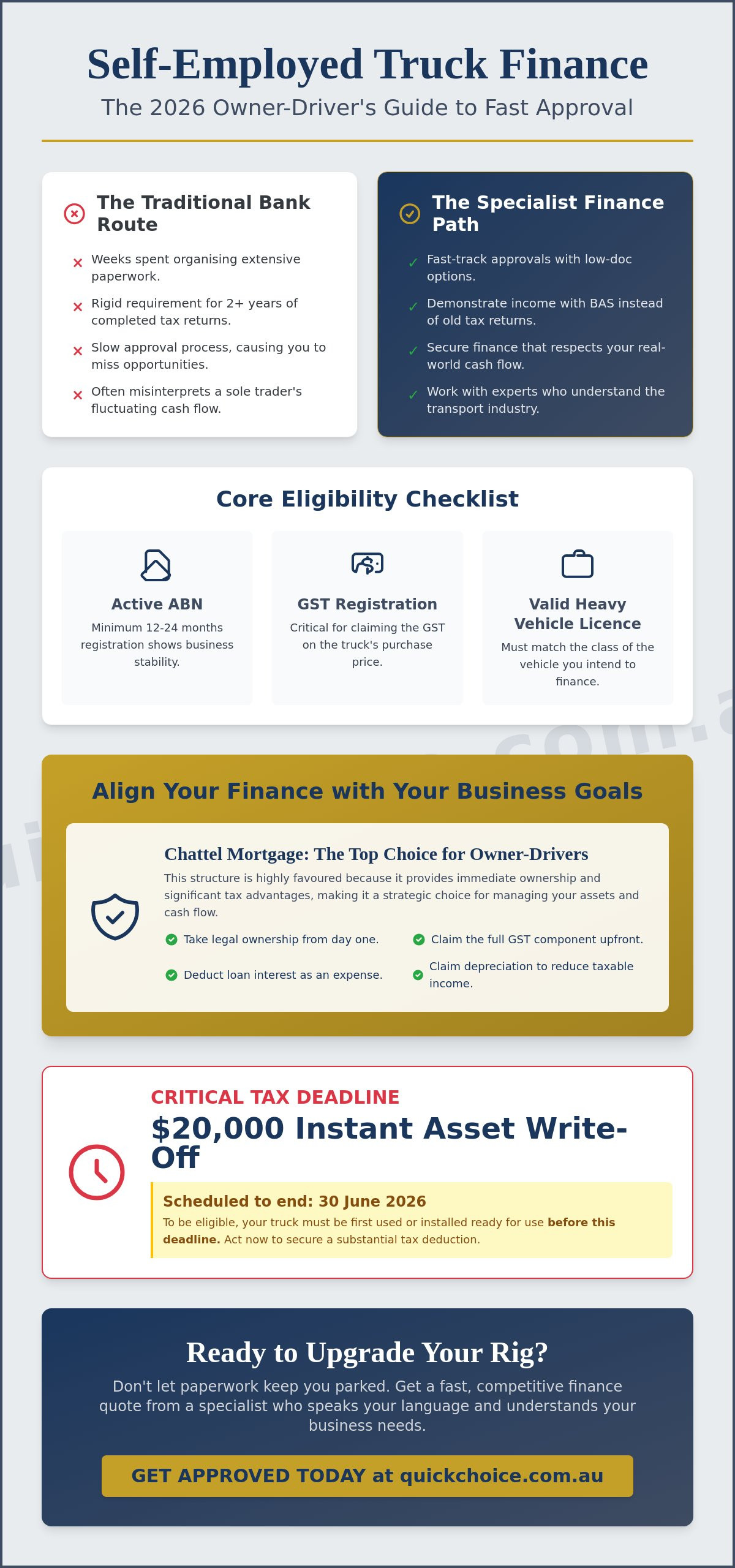
Securing self employed truck finance doesn't have to be a bureaucratic nightmare. This 2026 guide explains how to access competitive low-doc options and leverage the $20,000 instant asset write-off before the 30 June deadline. You'll learn how to bypass rigid lending criteria and secure a loan structure that respects your ABN age and cash flow. We'll show you how to get approved quickly with a specialist who understands the transport industry; this allows you to focus on the road ahead instead of bank queues. From Euro 6 compliance to tax-effective chattel mortgages, we've got the insights you need to keep your business moving.
Key Takeaways
- Discover how to secure self employed truck finance using low-doc options that don't require years of traditional tax returns.
- Learn why matching your commercial loan structure to your specific accounting method is vital for sustainable business growth.
- Understand the updated 2026 documentation standards to ensure your application moves through the approval process without unnecessary delays.
- Explore how local expertise in Melbourne’s western freight hubs, such as Truganina and Melton, can streamline your path to the road.
- Identify tax-effective asset finance strategies that help you manage cash flow while modernising your fleet with Euro 6 compliant vehicles.
Understanding Self-Employed Truck Finance in 2026
At its core, self employed truck finance is a specialised commercial credit facility where the vehicle itself acts as the primary security for the loan. Unlike a personal loan that relies on a steady weekly salary, this asset-backed structure focuses on your business's capacity to generate revenue. Traditional big banks often struggle with sole trader applications because they prefer the predictable rhythm of a PAYG payslip. They frequently view seasonal income fluctuations or the lack of two years’ worth of completed tax returns as a high risk. However, the lending environment in 2026 has evolved significantly. Lenders now recognise the vital role of the contractor economy, offering more flexible pathways for those who can demonstrate their income through Business Activity Statements (BAS) rather than traditional financial statements.
The 2026 shift in lending standards reflects a broader acceptance of the "smart efficiency" trend in the Australian transport sector. Finance providers are now more interested in your operational intelligence and the specific contracts you have in place. If you're moving freight in high-demand sectors, which currently account for approximately 75% of Australia's non-bulk domestic freight, lenders are more likely to offer competitive rates. This modern approach values your actual cash flow and industry experience over rigid, outdated paperwork requirements.
The Core Eligibility Requirements for Sole Traders
Your Australian Business Number (ABN) is the foundation of any application. Most prime lenders look for a registration history of at least 12 to 24 months to establish business stability. Being registered for GST is another critical factor; it allows you to claim back the GST component of the truck’s purchase price as an Input Tax Credit (ITC), which helps your initial cash flow. You'll also need a valid heavy vehicle licence matching the class of truck you’re financing, along with standard identification to satisfy current regulatory requirements.
Why Specialised Transport Finance Matters
It's important to distinguish these facilities from standard business vehicle finance Australia. A truck is a high-utilisation asset with a specific "useful life" that differs greatly from a passenger car or a light van. Lenders evaluate heavy vehicles based on their durability, the Euro 6 emissions standards now mandatory in 2026, and their projected resale value in a cooling market. By understanding finance leases and chattel mortgages, you can choose a structure that matches your specific depreciation schedule. This specialised approach ensures your self employed truck finance terms align with the truck’s operational reality, providing a more sustainable path to ownership than a generic commercial loan.
Choosing the Right Loan Structure for Your Business
Selecting the right financial framework for your self employed truck finance is a strategic move that affects your bottom line far beyond the initial purchase. It's not just about securing the lowest interest rate; it's about how the debt interacts with your tax obligations and daily cash flow. You need to align your finance product with your specific accounting method. If you manage your books on a cash basis, for example, the timing of your GST claims will differ significantly between a lease and a mortgage. Before committing to a specific rig, you should also explore available government grants and programs that might support your business expansion or fleet modernisation.
Timing is equally critical in the current fiscal environment. The temporary $20,000 instant asset write-off threshold for small businesses is scheduled to expire on 30 June 2026. After this date, the threshold is set to revert to $1,000. If you're planning to add a vehicle to your fleet, ensuring it is first used or installed ready for use before this deadline could result in a substantial immediate deduction. Always balance these tax incentives against your projected contract revenue to ensure your monthly repayments remain manageable during quieter seasonal periods.
Chattel Mortgage: The Popular Choice for Tradies
A chattel mortgage is often the preferred route for owner-drivers because it allows you to take legal ownership of the truck from the day of settlement. This structure is particularly effective if you want to claim the interest and depreciation as business expenses. For those registered for GST on a cash basis, you can typically claim the entire GST component of the purchase price as an Input Tax Credit in your next Business Activity Statement. This provides a significant upfront cash injection that can be reinvested into fuel, maintenance, or other operational costs. If you're unsure which path fits your current contracts, our specialists in asset finance for the self employed can help you compare the long-term costs.
Commercial Hire Purchase and Finance Leases
If your priority is keeping monthly overheads as low as possible, a finance lease or commercial hire purchase might be more suitable. These structures often involve a residual value, commonly known as a balloon payment, at the end of the term. By deferring a portion of the principal to the end of the loan, you reduce your ongoing monthly commitment, which helps preserve your working capital. While a hire purchase leads to eventual ownership, a finance lease focuses on the use of the asset. This can be an excellent way to manage shorter ownership cycles, allowing you to upgrade to newer, more efficient models every few years without a heavy capital outlay.
Low Doc vs. Full Doc: Which Path Suits Your ABN?
Choosing between a Low Doc and a Full Doc application often comes down to a simple trade-off: do you need the keys tomorrow, or do you have the time to prove every cent of your income for a lower interest rate? In the 2026 lending environment, the documentation spectrum has become more defined. While some competitors might use "No Doc" as a marketing hook, the reality is that nearly all reputable lenders require some form of income verification. Low Doc is the realistic middle ground for most owner-drivers. It allows you to bypass the need for full profit and loss statements if your ABN has been active and GST-registered for at least 12 to 24 months. This path prioritises speed and ease, though it typically carries a slightly higher interest rate compared to traditional applications.
Lenders view self employed truck finance through the lens of risk. By providing less documentation, you're asking the lender to take a broader view of your business's health. For those who are still refining their business structure or seeking additional support, the Self-Employment Assistance program can provide valuable resources to ensure your operation remains viable and attractive to credit providers. Ultimately, the right choice depends on your current record-keeping and how quickly you need to get that new rig on the road.
Qualifying for Low Doc Truck Finance
Low Doc finance relies heavily on a "Self-Declaration" of income, supported by other evidence of business activity. Instead of full tax returns, lenders might ask for your last two Business Activity Statements (BAS) or a simple letter from your accountant. This approach is perfect for contractors with seasonal income who might not look as strong on a single year's tax return. However, a clean personal and business credit history is non-negotiable here. Because the lender has less financial data to review, they'll rely heavily on your track record of meeting previous obligations to approve your request.
When to Choose a Full Doc Application
If you're planning a large fleet expansion or want to secure the absolute sharpest commercial asset finance rates, a Full Doc application is the way to go. By providing two years of clean tax returns and detailed financial statements, you give lenders the confidence to offer their most competitive terms. This extra effort can also help you overcome minor credit blemishes, as your overall financial strength can provide the necessary context that a simple credit score cannot. For those with a long trading history and up-to-date books, the savings over a five-year loan term can be significant.
Qualifying for Heavy Vehicle Finance in Melbourne’s West
Melbourne’s western suburbs are the engine room of the Victorian freight industry. For owner-drivers operating out of Truganina, Melton, or Hoppers Crossing, being at the centre of these logistics hubs provides a massive advantage. However, securing self employed truck finance requires more than just a good location. You need a broker who understands the specific demands of the Werribee and Caroline Springs markets. A local specialist knows that your finance structure must be as reliable as the rig you're driving, especially when you're servicing high-pressure contracts in these busy distribution corridors.
If you're a new sub-contractor with a fresh ABN, presenting a strong business case is essential. While big banks might see a new business as a risk, a specialised broker looks at the potential of your contracts. Providing a "Letter of Intent" from a reputable freight partner can be the difference between a rejection and an approval. It proves to the lender that your new venture has guaranteed work lined up, making you a much more attractive prospect for commercial credit.
The 5-Step Application Checklist for Contractors
Preparation is the key to a fast approval. Follow these steps to ensure your application is ready for assessment:
- Step 1: Confirm your ABN and GST status are active and correct. Lenders will verify this immediately.
- Step 2: Organise your last six months of business bank statements to demonstrate consistent cash flow.
- Step 3: Secure a "Letter of Intent" or a formal contract of work from your primary freight partner.
- Step 4: Identify the specific truck or trailer you intend to purchase, including all technical specifications.
- Step 5: Ensure your heavy vehicle licence is current and matches the class of the asset you're financing.
Financing New vs. Used Trucks
Lenders generally have a preference for newer assets, typically favouring trucks that are under 10 years old at the end of the loan term. While used trucks offer a lower entry price, they often come with stricter lending criteria and may require a higher deposit. If you're buying through a private sale rather than a dealership, expect extra steps like independent valuations and PPSR checks to verify the asset's history. Remember that equipment finance for sole traders should also account for the cost of trailers or specialised bodies, ensuring your entire setup is covered under one manageable facility. If you're ready to get on the road, speak with our Melbourne-based asset finance team to discuss your specific needs.
How Quick Choice Drives Your Transport Ambitions
Choosing the right partner for your self employed truck finance is just as important as choosing the right rig. At Quick Choice, we don't operate like a faceless, high-street bank or a cold algorithm. We position ourselves as your Reliable Specialist Guide; a team that values practical results and understands the unique pressures of the Australian transport industry. Our roots are firmly planted in Melbourne’s western suburbs. We've spent years helping owner-drivers from Rockbank to Caroline Springs move through the complexities of commercial credit with quiet confidence. We believe that securing a loan shouldn't be a source of stress. Instead, it should be a straightforward milestone that signals the growth of your business.
Our approach is designed to simplify the asset finance for self employed journey by removing unnecessary obstacles. We focus on bespoke solutions that match your specific cash flow reality. Because we understand the local logistics landscape, we can often secure approvals that traditional lenders might overlook. We take pride in our niche expertise, ensuring that every piece of advice we give is grounded in the current 2026 market conditions. This personalised service means you get a collaborator who is genuinely invested in your success, rather than just a service provider ticking boxes.
A Partner for Every Stage of Your Business
We're here to support you whether you're just starting out or looking to expand an existing fleet. For new ABN holders in Aintree and Thornhill Park, we provide the guidance needed to secure your first prime mover without the usual paperwork headache. We know that the first few years are critical, so we focus on sustainable loan structures that won't cripple your early cash flow. For established operators in Tarneit, we specialise in fleet upgrades and trailer finance. We help you leverage your trading history to secure the sharpest possible rates on the latest Euro 6 compliant models. Our goal is to ensure your finance remains an asset to your business, not a burden.
Ready to Get on the Road?
Starting a conversation with us is the first step toward getting your new truck on the road. We take a "no-jargon" approach to every consultation. This means we explain your options in plain English, ensuring you understand exactly how your chattel mortgage or finance lease will work. We value your time and get straight to the point, providing a streamlined experience that mirrors the efficiency of your own operations. If you're ready to take the next step, our team is standing by to help you navigate the application process from start to finish. Organise your self-employed truck finance with Quick Choice today and experience the difference that local, specialist expertise makes to your business momentum.
Take the Next Step Toward Your New Rig
Success as an owner-driver depends on your ability to adapt to a changing market and seize opportunities as they arise. You now understand how low-doc options provide the flexibility you need when traditional tax returns aren't ready, and how choosing the right chattel mortgage can protect your cash flow. By aligning your finance with the specific demands of Melbourne’s western logistics hubs, you position your business for sustainable growth and long-term stability.
Securing self employed truck finance is a strategic decision that requires a partner who understands the road you travel. Quick Choice offers specialised expertise for independent contractors and access to a wide panel of commercial lenders, ensuring you get a solution tailored to your unique ABN history. We pride ourselves on being a reliable guide for professionals across Melbourne’s west who value efficiency, precision, and practical results over abstract promises.
Don't let complex bank requirements stall your progress. Get a Tailored Truck Finance Quote from Quick Choice today and see how simple the process becomes with a specialist in your corner. We're ready to help you get behind the wheel of your next rig with confidence and clarity.
Frequently Asked Questions
Can I get truck finance if I have only been self-employed for 6 months?
Yes, you can secure finance with a six-month trading history, though options are typically more limited than for established businesses. Most prime lenders prefer a 12 to 24-month ABN history, but specialist lenders offer "new venture" products for those with industry experience. You may need a larger deposit or a letter of intent from a freight partner to demonstrate your ability to service the debt from day one.
What is the difference between a truck loan and a chattel mortgage?
A chattel mortgage is the most common form of self employed truck finance in Australia. While "truck loan" is a general term, a chattel mortgage specifically allows you to take ownership of the vehicle immediately. The lender secures the loan by taking a mortgage over the truck itself. This structure provides significant tax advantages, such as the ability to claim the GST component upfront in your next Business Activity Statement.
Do I need a deposit for self-employed truck finance?
You don't always need a deposit, but providing one can significantly lower your interest rate. Prime borrowers who provide a 20% deposit often access rates starting from approximately 7.5% per annum. While 100% finance is available for some established operators, a deposit reduces the lender's risk and lowers your monthly repayments. This makes your overall business overheads more manageable during quieter freight periods.
Can I finance a used truck from a private seller?
Financing a used truck from a private seller is possible, though it involves extra steps compared to a dealership purchase. Lenders will require an independent valuation and a PPSR check to ensure the asset is free of existing debt. Most lenders also have age restrictions, preferring trucks to be under 10 years old at the conclusion of the loan term to ensure the asset maintains sufficient resale value.
Will a truck loan affect my ability to get a home mortgage later?
Any commercial debt will be factored into your total liabilities when applying for a home mortgage. Lenders assess your debt-to-income ratio to ensure you can manage all repayments. However, because the truck is an income-producing asset, the revenue it generates can offset the liability. Maintaining a clean repayment history on your truck loan actually demonstrates your reliability as a borrower to future mortgage lenders.
How much can I borrow as a sole trader truck driver?
Your borrowing capacity depends on your business's cash flow and the specific asset you are purchasing. Lenders evaluate your ability to service the loan by reviewing your Business Activity Statements or bank statements. While there is no fixed limit, the loan amount is typically tied to the truck's market value. Specialist brokers can help you determine a realistic borrowing limit that won't overstretch your weekly operational budget.
What is Low Doc truck finance and do I qualify?
Low Doc finance is designed for sole traders who haven't yet completed their latest tax returns. You generally qualify for this self employed truck finance path if you have an active ABN and have been registered for GST for at least 12 months. Instead of full financials, you provide alternative proof of income, such as an accountant's letter or recent BAS, allowing for a faster and more streamlined approval process.
Is the interest on my truck loan tax-deductible?
The interest on a commercial truck loan is generally tax-deductible when the vehicle is used for business purposes. You can also claim depreciation on the asset to reduce your taxable income. For the 2024–25 income year, the car depreciation limit is $68,108, but heavier vehicles with a carrying capacity over one tonne are typically exempt from this limit. Always consult your accountant to maximise these benefits.


