
Why is it that having a healthy ABN and a solid pipeline of work still isn't enough to satisfy the big banks? You've likely spent hours gathering tax returns and BAS statements, only to be told you don't fit into their rigid "one-size-fits-all" box. It's a common story for Australian business owners who find that traditional lenders just don't speak their language. This is where a self employed finance specialist changes the game. Instead of looking for reasons to say no, a specialist looks at the real-world momentum of your business to find a path toward "yes."
We understand the frustration of excessive paperwork and the anxiety that comes with a potential rejection affecting your credit score. You shouldn't have to choose between running your job site and sitting in a bank branch during business hours. This article explains how a specialist broker navigates unique financial hurdles to secure the assets your business needs to grow. We'll bust five common myths that hold business owners back and show you how to get fast approval for new trucks or machinery with competitive rates, all without the corporate runaround.
Key Takeaways
- Understand why traditional bank algorithms often penalise variable income and how to bypass these rigid lending criteria.
- Discover how a self employed finance specialist can secure asset approvals without requiring two years of tax returns or risking your family home as security.
- Learn the reality of Low-Doc and Alt-Doc finance options that prioritise your current business momentum over historical paperwork.
- Identify the three essential items every sole trader needs to prepare for a successful application in Melbourne's western suburbs.
- Get a clear roadmap to fast-track approvals for the trucks and machinery your business needs to scale in the current 2026 market.
The "Self-Employed Barrier": Why Traditional Banks Struggle with Independent Professionals
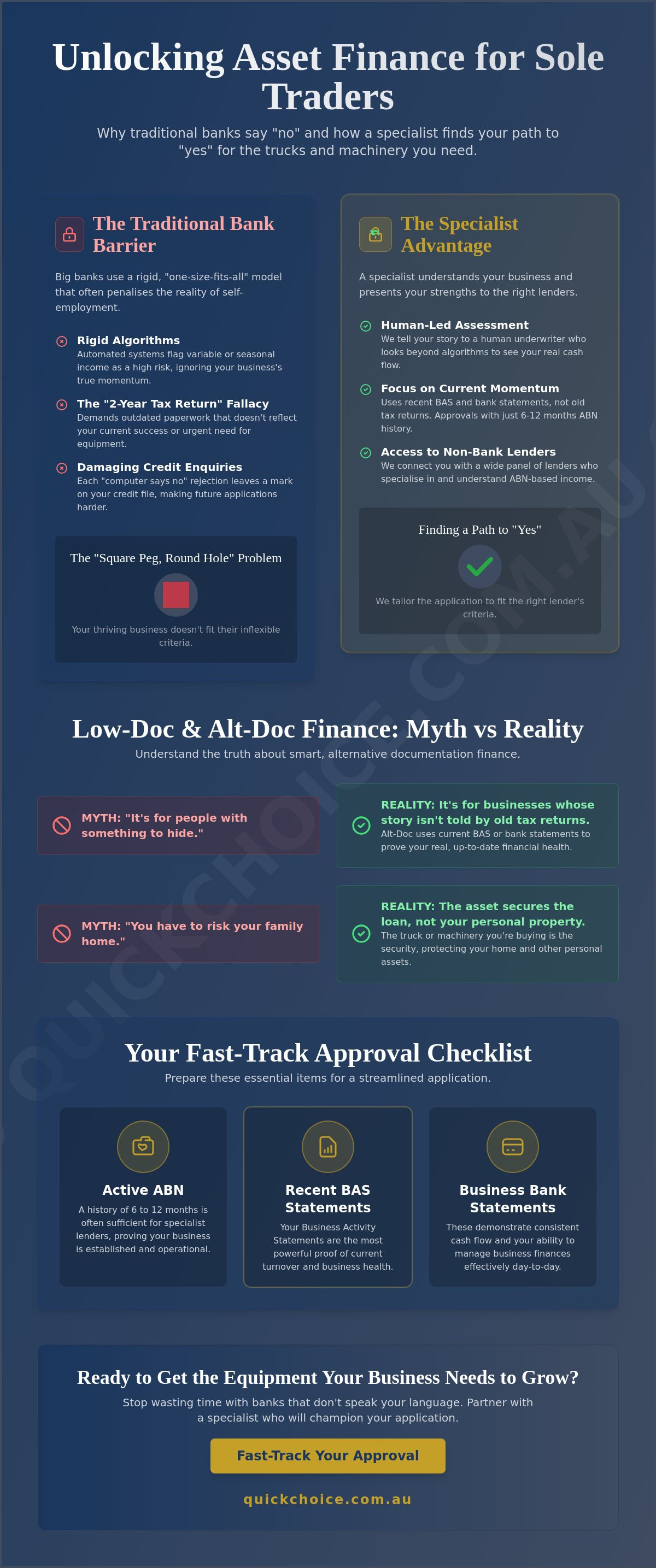
Traditional banks are designed to serve the "average" Australian. If you have a steady salary and a single employer, their systems work perfectly. However, Self-employment often involves fluctuating cash flow, seasonal peaks, and complex tax structures that don't fit neatly into a standard application form. This is the "Square Peg, Round Hole" problem. Bank algorithms are programmed to penalise variable income, seeing a quiet month not as a natural business cycle, but as a red flag for default.
A common frustration for independent professionals is the lack of human discretion. Modern bank managers often lack the authority to look past an automated credit score. If the computer flags your ABN income as inconsistent, the conversation usually ends there. Even worse, every time a bank runs a formal credit check and says "no," it leaves a mark on your file. These rejections can accumulate, making it even harder to secure finance elsewhere, even if your business is actually thriving. You're left stuck in a loop where you need the equipment to grow, but the bank won't give you the equipment until you've already grown.
The "Two-Year Tax Return" Fallacy
One of the biggest hurdles banks put in your way is the demand for two years of perfect, finalised tax returns. In the fast-moving economy of 2026, waiting two years to upgrade your equipment is simply not an option for most businesses. A self employed finance specialist knows that your 2024 tax return doesn't reflect your 2026 reality. Many specialist lenders now accept 6 to 12 months of ABN history, using your recent BAS statements to prove current serviceability. This shift toward real-time financial assessment allows you to strike while the iron is hot rather than waiting for your accountant to catch up with last year's paperwork.
Why "Computer Says No" is the Wrong Answer for Tradies
For those in industries like construction or transport, income is rarely a straight line. You might have a massive quarter followed by a period of downtime for maintenance or weather. Banks fail to account for these seasonal realities, often rejecting applications during a natural lull. Working with a self employed finance specialist gives you a human advocate who can explain these cycles to a lender. Manual credit assessment is the process where a human underwriter reviews your specific business circumstances and cash flow momentum rather than relying solely on an automated score, and it's the ultimate key to self-employed success. This tailored approach is often the only way to get a fair hearing when your business doesn't look like a standard 9-to-5 job.
What is a Self-Employed Finance Specialist (and Why You Need One)?
A self employed finance specialist is more than just a middleman. They are experts in ABN lending who understand how to translate your business success into a language lenders accept. While a local bank branch only offers its own limited suite of products, a specialist has access to a broad panel of non-bank lenders. These institutions often have a much higher appetite for sole trader risk and offer flexible terms that big banks simply can't match. They look at your business as a living entity with momentum rather than a static set of numbers on a page.
Your specialist's primary job is to "package" your application. This involves presenting your BAS statements, bank feeds, and contracts in a way that highlights your serviceability and business strength. While international resources like the SBA financing options guide provide a broad overview of funding strategies, an Australian specialist focuses on the specific nuances of our 2026 credit market. They ensure your application doesn't just land on a desk, but actually tells a compelling story of growth. If you're tired of the corporate runaround, consulting with Quick Choice can provide the clarity you need to move forward.
Asset Finance vs. Standard Personal Loans
Many tradies make the mistake of applying for a personal loan to buy a work vehicle. This is often the least efficient way to fund a business asset. A personal loan usually carries higher interest rates and offers zero tax flexibility. By using specific types of asset finance, such as a chattel mortgage, you can often claim the GST upfront and benefit from depreciation. Keeping your business debt separate from your personal debt also protects your individual credit capacity for future needs, like a home mortgage. It's about using commercial asset finance to make your money work harder for you.
Navigating Complex Business Structures
Lenders view a "self-employed" individual differently than a "business owner" with established structures. Whether you operate as a sole trader, a partnership, or through a family trust, a self employed finance specialist understands how to verify your income correctly. They look at your ABN history to determine the stability of your enterprise. Even if you've recently restructured or started a new partnership, a specialist knows which lenders will accept your previous industry experience as proof of reliability. This level of expertise is vital for an asset finance broker in Melbourne who deals with the diverse industrial landscape of the western suburbs every day.
Myth vs Reality: Low-Doc and Alt-Doc Asset Finance Decoded
Low-Doc finance is often misunderstood as a last resort for businesses with poor records. In reality, it's a strategic tool for those whose tax returns haven't caught up to their current bank balance. While international standards like the Fannie Mae underwriting guidelines highlight the complexity of verifying independent income, an Australian self employed finance specialist uses local "Alt-Doc" methods to bypass these hurdles. They look at your Business Activity Statements or bank feeds to confirm you can afford the repayments today, not what you earned two years ago.
One of the most persistent fears is that you'll need to put your family home on the line to buy a new piece of machinery. This is simply not true in the world of asset-backed lending. The equipment you're buying, whether it's a prime mover, an excavator, or a fleet of delivery vans, serves as the primary security for the loan. This structure protects your personal assets and keeps your home equity available for personal goals or future property investment. It's about containing business risk so it doesn't spill over into your kitchen at home.
Myth: Low-Doc Means High Interest
Many business owners assume that "Low-Doc" automatically means "high interest." In 2026, commercial asset finance rates for self-employed Australians have become incredibly competitive. For an established ABN holder with a clean credit history, the difference between a full-doc and a low-doc rate is often negligible. The real cost isn't the interest rate; it's the "opportunity cost" of losing a contract because you didn't have the gear ready to go. Even if your credit history isn't perfect, bad credit equipment finance for the self-employed provides a viable path to acquire the tools you need to rebuild and grow.
Myth: You Need Property as Security
A chattel mortgage is the gold standard for many tradies because it allows the business to own the asset from day one while the lender takes a mortgage over that specific item. This is fundamentally different from the "unsecured" loans banks often push, which might come with hidden caveats or higher overall costs. By keeping your business finance asset-backed, you preserve your borrowing power and maintain a clear boundary between your professional risks and your family's security. A self employed finance specialist can help you set up these structures to ensure your business growth never compromises your personal stability.
Securing Approval in Truganina and Beyond: A Specialist’s Checklist
Securing approval in Truganina and the broader western corridor requires more than just a decent credit score. It requires a lender who understands that a tradie in Werribee or a transport operator in Melton is part of one of Australia's fastest-growing economic zones. A self employed finance specialist uses this local context to strengthen your application. They don't just see a loan request; they see a business contributing to the massive infrastructure investment currently transforming Melbourne's west. This local knowledge helps "sell" your business story to a lender who might otherwise only see a postcode on a map.
Before you start shopping for a new truck or excavator, use an asset finance eligibility checker to see where you stand. This simple step saves time and protects your credit file from unnecessary enquiries that can lower your score. Organising your digital paper trail is the fastest way to move from "pending" to "approved." Specialists generally look for the "Big Three": a valid ABN with at least six months of history, a clear statement of what the asset will do for your revenue, and recent evidence of income through bank statements or BAS.
Organising Your ABN and GST Details
GST registration is often seen as another tax chore, but it's actually a powerful signal to lenders. It shows your business has reached the $75,000 turnover threshold and is operating at a professional level. You should also verify that your ANZSIC industry code is correct on the ABN register. If you are a specialised contractor but your code says "general labour," it might trigger an automatic rejection from certain bank algorithms. A clean ATO portal is equally vital. Even if you haven't lodged your 2025 returns yet, showing that you are up to date with your current BAS payments and have no significant tax debt builds significant trust with a self employed finance specialist.
Demonstrating Business Cash Flow Momentum
Proving your income has never been easier thanks to open banking technology. A specialist can use secure bank feeds to analyse your cash flow momentum in real time, often providing a decision within 24 hours. This is particularly helpful if you've recently secured a major contract in Melton or have recurring work with developers in the western suburbs. For local tradies, the permanent $20,000 instant asset write-off remains a vital tool for upgrading equipment while managing tax liabilities for businesses with a turnover of up to $10 million. If you are ready to secure your next asset, you can start your application with Quick Choice today to get an expert review of your business financials.
Partnering with Quick Choice: Streamlined Finance for Melbourne’s West
When a bank says "no," they often stop looking at the person behind the ABN. At Quick Choice, we take the opposite approach. We specialise in the "hard" cases that traditional lenders find too complex, such as variable income streams or recent business restructures. As a dedicated self employed finance specialist, we don't just look at your past paperwork; we focus on where your business is headed. We believe that a few quiet months in a previous tax year shouldn't stop you from acquiring the machinery you need to secure a massive contract today.
Our process is built on quiet confidence and practical results. We move your application from an initial yarn to having the keys in your hand with minimal disruption to your workday. While banks might leave you waiting for weeks, we use our niche expertise to navigate the 2026 lending market with speed and precision. We treat you like a partner in growth, ensuring you have the resources to scale without the corporate runaround that often plagues small business owners.
Local Expertise in the Western Growth Corridor
We have deep roots in the industrial hubs of Truganina, Tarneit, and Hoppers Crossing. This local presence gives us a unique advantage because we understand the specific economic drivers of Melbourne's west. We know the challenges faced by owner-drivers and earthmoving contractors because we see their work every day on our local roads and job sites. Working with a local self employed finance specialist beats using a generic online lending marketplace every time. We provide a tailored service that accounts for the local economy, rather than a distant algorithm that doesn't know the difference between Caroline Springs and a city on the other side of the country.
Our Support-First Approach to Asset Acquisition
We understand that your time is your most valuable asset. Our team handles the heavy lifting of the paperwork so you can stay on the tools or on the road. You won't be bounced around a call centre or left waiting for a return phone call from a faceless corporation. Instead, you get direct access to a dedicated specialist who understands your ABN history and your business goals. We pride ourselves on being a reliable guide, removing the obstacles that stand between you and your next business milestone. Ready to grow your business? Speak to a Quick Choice specialist today.
Take the Next Step Toward Your Business Goals
Traditional banks often see your ABN as a risk, but we see it as a sign of ambition and hard work. By busting these common myths, it's clear that securing equipment doesn't have to mean compromising your personal security or waiting years for the perfect tax return. A self employed finance specialist understands that your business is defined by its current momentum and future potential, not just by an automated credit score. You've built your business on results, and you deserve a finance partner who does the same.
As local Melbourne western suburbs experts, Quick Choice provides direct access to over 30 specialised business lenders who value independent professionals. We take the stress out of the application process by handling the complex packaging so you can stay focused on your trade. Book a free consultation with a Quick Choice specialist today to see how we can streamline your next asset acquisition. Your growth shouldn't be on hold just because a bank algorithm didn't get the full story. We're here to help you get the keys and get moving.
Frequently Asked Questions
Do I need to be in business for two years to get asset finance?
No, you don't need two years of trading history to qualify for most asset finance options. While big banks often insist on long-term records, a self employed finance specialist can work with businesses that have been active for as little as six months. We look at your current cash flow and industry experience rather than just the age of your ABN.
What is the difference between a bank and a self-employed finance specialist?
Banks are limited to their own rigid products and automated scoring systems. A specialist has access to a panel of over 30 lenders, many of whom specialise in non-conforming or sole trader risk. This allows for a manual assessment of your application, ensuring your business's unique circumstances are understood by a human underwriter rather than just a computer algorithm.
Can I get a truck or ute loan with a new ABN?
Yes, it's definitely possible to secure a loan for a truck or ute with a relatively new ABN. Lenders often look for "replacement" assets or industry experience to mitigate risk. If you can show you've worked in the same industry for several years before starting your own business, many specialist lenders will consider your application even if your ABN is less than a year old.
Will applying for finance with a specialist affect my credit score?
Seeking a quote or a pre-assessment through a specialist typically doesn't affect your credit score. We conduct a thorough review of your situation before submitting a formal application. This approach prevents the "shotgunning" of applications that often happens at banks, which can leave multiple hard enquiries on your file and lower your score over time.
Do I have to provide my house as security for equipment finance?
No, you do not need to use your family home as security for equipment finance. Most business loans for vehicles or machinery are "asset-backed," meaning the equipment itself serves as the collateral. This keeps your personal property separate from your business liabilities, protecting your home equity for personal use or future property investments.
What documents do I need for a low-doc business loan in 2026?
For a low-doc loan in 2026, you generally only need your ABN, a valid driver's licence, and basic details about the asset. Depending on the lender, you might also provide recent Business Activity Statements (BAS) or use secure bank feeds to demonstrate your cash flow. This streamlined process avoids the need for full, accountant-prepared tax returns.
How long does the approval process take with Quick Choice?
We aim to provide a decision within 24 to 48 hours of receiving your initial information. Because we understand "tradie talk" and ABN income structures, we don't waste time asking irrelevant questions. Our streamlined process is designed to get you an answer quickly so you can get your new equipment on the road without delay.
Is asset finance tax-deductible for sole traders?
Yes, asset finance is generally tax-deductible for sole traders when the equipment is used for business purposes. You can typically claim the interest on the loan and the depreciation of the asset. In 2026, the permanent $20,000 instant asset write-off also allows eligible businesses to immediately deduct the full cost of assets under that threshold.


