What if your business's future was measured by the contracts you can win tomorrow rather than a missed phone bill from three years ago? For many independent contractors, the fear of rejection from mainstream lenders is enough to stall growth before it even begins. It's frustrating when irregular cash flow makes traditional "Full Doc" applications feel impossible, but securing bad credit equipment finance for self-employed professionals is more achievable than you might think.
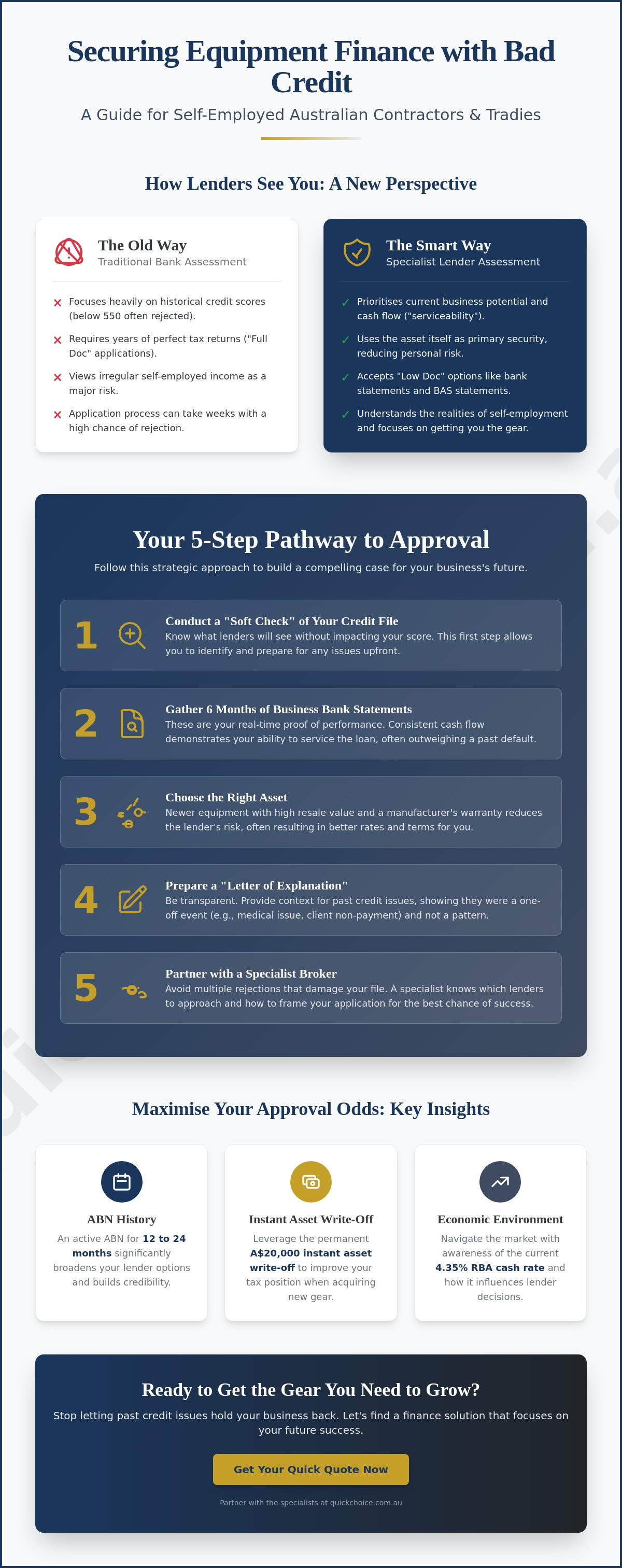
At Quick Choice, we believe a credit score below 550 shouldn't be the final word on your capability. You deserve a partner who looks at your business potential and the value of the asset itself, not just a snapshot of your history. This guide shows you the exact steps to secure the machinery or vehicles you need to take on bigger jobs. We'll explore how to navigate the current environment of a 4.35% RBA cash rate, leverage the permanent A$20,000 instant asset write-off, and find a straightforward path to getting your gear on-site without wasting weeks on applications that lead nowhere.
Key Takeaways
- Learn how specialist lenders prioritise your current business potential over past credit defaults when assessing your eligibility for gear.
- Follow a clear five-step guide to secure bad credit equipment finance self employed Aussies need to win bigger contracts and expand their operations.
- Determine if Low Doc or Full Doc financing is the right fit for your records, even if you haven't finalised your latest tax returns.
- Gain practical advice on preparing your bank statements and keeping your BAS current to ensure your application is as strong as possible.
- Discover how a specialist guide can simplify the process, especially for contractors and tradies operating across Melbourne's western suburbs.
Understanding Bad Credit Equipment Finance for Self-Employed Australians
For many Australian business owners, a credit score feels like a shadow that follows them into every bank meeting. Bad credit equipment finance is a specialised commercial loan designed specifically for ABN holders who have defaults, court actions, or low scores on their credit file. It acknowledges that a past financial hiccup shouldn't prevent you from growing your business today. Traditional banks often reject self-employed applicants because they view irregular income as a risk, especially when paired with a less-than-perfect credit history. They prefer "Full Doc" applications with years of perfect tax returns, which many growing businesses simply don't have ready.
Specialist lenders take a more practical approach. They focus on the asset itself as the primary security for the loan rather than obsessing over your personal credit file. If you're looking for bad credit equipment finance self employed options, your ABN is your most valuable tool. How long you've been trading impacts your choices, but it's not the only hurdle. While some lenders prefer 12 to 24 months of history, others specialise in helping newer businesses get the tools they need to succeed. They understand that you need the gear to make the money, not the other way around.
Why Your Credit Score Isn’t the Only Factor
Lenders shift their focus toward "serviceability" to determine if your new machinery will generate enough revenue to pay for itself. They want to see that your business has the cash flow to handle the monthly repayments comfortably. The resale value of the equipment is a major part of this equation. If the gear holds its value well, the lender's risk is lower. Often, a strong set of recent business bank statements showing consistent turnover carries more weight than a poor Equifax score from several years ago. It’s about your business's current momentum, not just its past struggles.
Common Credit Issues for Sole Traders
Small oversights often lead to credit damage for sole traders. Late utility payments, tax defaults, or previous overdrawn accounts can linger on your record for years. Lenders distinguish between a "paid" default, where you've settled the debt, and an "unpaid" default. Having a clear explanation or a plan to settle these can help your application. A Chattel mortgage is a commercial finance product where the business owner takes immediate ownership of the equipment, and the lender secures the loan by taking a mortgage over that specific asset. This structure provides a straightforward path for self-employed pros to get back on track and focus on winning bigger contracts.
How to Apply for Equipment Finance with Bad Credit: A 5-Step Guide
Securing bad credit equipment finance self employed professionals can use to grow their business requires a strategic approach. You aren't just filling out a form; you are building a case for your business's future. While a bank might see a low score and stop there, specialist lenders look for reasons to say yes. Follow these five steps to prepare an application that commands respect and gets results.
- Step 1: Conduct a "soft check" of your credit file. Before applying, identify exactly what a lender will see. A soft check allows you to view your file without leaving a "footprint" that could further lower your score.
- Step 2: Gather 6 months of business bank statements. These statements act as your real-time credit score. Lenders use them to verify consistent cash flow and your ability to meet monthly repayments.
- Step 3: Choose the right asset. Newer equipment often attracts better interest rates. Lenders feel more secure financing gear that is under warranty and has a high resale value.
- Step 4: Prepare a "letter of explanation." Provide context for past credit issues, such as a one-off medical bill or a late-paying client. Proven strategies for getting a business loan with bad credit often hinge on this level of transparency.
- Step 5: Partner with a specialist broker. A broker who understands the sub-prime commercial market knows which lenders are currently active and what they are looking for. If you're ready to move forward, consulting a specialist asset finance broker can help you avoid unnecessary rejections.
Organising Your Business Paperwork
Your ABN is the foundation of your application. Having an active ABN for at least 12 to 24 months significantly broadens your lender options. If you're registered for GST, it signals to the lender that your business has reached a certain scale of operation. To further strengthen your position, provide exports from accounting software like Xero or MYOB. These reports offer a professional snapshot of your profitability that bank statements alone might miss.
Choosing the Right Equipment
Lenders have a clear preference for "yellow goods" like excavators or standard commercial vehicles like utes and trucks. These assets are easy to value and easy to sell if the business hits a rough patch. The age of the equipment directly influences your loan term; most lenders prefer assets that will be less than 10 or 12 years old at the end of the finance period. Older assets may require a larger deposit to offset the lender's risk, but they can still be financed with the right preparation.
Comparing Your Options: Low Doc vs. Full Doc for Bad Credit
Choosing the right documentation path is a critical decision when seeking bad credit equipment finance self employed operators can actually qualify for. It isn't just about what paperwork you have on hand; it's about which lever you pull to balance speed, cost, and approval odds. Different lenders have different appetites for risk, and how you present your income can be the deciding factor in your application's success.
Low Doc finance is the go-to choice for contractors who haven't finalised their latest tax returns or prefer not to disclose every detail of their financial history. It allows you to move forward without the exhaustive paperwork a major bank requires. Conversely, Full Doc finance involves providing complete financial statements and tax returns. If your books are current and show profitability, this route often unlocks lower interest rates, even if your credit score is still in the recovery phase. The way commercial asset finance structures vary depends heavily on these documentation levels, with "No Doc" options sitting at the far end of the spectrum, typically requiring much higher equity or deposit amounts to offset the lender's risk.
The Pros and Cons of Low Doc Finance
The primary benefit of Low Doc is speed and simplicity. For a contractor in Truganina or Tarneit who needs to replace a broken excavator or truck fast, getting back on the tools in 48 hours is more important than a slightly higher interest rate. The process usually involves a "Self-Declaration of Income," where you state your earnings and the lender verifies this against your recent business bank statements. While approval is often faster, the trade-off is a slightly higher rate compared to a Full Doc loan, as the lender has less visibility into your long-term financial health.
When to Consider a Deposit
A deposit is one of the most powerful tools for an applicant with a poor credit file. Putting down 10 to 20 percent of the asset's value can often flip a "No" into a "Yes." This reduces the Loan to Value Ratio (LVR), which moves your application into a lower risk bracket for the lender. If you don't have the cash ready, you might be able to use existing unencumbered equipment as additional security. This shows the lender you have "skin in the game" and significantly improves your chances of securing a more competitive interest rate bracket despite your past credit history.
Maximising Your Approval Odds: Preparation Tips for Tradies
Your bank statements are essentially a diary of your business's health. Lenders look for stability, so avoid non-essential high-risk spending, such as gambling, for at least three months before you apply. This simple step shows you're prioritising your business commitments and managing your cash flow with discipline. Keeping your ATO obligations, like your Business Activity Statements (BAS), as current as possible is equally vital. It demonstrates that you're a responsible operator who manages their tax affairs professionally, which builds immediate trust with a credit assessor.
One of the biggest mistakes you can make is applying to multiple lenders at once. Every time a lender performs a hard credit check, it leaves a mark on your file. If you rack up several inquiries in a short period, it signals desperation and can damage your credit score further. This is where local expertise becomes a massive advantage. Finding the right asset finance for self employed professionals in Victoria means working with someone who knows exactly which lenders are receptive to your specific industry and current financial position.
The Power of a Professional Broker
A specialist broker does more than just submit paperwork. They "package" your application to tell a story of growth and resilience, ensuring a lender sees your future potential rather than just past mistakes. You gain access to private and non-bank lenders who don't advertise to the public but specialise in bad credit equipment finance self employed applicants often need. Your broker can also negotiate specific terms, such as balloon payments, to keep your monthly cash flow manageable while you're getting a new contract off the ground.
Avoiding Common Application Pitfalls
Accuracy is your best friend during this process. Guessing your income on an application creates immediate red flags when the lender cross-references your bank statements. Similarly, the presence of payday loans is often a deal-breaker for commercial lenders, as it suggests an inability to manage short-term cash flow. Be mindful of inter-account transfers as well. Moving money between personal and business accounts can look like you're trying to fabricate income, so keep your transactions clean and transparent. If you want to ensure your application is built on solid ground, contact a specialist finance broker to review your file before you hit submit.
Why Local Self-Employed Pros in Melbourne’s West Choose Quick Choice
Melbourne’s West is currently the engine room of Victoria's infrastructure growth. If you are a sub-contractor based in Hoppers Crossing or Caroline Springs, you know the pressure of keeping up with the rapid pace of local development. Quick Choice has built its reputation on supporting these local businesses when traditional banks turn them away due to past credit issues. We understand that finding bad credit equipment finance self employed Aussies can rely on requires more than just a generic online form. It requires a partner who knows the local tradie scene and the specific demands of working on projects from Melton to Werribee.
Our approach is built on being a reliable specialist guide for independent professionals. We don't just look at a credit score; we look at the person behind the ABN and the potential of their business. Whether you are a solo operator or managing a small crew, we focus on securing the business vehicle finance australia wide that helps you stay competitive. By choosing a local specialist, you gain an advocate who understands the Victorian market conditions and the importance of having the right gear on-site today.
Specialised Support for Western Suburbs Contractors
Earthmovers and civil contractors in Rockbank and Aintree face unique equipment needs. You need heavy-duty machinery that can handle demanding local sites, and you need it without the delay of a faceless Sydney-based call centre. Because we are deeply rooted in Truganina, we provide a level of personal service that national brokers simply can't match. We prioritise fast turnaround times to keep your business moving. We know that in the construction industry, a day spent waiting for a loan approval is a day of lost revenue and missed opportunities.
Your Next Steps to Equipment Ownership
Taking the first step toward new machinery doesn't have to be a source of anxiety. We offer a simple, no-obligation chat to assess your current credit standing and explain your options clearly. Our goal is to help you secure the bad credit equipment finance self employed specialists provide while building a long-term plan for your success. As your business grows and your credit file improves, we work with you to eventually move from sub-prime rates toward prime financing options. Don't let a past mistake stop your future growth; reach out to a team that understands your local community and values your ambition.
Secure Your Business Growth and Upgrade Your Gear
Your business's success is defined by your ability to deliver on your promises, not by a credit score from several years ago. By focusing on the value of your assets and demonstrating consistent cash flow, you can move past the limitations of mainstream banks. Finding the bad credit equipment finance self employed specialists can provide ensures you have the tools to scale your operations and take on more ambitious projects. Preparation is your greatest asset in this process, and having a guide who understands the local Victorian landscape makes all the difference.
Quick Choice offers the specialist expertise needed to navigate the sub-prime commercial market. We provide access to non-bank lenders who look at the bigger picture, particularly for contractors operating across Melbourne's Western suburbs. Our team takes the stress out of the application process by packaging your story for the best possible outcome. Get a Fair Go with Quick Choice: Apply for Equipment Finance Today. We believe in your business's potential and are here to help you move forward with confidence.
Frequently Asked Questions
Can I get equipment finance with a credit score under 500?
You can definitely secure finance with a score below 500, as many specialist lenders set their minimum threshold around 475. While traditional banks might decline the application, non-bank providers prioritise the value of the machinery and your current business turnover. Providing a larger deposit or using existing assets as security can further improve your chances of approval despite a lower personal score.
What is the minimum ABN age for bad credit equipment loans?
Most lenders require an active ABN for a minimum of 6 to 12 months before they will consider a commercial application. If your business has been trading for less than a year, you may need to provide more detailed bank statements to prove consistent monthly revenue. Having a GST-registered business often helps demonstrate that your operations have reached a professional scale and meet standard eligibility criteria.
Do I need to provide tax returns for a bad credit machinery loan?
You don't always need to provide full tax returns, especially if you opt for a Low Doc loan structure. These applications are assessed using your ABN history, a declaration of income, and recent business bank statements. This is a practical solution for bad credit equipment finance self employed professionals who are behind on their paperwork but have the cash flow to support repayments.
Are interest rates significantly higher for bad credit finance?
Interest rates for bad credit borrowers are higher than prime rates to account for the increased risk to the lender. While prime borrowers might see rates between 6.59% and 7.49%, bad credit options typically range from 10% to 22%. These rates are influenced by the current RBA cash rate of 4.35% and your specific credit profile, though they can decrease as your credit history improves over time.
Can I finance used equipment with a poor credit history?
You can finance used equipment, provided the asset has a strong resale market and meets the lender’s age requirements. Most providers prefer machinery or vehicles that will be no more than 12 years old at the end of the loan term. If you're purchasing from a private seller rather than a licensed dealer, the lender will usually require an independent valuation to confirm the asset's worth before settlement.
How long does the approval process take for self-employed applicants?
The approval process typically takes between 24 and 48 hours once all your documentation is submitted. For self-employed applicants, the speed of the process depends on how quickly you can provide your business bank statements and proof of ID. Using digital statement links can often accelerate the assessment, allowing you to settle the loan and collect your gear within a few business days.
Will a new application for equipment finance hurt my credit score?
A formal application will involve a "hard" credit check, which leaves a permanent mark on your file and can slightly lower your score. To protect your rating, it's best to work with a broker who can perform a "soft" check first to gauge eligibility without a footprint. Avoiding multiple simultaneous applications is a key strategy for bad credit equipment finance self employed Aussies who want to keep their credit file healthy.
What happens if I have an unpaid ATO debt?
An unpaid ATO debt can complicate your application, but it isn't always an immediate rejection. Most specialist lenders will require you to have an active, complied-with payment plan in place before they consider your file. Transparency is vital here; showing that you are proactively managing your tax obligations helps reassure the lender that you are a responsible borrower despite past financial challenges.


