Waiting for your next tax return to upgrade your equipment could be the most expensive mistake your business makes this year. If you've ever felt the sting of a bank rejection because your financials aren't perfectly aligned with their rigid timelines, you're not alone. Most self-employed professionals find the jargon surrounding different types of asset finance more of a hurdle than the actual cost of the equipment. It's time to simplify the process so you can focus on your growth.
We know that keeping your cash flow steady is just as important as the tools you use. This guide will show you exactly how to select a finance structure that aligns with your tax goals, including how to leverage the A$20,000 instant asset write-off before the June 2026 deadline. We'll compare Chattel Mortgages and Finance Leases while clarifying how GST claims work for each, giving you a clear path to securing your next vehicle or machine with confidence.
Key Takeaways
- Understand how using the asset itself as security can unlock lower interest rates and preserve your essential working capital.
- Compare the three primary types of asset finance in Australia to determine whether a Chattel Mortgage, Finance Lease, or Hire Purchase best fits your balance sheet.
- Learn how to maximise your tax position by identifying which finance structures allow for upfront GST claims and instant asset write-offs.
- Discover how self-employed professionals and new ABN holders can secure funding through Low Doc options without needing current tax returns.
- Gain a clear, step-by-step roadmap for organising your finance efficiently so you can move from the showroom to the worksite faster.
What is Asset Finance and How Does it Benefit Your Business?
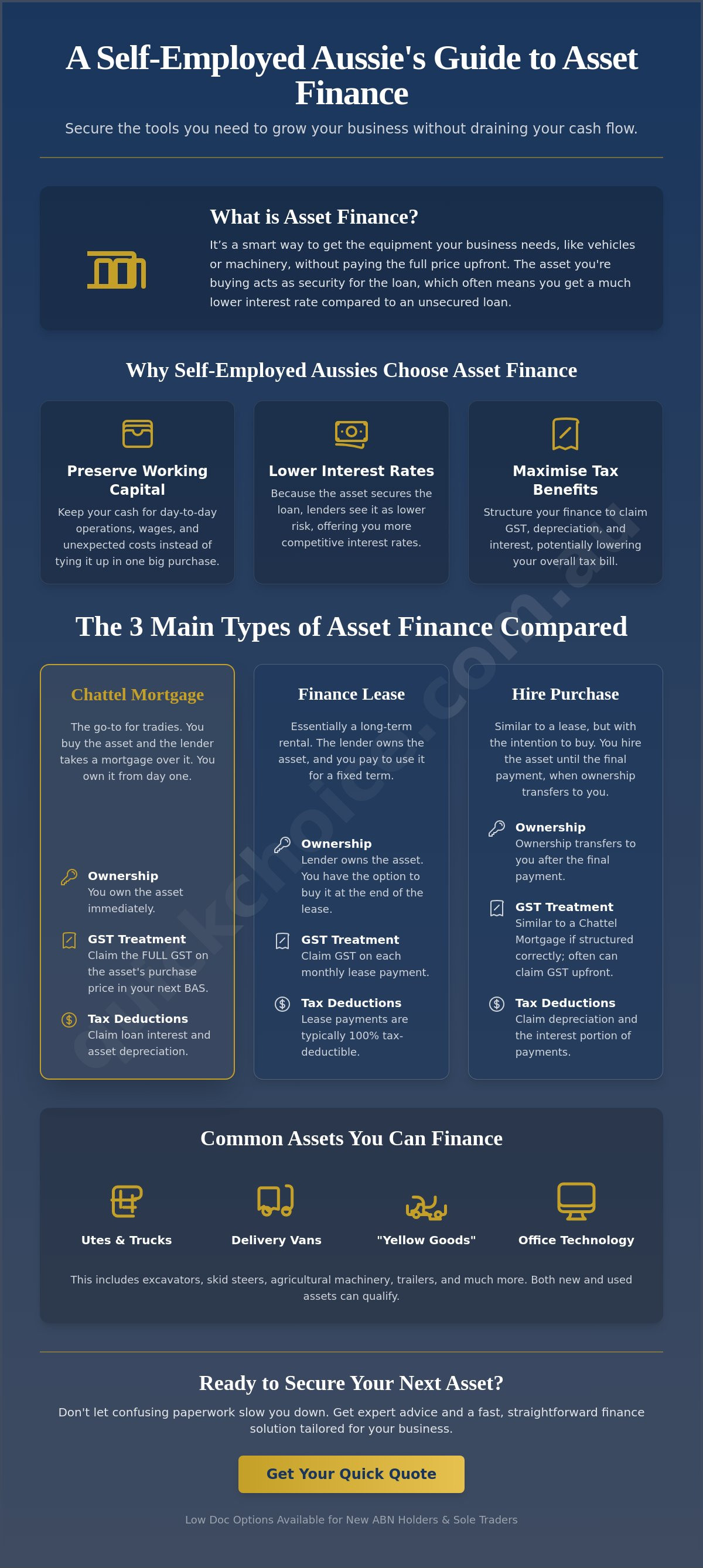
Asset finance is a practical way to acquire the physical equipment your business needs without draining your bank account. It sits as a specialised subset of commercial asset finance, focusing specifically on tangible items like vehicles, machinery, and technology. The fundamental principle is simple: the asset you're purchasing serves as the primary security for the loan. By using the equipment as collateral, you provide the lender with a safety net, which often results in significantly lower interest rates compared to unsecured business loans.
To understand the technical side, you can look at the broader definition of What is Asset Finance and how it functions as a form of secured lending. For a business owner, this means you aren't just borrowing money; you're using your purchasing power to secure a tool that generates income. It allows you to keep your "cash under the mattress" for day-to-day operational expenses, emergency repairs, or unexpected opportunities. Because there are several types of asset finance available, you can choose a structure that matches your current business stage and long-term goals.
Why Self-Employed Aussies Choose Asset Finance
For sub-contractors working in booming growth corridors like Tarneit, maintaining liquidity is vital. You can't afford to tie up every cent in a single piece of machinery when you have invoices to pay and materials to buy. Asset finance provides a buffer. It offers the flexibility to tailor repayments to your specific situation, whether that involves seasonal adjustments for quieter months or a balloon payment at the end to keep monthly costs low. It's also important to recognise that these are not standard consumer car loans. Commercial finance is built for business logic, offering different tax treatments and lending criteria that cater specifically to those with an ABN.
Common Assets You Can Finance in 2026
The range of equipment you can fund is extensive. In 2026, we see a high demand for work-ready utes, delivery vans, and heavy-duty trucks. For those operating in Rockbank and Melton, "yellow goods" such as excavators, skid steers, and agricultural machinery are frequently financed to keep up with local infrastructure projects. You aren't limited to brand-new gear, either. Most types of asset finance apply to used assets as well, provided they meet the lender's age and condition requirements. From specialised office technology to the trailer behind your rig, if it helps your business earn, it's likely something you can finance.
The 3 Main Types of Asset Finance in Australia
Choosing between the various types of asset finance is a strategic decision that affects your tax returns and your monthly cash flow. In Australia, the "Big Three" options are Chattel Mortgages, Finance Leases, and Hire Purchases. Think of these as different financial tools; one might help you maximise an immediate tax break, while another keeps your monthly repayments lower to protect your working capital. The right choice often depends on whether you report GST on a cash or accruals basis and how your accountant prefers to manage your balance sheet.
Chattel Mortgage: The Tradie’s Favourite
The Chattel Mortgage is the go-to option for most Australian contractors and small business owners. Under this structure, you take ownership of the asset immediately. The lender secures the loan by taking a mortgage over the chattel, which is the industry term for the equipment or vehicle. This ownership status is a significant advantage because it allows you to claim the full GST amount on the purchase price in your very next Business Activity Statement (BAS). For a A$60,000 ute, that's a substantial cash injection back into your business quite quickly. Additionally, you can claim both the interest on the loan and the asset's depreciation as tax deductions.
Finance Lease: Flexibility Without Ownership
A Finance Lease works differently because the lender retains ownership of the asset throughout the term. You essentially rent the equipment from them for a fixed period. This structure is excellent for businesses that want to upgrade their gear regularly without the hassle of selling old equipment. At the end of the term, you'll have a residual value to deal with. This is a pre-determined lump sum that reflects the asset's value at that time. You can pay the residual to keep the asset, or you can trade it in and start a new lease on a newer model. When Comparing Asset Finance Options, many professionals prefer this because the lease payments are usually 100% tax-deductible as a business expense.
Commercial Hire Purchase (CHP)
Commercial Hire Purchase was once the standard, but it's become less common over the last decade. In a CHP agreement, the lender buys the asset and you hire it from them for a set term. You only gain legal ownership after the final instalment is paid. The decline in CHP popularity stems from GST law changes in 2012, which made the tax treatment less favourable for many businesses compared to a Chattel Mortgage. While it still serves a purpose for specific niche accounting requirements, most modern businesses find more value elsewhere. If you're ready to see how these structures apply to your specific situation, looking into asset finance for self-employed operators is a great next step.
Comparing Asset Finance Options: Tax, Ownership, and GST
Deciding between the various types of asset finance often comes down to how you want your balance sheet to look at the end of the financial year. Accountants generally categorise these options into "On-Balance Sheet" and "Off-Balance Sheet" financing. A Chattel Mortgage is an on-balance sheet structure because you own the asset from day one; it appears as both a business asset and a corresponding liability. In contrast, a Finance Lease is traditionally viewed as off-balance sheet because the lender retains ownership, and your payments are treated as an operating expense. Understanding this distinction is vital for managing your debt-to-equity ratio and overall borrowing capacity.
The most frequent question we hear is, "Which option gives me the biggest tax break right now?" For many small businesses in 2026, the answer lies in the instant asset write-off. Currently, the Australian Government allows an immediate deduction for the full cost of eligible assets costing less than A$20,000. This threshold is in effect until 30 June 2026. If you purchase a piece of equipment using a Chattel Mortgage, you can often claim this deduction immediately. However, if the asset exceeds this price or if you choose a lease, the tax benefits are spread out differently. Because every business has a unique financial footprint, you should consult the Australian Government's guide to business funding options and speak with your tax professional before signing a contract.
Ownership vs. Usage Rights
Ownership is a powerful motivator for sub-contractors. When you use a Chattel Mortgage, you're building equity in a piece of machinery that eventually becomes a debt-free asset for your business. This is often the preferred route for those who plan to keep their equipment for a long time. On the other hand, a Finance Lease focuses on usage rights. It's ideal if you prefer to rotate your fleet every three to five years to avoid high maintenance costs. It's also worth noting that a Novated Lease is a different vehicle altogether; that structure is specifically for employees wanting to package a car through their salary, rather than a business-led purchase for operational gear.
GST and Depreciation Breakdown
The timing of your GST claims can significantly impact your quarterly cash flow. With a Chattel Mortgage, you're usually entitled to claim the full GST amount on the purchase price upfront in your next BAS. This can provide a much-needed cash injection. Conversely, with a Finance Lease, GST is charged on each monthly repayment, spreading the credit over the life of the lease. Depreciation also plays a role. Depreciation is the process of reducing your taxable income by allocating the cost of a physical asset over its useful life. Mastering asset finance for self employed requires a solid grasp of these nuances to ensure you aren't leaving money on the table. Different types of asset finance offer different paths to the same goal: growing your business while staying tax-efficient.
Specialised Finance for Sole Traders and New ABN Holders
Traditional banks often close their doors to self-employed Aussies who don't have a mountain of paperwork ready. If you're a subbie in Aintree or Caroline Springs, you know that your bank balance doesn't always tell the whole story of your business success. Specialised types of asset finance like "Low Doc" and "No Doc" loans are designed to bridge this gap. Instead of demanding two years of full tax returns, these lenders focus on your credit history and the length of time you've held an active ABN. There's also a common myth that you need a 20% deposit to even be considered; in reality, many specialised products allow for much lower entry points, helping you get on the road sooner.
The goal of these products is to provide a streamlined path to growth. Lenders in this space understand that a sole trader's time is better spent on the tools than chasing down historical financial statements. By looking at alternative data points, they can offer competitive rates that were once reserved for large corporations. This approach transforms a potentially stressful application into a straightforward transaction, allowing you to secure the equipment that will actually help you pay for the loan itself.
Low Doc Equipment Finance
Lenders providing Low Doc options typically look for an active ABN that has been running for at least 12 to 24 months. You'll need a clean credit score, but the primary benefit is the "Self-Declared Income" model. This means you provide a statement of what you earn rather than waiting for your accountant to finalise your latest returns. If you've had some financial speed bumps in the past, you can still find a way forward by reading about bad credit equipment finance self employed. These products are built to be flexible because your business isn't a cookie-cutter operation.
New ABN and Startup Options
Securing funding when your ABN is less than six months old is undeniably harder, but it isn't impossible. Standard types of asset finance might be out of reach for a brand-new entity, but alternative structures like "Rent-to-Own" or non-conforming startup lenders can provide a lifeline. These lenders take a broader view of your experience in your trade rather than just your time as a business owner. Navigating these niche markets requires a specialist broker who knows which lenders are actually active in the startup space and which ones offer the best terms for new ventures. If you're ready to secure your next piece of gear, you can apply for asset finance for self employed today.
How to Organise the Right Asset Finance for Your Business
Organising the right funding doesn't have to be a source of stress. Once you've identified the equipment that will drive your business forward, the next step is matching that need with the correct financial structure. Your 2026 business plan should dictate which of the types of asset finance you select, ensuring that your repayments remain manageable while you scale. Whether you’re eyeing a new fleet of utes or a heavy-duty excavator, the goal is to move from the showroom to the worksite as efficiently as possible.
Attempting to compare every lender on your own is a full-time job. A specialist broker acts as your advocate, scanning a panel of over 30 lenders to find the lowest rates and most favourable terms for your specific profile. This takes the uncertainty out of the equation and prevents you from making multiple applications that could negatively impact your credit score. We focus on the heavy lifting so you can stay focused on your clients.
Step-by-Step Application Process
Securing your finance follows a logical, steady path designed to save you time. We've refined the process into four clear stages:
- Step 1: Get a quote. Identify the asset you need from a dealer or a private seller and get a formal quote. This includes everything from work vans to specialised machinery.
- Step 2: Gather your information. For most self-employed professionals, we only need your active ABN, photo ID, and recent bank statements if we're pursuing a Low Doc path.
- Step 3: Broker comparison and submission. We compare the available types of asset finance across our lender panel and submit the application to the one that fits your business profile.
- Step 4: Approval and settlement. Once approved, the lender pays the supplier directly. You can usually pick up your new asset within days of the initial application.
Why Quick Choice is the Smart Move
We pride ourselves on being a "Reliable Specialist Guide" for business owners across Melbourne’s western suburbs. Our team understands the local landscape because we're part of it. Whether you're based in Truganina, Hoppers Crossing, or Laverton, we offer a personalised service that big banks simply can't match. We don't just see a set of numbers; we see a local business looking to grow. If you're ready to take the next step, you can get a quick quote on your business asset finance today and see how we can support your success.
Drive Your Business Forward with Confidence
Securing the right equipment is the catalyst for your next stage of growth. By understanding the different types of asset finance, you can make a choice that protects your cash flow today while building a stronger balance sheet for tomorrow. Whether you need the immediate ownership benefits of a Chattel Mortgage or the streamlined flexibility of a Lease, your decision should always align with your specific tax strategy and operational needs.
You don't have to navigate these complex financial structures alone. As specialists in Low Doc finance for ABN holders, we provide access to over 30 leading Australian lenders. We take pride in serving our local community in Melbourne’s west, from Werribee across to Melton, ensuring that independent professionals get the support they deserve. We do the heavy lifting so you can stay focused on the work that matters most to your clients.
Ready to upgrade your gear? Talk to a Quick Choice specialist about your asset finance options and get a tailored solution that fits your business profile. Your next piece of machinery is closer than you think.
Frequently Asked Questions
What is the most common type of asset finance for tradies?
The Chattel Mortgage is the most popular choice for Australian tradies because it offers immediate ownership and significant upfront tax advantages. This structure allows you to claim the full GST on the purchase price in your very next Business Activity Statement (BAS). It's a straightforward way to put a new ute or tool to work while keeping your tax situation clear and simple.
Can I get asset finance if I have only just started my ABN?
Yes, you can secure funding even if your ABN is brand new, though your options will differ from established businesses. While major banks often require two years of trading history, specialised lenders offer startup products for new ventures. You might need to provide a larger deposit or demonstrate significant industry experience in your trade to offset the lack of long-term trading history.
Is a Chattel Mortgage better than a Finance Lease for tax?
A Chattel Mortgage generally allows for an upfront GST claim and depreciation deductions, whereas a Finance Lease spreads the tax benefits across the life of the agreement. The "better" option depends entirely on whether you want an immediate tax impact or a steady deduction over several years. Your accountant can help you decide which of these types of asset finance supports your specific cash flow goals for the 2026 financial year.
Do I need a deposit for business equipment finance?
You don't always need a deposit for business equipment finance, as many lenders offer 100% finance to eligible ABN holders. This allows you to keep your working capital intact for other operational costs like materials or wages. However, providing a deposit can sometimes help you secure a lower interest rate or gain approval if you have a shorter trading history or a complex credit profile.
Can I buy equipment from a private seller using asset finance?
You can certainly purchase equipment from a private seller, provided the asset meets the lender's condition and age requirements. The process usually involves an independent valuation or inspection to ensure the asset's value matches the loan amount. Your broker will coordinate the paperwork and ensure the funds are securely transferred to the seller once the title is cleared and the asset is verified.
What documents do I need for a Low Doc asset loan?
Low Doc applications typically require your ABN, a valid driver's licence, and recent bank statements to verify your business turnover. You won't need to provide full tax returns or profit and loss statements, which makes the approval process much faster. This streamlined approach is ideal for self-employed professionals who are up to date with their BAS but haven't finalised their annual tax filings yet.
How does the instant asset write-off work with a Chattel Mortgage?
A Chattel Mortgage is perfectly suited for the instant asset write-off because you take legal ownership of the asset at the time of purchase. For eligible assets under the A$20,000 threshold until 30 June 2026, you can claim the full deduction in that financial year. This provides a significant reduction in taxable income for businesses looking to upgrade their equipment before the current threshold expires.
Can I pay off my asset finance early?
Most types of asset finance allow for early repayment, though the terms and fees vary between different lenders. Some contracts include a small early termination fee, while others may calculate the remaining interest differently. It's always wise to check the "payout" conditions before signing to ensure you have the flexibility to clear the debt early if your business has a profitable quarter.


