
What if the biggest hurdle to growing your business isn't your actual income, but simply not knowing where you stand before you hit 'submit'? Many self-employed Australians hesitate to apply for funding because they fear a rejected application will leave a lasting mark on their credit file. Using an asset finance eligibility checker allows you to move away from guesswork and toward a strategy built on clarity. You deserve to understand your borrowing power without the stress of traditional bank hurdles or the immediate need for two years of tax returns.
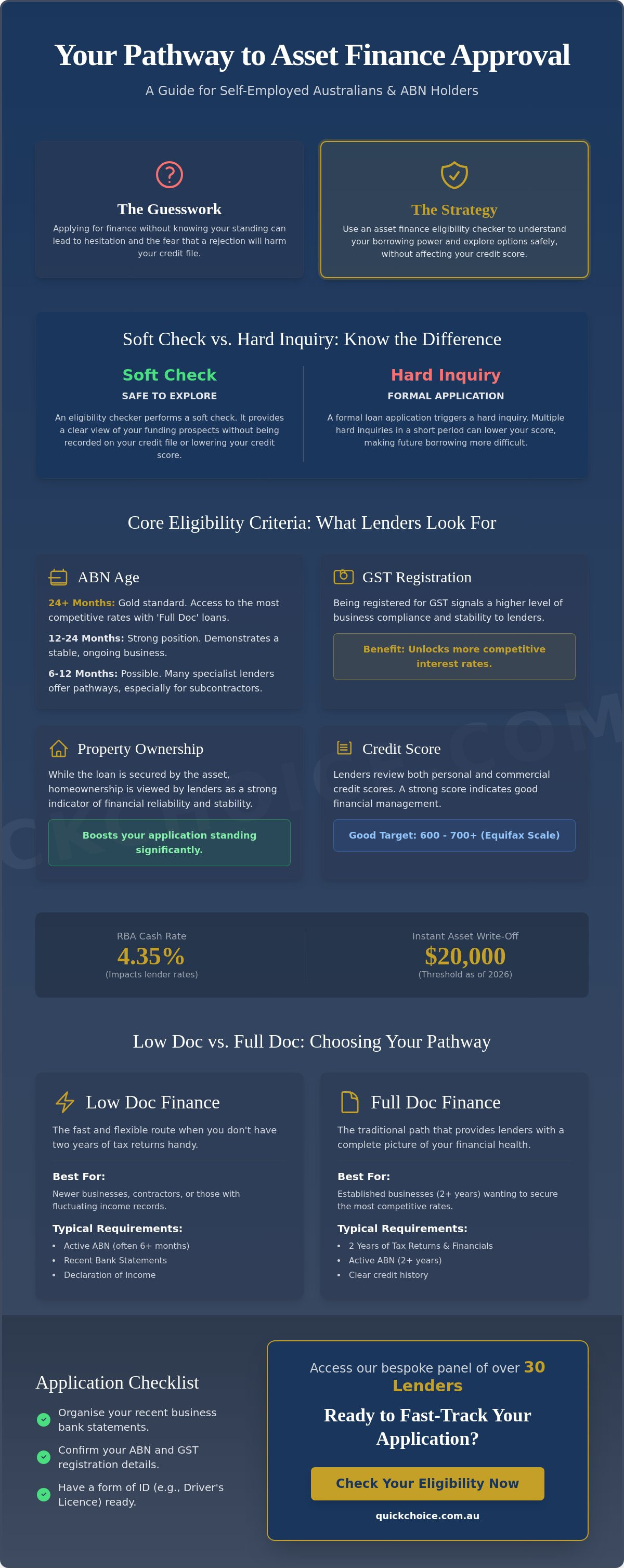
It's understandable to feel overwhelmed by the choice between "Low Doc" and "Full Doc" pathways, especially when your income doesn't always follow a straight line. We recognise that for independent professionals, securing equipment quickly is vital for maintaining momentum. This guide breaks down exactly what Australian lenders are looking for in 2026, from the impact of the 4.35% cash rate to the $20,000 instant asset write-off threshold. You'll gain a clear pathway to approval that focuses on your current potential, helping you access the machinery or vehicles you need with confidence.
Key Takeaways
- Understand how an asset finance eligibility checker allows you to explore your funding options safely without triggering a hard credit pull.
- Identify the specific ABN and GST milestones that Australian lenders look for when offering their most competitive interest rates.
- Compare Low Doc and Full Doc pathways to find the most efficient route to approval based on your available financial records.
- Access a practical checklist to help you organise your bank statements and prepare your business for a successful application.
- Learn how a specialist guide can connect you with a bespoke panel of over 30 lenders that understand the unique needs of self-employed professionals.
What is an Asset Finance Eligibility Checker and Why Use One?
An asset finance eligibility checker is a specialised tool designed to give you a clear view of your funding prospects before you commit to a formal application. It works by assessing your business profile against specific lender criteria without leaving a mark on your credit report. In the current economic climate, where the RBA cash rate sits at 4.35%, lenders have become more selective. Using a checker ensures you don't waste time on products that aren't a fit for your specific industry or equipment needs.
Lender appetite refers to the types of risks a bank or non-bank lender is willing to take at any given time. This fluctuates based on the broader economy and the lender's own internal portfolio targets. By understanding the fundamentals of Asset-based lending, you can see how your equipment serves as the primary security. This makes the checker's role even more vital, as it matches your specific asset to the right financier's current preferences.
The Difference Between a Soft Check and a Hard Inquiry
When you use an asset finance eligibility checker, you're usually undergoing a "soft check." This process allows you to see potential outcomes without impacting your credit score. In contrast, every hard inquiry from a formal application can lower your score, making future borrowing more expensive or difficult. Quick Choice prioritises your credit health by ensuring you only move forward when the data suggests a high probability of success. This allows you to explore various types of asset finance with total peace of mind.
Why "Self-Employed" Eligibility Differs from PAYG
Lenders view ABN holders through a different lens than standard employees. While a PAYG worker relies on a steady salary, your income might fluctuate based on project cycles or seasonal demand. Lenders look at your business age and GST status as primary indicators of stability. Achieving asset finance for self employed professionals often requires demonstrating that your business is a going concern, typically through at least 12 months of active ABN registration. The checker helps bridge this gap by highlighting which lenders value your specific industry experience over traditional payslips.
Core Eligibility Criteria for Australian Sole Traders and ABN Holders
Eligibility for commercial funding isn't a one-size-fits-all calculation. Australian lenders look for specific markers that indicate your business is stable and ready for growth. While every financier has different "appetites," certain core criteria remain consistent across the board. Using an asset finance eligibility checker helps you see how these factors align with your current business profile before you talk to a bank.
Lenders generally prioritise businesses with an active ABN registered for at least 12 to 24 months. This timeframe demonstrates that you've moved past the initial startup phase. If you're registered for GST, you often gain access to more competitive interest rates, as it signals a higher level of professional compliance. Beyond these basics, being a property owner can significantly boost your standing; even though the loan is secured by the equipment, lenders view homeownership as a sign of financial reliability. When exploring business funding options, it's vital to know which of these boxes you currently tick.
The "ABN Age" Factor
While 24 months is the gold standard for "Full Doc" loans, don't be discouraged if your ABN is newer. Many specialised lenders offer pathways for those with 6 to 12 months of trading history, especially for sub-contractors with strong industry experience. For those with a very fresh ABN, some financiers may still provide funding if you can demonstrate a clear contract for work or significant industry background. If you're unsure where you sit, checking your options with a specialist can clarify your path forward.
Credit Scores and Commercial Finance
Your commercial credit score is separate from your personal one, though lenders will often look at both. A "good" score for equipment finance typically starts around 600 to 700 on the Equifax scale. If your history isn't perfect, there are still viable bad credit equipment finance self employed pathways available. These often focus more on your current bank statements and the value of the asset rather than past slip-ups. We recommend checking your credit report through providers like Equifax or Experian to ensure there are no errors before you start the process.
The asset itself also plays a major role. Lenders prefer "primary" assets like trucks, excavators, or standard commercial vehicles because they hold their value well. If you're looking at older equipment, typically over 10 to 12 years at the end of the term, the eligibility criteria might tighten. You might find the loan terms are shorter to match the asset's remaining useful life.
Low Doc vs Full Doc: Choosing Your Eligibility Pathway
Documentation is the primary variable that determines which lenders will work with you and what rates they'll offer. While some financiers demand a complete history of your business performance, others are happy to look at your current cash flow as proof of serviceability. An asset finance eligibility checker simplifies this choice by categorising your application based on the documents you actually have on hand, rather than what a bank wishes you had. This distinction is vital for self-employed professionals who need to move quickly without getting bogged down in administrative hurdles.
Full Doc (Full Documentation) is the traditional pathway. It requires two years of comprehensive tax returns and financial statements for both the business and the individuals involved. It's a thorough process, but it usually yields the lowest interest rates because the lender has total visibility of your financial health. Low Doc (Low Documentation) is the streamlined alternative. It's designed for Aussies who may be behind on their tax lodgements or simply prefer a faster approval. Instead of years of returns, lenders might only ask for recent bank statements, a Business Activity Statement (BAS), or a simple declaration from your accountant.
When to Choose Low Doc Finance
This pathway is a favourite for Melbourne tradies who need to replace a ute or upgrade tools to stay on schedule. If your BAS is up-to-date but your tax returns are still with the accountant, Low Doc is often the most logical choice. Some lenders even offer "No Doc" options for brand-new commercial vehicles if your ABN has been active for over two years and you're a property owner. An asset finance eligibility checker can quickly identify if you meet these specific criteria. Working with a specialised asset finance broker melbourne ensures you don't over-disclose, protecting your business privacy while still securing a competitive deal.
Full Doc: Maximising Your Borrowing Power
If you're planning to finance heavy machinery, high-value yellow goods, or a fleet of vehicles, providing the full "shoebox" of financials is often a strategic move. Full Doc applications give lenders the confidence to offer their absolute lowest rates. It demonstrates long-term stability and profitability that bank statements alone might not fully capture. The way commercial asset finance is structured depends heavily on this choice. While it requires more effort upfront to organise your records, the interest savings over a five-year term can be substantial, especially when financing assets worth over $100,000.
Preparing Your Business for Approval: A Checklist for Western Suburbs Tradies
Melbourne's West is currently a powerhouse of construction and transport activity. If you're based in Truganina, Werribee, or Melton, your business likely plays a vital role in the region's rapid expansion. Getting your paperwork sorted before using an asset finance eligibility checker ensures that when the right opportunity arrives, you're ready to strike. Lenders want to see a clear business purpose for the asset you're buying. Whether it's a new tipper for a contract in Melton or a forklift for a Truganina warehouse, proving how the equipment generates income is the fastest way to a "yes."
Cleaning up your bank statements is a practical first step. Over the three months leading up to your application, try to keep your account conduct as professional as possible. Lenders look for consistent cash flow and a lack of overdrawn fees. Small adjustments to how you manage your daily expenses can make a significant difference in how an automated system or a credit officer views your business health. Consistency in your banking habits signals that you're a reliable borrower who manages commitments with ease.
Local Industry Requirements
Owner-drivers operating out of Truganina’s logistics hub face unique eligibility nuances. Lenders often look for "work-in-hand" or a letter of intent from a major carrier to provide confidence in your future earnings. For earthmoving contractors in Tarneit or Werribee, yellow goods finance requires a focus on the asset's age and its specific role in your fleet. If you're a sub-contractor working on major Victorian infrastructure projects, having your contract details ready can help fast-track your approval. These projects provide the long-term income certainty that financiers love to see, making them more comfortable with higher loan amounts.
The "Eligibility Kit" Checklist
To hit that 24-hour approval goal, you need your "Eligibility Kit" ready to go. Having these items organised prevents back-and-forth delays that can cost you a deal on a piece of equipment. We recommend gathering these three essentials before you begin:
- Current Identification: A clear copy of your Australian Driver’s Licence or passport.
- ABN and GST Details: Verify your status on the ABN Lookup tool to ensure your registration is active and correctly reflects your GST status.
- Bank Statements: Usually the most recent three to six months of your primary business transaction account in digital format.
Try to keep your personal and business expenses somewhat separated. While it's common for sole traders to mix accounts, a cleaner business statement makes it much easier for a lender to verify your true surplus. Once you have these basics in place, you can start your application with Quick Choice to see exactly where you stand and which lenders are ready to support your growth.
Fast-Track Your Application with Quick Choice Asset Finance Specialists
Finding the right funding shouldn't feel like a second job. Once you've used an asset finance eligibility checker to understand your baseline, the next step is moving from theory to reality. Quick Choice acts as your reliable specialist guide, navigating the complex maze of lender requirements so you don't have to. We provide access to a bespoke panel of over 30 lenders. Many of these financiers specialise specifically in supporting self-employed Australians. This variety is crucial. It means we can match your business profile with a financier who actually values your industry and equipment choice.
Our process focuses on speed and clarity. In industries like transport or construction, a delay of a few days can mean a missed contract. We recognise that. That's why we aim to move from your initial asset finance eligibility checker results to final settlement in as little as 48 hours. We handle the heavy lifting. From the initial document review to communicating with the lender, we ensure you stay focused on running your business while we secure the resources you need to grow.
Why a Broker Beats a Bank for Eligibility
Banks often rely on rigid, automated policies that don't account for the nuances of small business ownership. If you don't fit their exact mould, you're often met with a quick rejection. Quick Choice takes a different approach. We look for a "fit" by understanding how your cash flow actually works as a sole trader. We translate your financial story into a language that lenders understand. This removes the stress of jargon and complex paperwork. Our commitment is to provide a supportive, professional experience where you feel like a partner, not just a file number. We value your time and your ambition.
Ready to Check Your Eligibility?
If you're operating anywhere from Laverton to Melton, we're here to help you secure the assets that will drive your business forward. Whether you're ready to buy today or just want a personalised assessment of your borrowing power, a quick conversation provides the clarity you need. We offer a professional, no-obligation environment where your goals are the priority. There's no need to wonder about your prospects. You can have a clear answer within hours. Get started with Quick Choice today and take the next step toward your business goals with confidence.
Take the Next Step Toward Your Business Growth in 2026
Securing the machinery or vehicles you need doesn't have to be a stressful ordeal. By understanding the core criteria for ABN holders and choosing the right documentation pathway, you can navigate the current economic environment with confidence. Your credit health is a priority; using an asset finance eligibility checker allows you to explore your options without the risk of unnecessary hard inquiries on your file. Preparation remains your best tool for securing a fast approval that keeps your business moving.
Whether you're a transport operator in Truganina or a construction contractor in Melton, the right funding strategy bridges the gap between your current capacity and your future goals. Quick Choice specialises in asset finance for self-employed professionals, providing access to a panel of over 30 Australian lenders. Our local experts understand the unique cash flow of sole traders and are dedicated to finding a bespoke fit for your business. We take pride in removing the obstacles that traditional banks often put in your way.
Don't let uncertainty hold your business back. Check Your Asset Finance Eligibility with Quick Choice today and discover exactly what you can achieve with a reliable specialist by your side. We're ready to help you move forward.
Frequently Asked Questions
Can I get asset finance if I have only had my ABN for 6 months?
You can certainly secure funding with a six-month ABN through specialised lenders. While major banks often require a two-year trading history, niche financiers look at your previous experience in the industry and the strength of your current contracts. Having a larger deposit or being a property owner can also help offset the risk of a newer business registration. We focus on finding lenders who value your actual work history over the age of your current ABN.
What is the minimum credit score required for business equipment finance?
There isn't a single "magic number" because lenders weigh your score against other factors like bank statements and asset type. Generally, a score above 600 on the Equifax scale is considered a strong starting point for competitive rates. If your score is lower, we can explore lenders who prioritise your current cash flow and the value of the equipment over past credit events. This approach ensures that a few old slip-ups don't stop your business from growing today.
Do I need to be a property owner to be eligible for asset finance?
You don't need to own property to qualify for equipment funding. Many successful applications come from renters who demonstrate strong business turnover and consistent banking habits. However, being a homeowner often unlocks lower interest rates and higher borrowing limits because it signals long-term financial stability to the lender's credit team. It acts as an additional layer of security that can make a "Low Doc" application even smoother.
How does an eligibility checker affect my credit rating?
A professional asset finance eligibility checker uses a "soft pull" method that has no impact on your credit score. This allows you to see which lenders are likely to approve your application without the risk of multiple hard inquiries lowering your rating. It's a safe way to compare options and protect your financial reputation while you plan your next equipment purchase. You get the clarity you need without the fear of damaging your borrowing power.
Can I qualify for finance if I have outstanding tax debt with the ATO?
You can still qualify for finance even with an ATO debt, provided you have a formal payment plan in place. Lenders want to see that you are managing your obligations responsibly rather than ignoring them. We recommend having your most recent ATO portal statements ready to show that you're meeting your agreed repayments on time. Demonstrating this compliance can satisfy a lender's concerns about your business's overall financial health.
What types of assets can I finance as a self-employed contractor?
You can finance a wide range of income-producing equipment, including commercial vehicles, excavators, forklifts, and specialised tools. Lenders generally prefer "primary" assets that are easily identifiable and hold their resale value well. If you're looking at "secondary" or niche assets, the criteria might be slightly stricter regarding the asset's age and your business's trading history. We help you identify which lenders have the strongest appetite for your specific type of machinery.
Is GST registration mandatory for asset finance eligibility?
GST registration isn't strictly mandatory for all loans, but it is a common requirement for the most competitive Low Doc pathways. Being registered for GST suggests a certain level of business turnover and professional compliance, which gives lenders more confidence. If you aren't registered, you might still qualify for Full Doc options where you provide complete tax returns to prove your income. We can guide you on which pathway fits your current registration status.
How much can I borrow based on my business turnover?
Lenders typically look for your monthly repayments to be a manageable percentage of your gross monthly income. While there's no fixed ratio, most financiers want to see that your business generates enough surplus cash to cover the new loan alongside your existing overheads. The value of the asset also acts as a natural cap on the borrowing amount. We work with you to determine a borrowing level that supports your growth without overstretching your cash flow.


