What if the secret to winning that next major civil contract in Melbourne isn't just your skill on the tools, but how you've structured your earthmoving equipment finance? Many self-employed contractors find themselves stuck in a cycle of bank rejections and complex "low doc" applications that don't account for the realities of sub-contracting. It's frustrating when you have the work lined up but can't get the gear to do it because your tax returns aren't ready. We understand that your business doesn't always fit into a neat corporate box, and your finance shouldn't either.
This 2026 guide will help you master the complexities of machinery lending so you can secure the digger or grader you need with confidence. You'll learn how to leverage the $20,000 instant asset write-off before the June 30 deadline and why a chattel mortgage could be the most tax-effective move for your cash flow. We'll also walk through the latest low doc options and specialized structures that allow you to grow your fleet without the usual paperwork headaches.
Key Takeaways
- Learn how to treat earthmoving equipment finance as a strategic business tool that supports your cash flow through the seasonal highs and lows of the civil sector.
- Compare the benefits of chattel mortgages against finance leases to ensure your gear is structured for maximum tax efficiency and balance sheet protection.
- Uncover the requirements for low doc and no doc applications, allowing established ABN holders to bypass the paperwork headache of traditional bank loans.
- Master the five essential checks for any finance contract, including how to calculate the effective interest rate and setting a realistic balloon payment for your machine.
- Discover why local knowledge of Western Melbourne’s growth corridors is vital for securing the right gear for major projects in Melton, Werribee, and beyond.
Navigating Earthmoving Equipment Finance for Self-Employed Contractors
Think of your machinery as more than just steel and hydraulics. It is the engine that drives your revenue. Earthmoving equipment finance isn't just another debt to manage; it's a specialised business tool designed to put you in the driver's seat of your own growth. Unlike a standard personal loan, this type of funding focuses on the productivity of the asset itself. It allows you to acquire the latest technology without draining your working capital, which is vital for maintaining a healthy business.
Traditional banks often struggle to understand the "lumpy" nature of a civil contractor's cash flow. You might have a massive month followed by a quiet spell while you're waiting for the next tender to start. Standard bank algorithms often see this volatility as a risk. Specialist lenders take a different view. They understand that a contractor isn't a risky bet; they're an essential part of the Australian infrastructure landscape. By using the machinery as security, you can often access better terms through asset-backed lending. This means the machine itself provides the collateral, often removing the need to use your family home as security.
Matching your loan term to the expected working life of your Heavy equipment is a critical step. You don't want to be stuck with repayments on a seven-year term for a machine that will likely be traded in after five years of hard work. A well-structured plan ensures your repayments align with the machine's most productive years, keeping your fleet modern and your maintenance costs low.
Why General Business Loans Often Fall Short
Unsecured business loans might seem convenient, but they often come with significant drawbacks for high-value assets. For excavators or skid steers, the interest rates on a general line of credit are usually much higher than equipment-specific finance. Because the machine acts as security, lenders can offer more competitive rates. Being self-employed requires a different underwriting approach. You need a lender who values your industry experience and bank statements over a simple "computer says no" credit score assessment.
The Role of a Specialist Broker in 2026
Walking into a local bank branch limits you to one set of products. A specialist broker gives you access to a wide panel of lenders who actually want to fund the civil sector. They act as a single point of contact who understands the difference between dry hire and wet hire contracts. This expertise is especially vital when looking for asset finance for self employed operators who need a bespoke solution rather than a generic bank product. They handle the negotiation, so you can stay focused on the job site.
Choosing the Right Finance Structure: Chattel Mortgages vs. Leasing
Selecting the right framework for your earthmoving equipment finance is just as important as choosing the right excavator for the job. The way you structure your funding impacts your tax obligations, your balance sheet, and your monthly cash flow. Understanding the nuances of equipment financing and leasing helps you avoid costly mistakes that could hinder your business growth. In the 2026 market, three main options dominate the landscape for self-employed contractors: Chattel Mortgages, Finance Leases, and Hire Purchase agreements.
Each structure handles Goods and Services Tax (GST) differently. For some, claiming the GST upfront provides a much-needed cash injection. For others, spreading the tax cost over the life of the loan is more manageable. Your choice should align with your business's accounting method and your long-term goals for the machinery.
Chattel Mortgage: The Tradie’s Favourite
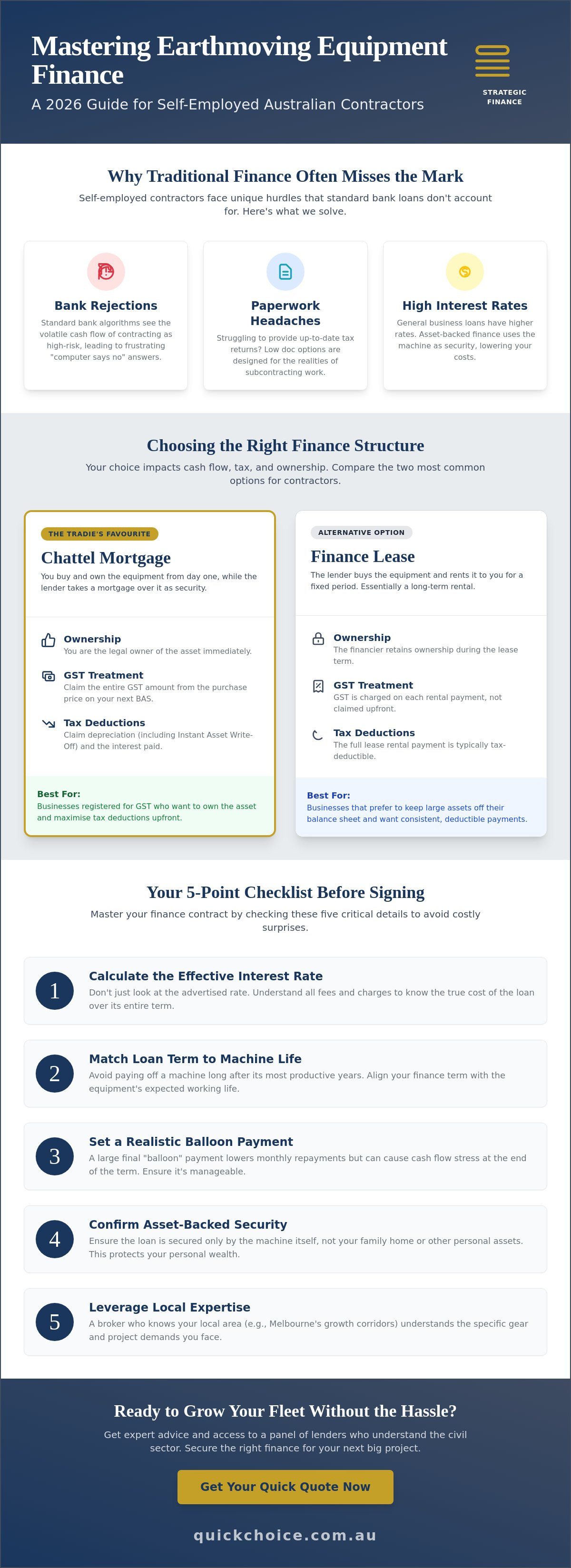
For the majority of ABN holders in the civil sector, the Chattel Mortgage remains the most popular choice. Under this arrangement, you take ownership of the equipment from the moment of purchase. While the lender holds a mortgage over the asset until the final payment is made, you enjoy the benefits of ownership, including depreciation and interest deductions. This structure is particularly effective for those looking to utilise the $20,000 instant asset write-off available for the 2025-2026 financial year. By owning the asset, you can typically claim the full GST component of the purchase price in your very next Business Activity Statement (BAS), providing a significant boost to your working capital.
Operating Leases and Rental Options
Ownership isn't always the best path for every contractor. If you’ve secured a short-term contract that requires a specialised machine you don't intend to keep long-term, an operating lease or rental option might be more suitable. These structures often keep the asset off your balance sheet, which can be beneficial for certain tax strategies. You pay to use the equipment rather than to own it, giving you the flexibility to hand the gear back at the end of the term. This reduces the risk of being stuck with an outdated machine or one that no longer fits your project pipeline. While the total cost of ownership might be higher over time, the ability to constantly upgrade to the latest technology can give you a competitive edge on site.
Commercial Hire Purchase is another alternative, though its popularity has shifted as tax laws have evolved. It involves the lender buying the equipment and "hiring" it to you over a set period, with ownership transferring only after the final payment. If you’re unsure which path fits your current contract, talking to a specialist in asset finance for self employed operators can clarify your options and help you build a more resilient business.
Low Doc Options: Securing Machinery Without the Paperwork Headache
Low Doc earthmoving equipment finance is a specialised solution designed for contractors who don't have up-to-date tax returns or full financial statements ready for a bank's scrutiny. It isn't a "second-rate" loan; rather, it is a recognition of how the modern civil sector operates. In 2026, lenders have moved away from relying solely on historical data. They now prioritise real-time performance, looking at your Business Activity Statements (BAS) and bank statements to verify your ability to manage repayments. This shift allows you to secure gear based on what your business is doing right now, not what it did eighteen months ago.
A common hurdle for many sub-contractors is the "No Doc" threshold. If you have been an established ABN holder for several years with a clean credit history, you might qualify for finance without providing any income evidence at all. Industry data from the Equipment Leasing & Finance Association highlights the massive scale of machinery funding globally, and Australian lenders have adapted by offering these streamlined paths to keep the local construction industry moving. If you're asking, "Can I get finance if my 2025 tax return isn't lodged?" the answer is often a resounding yes, provided you can show consistent turnover through your recent bank records.
Qualifying for Low Doc Machinery Loans
To qualify for these streamlined products, most lenders look for a few specific markers. You generally need an active ABN for at least 12 to 24 months and a current GST registration. While not always mandatory, being "asset-backed" makes a significant difference. Statistics show that approximately 75% of equipment finance applicants are homeowners, and these borrowers typically access higher loan amounts, often doubling the capacity of non-homeowners. If you're a sub-contractor, providing a "Letter of Intent" or a signed contract from a major builder can further strengthen your case, proving that the machine will be earning income from day one.
New ABN and Startup Earthmoving Finance
Starting a new earthmoving business is a bold move, but securing finance as a startup requires a different strategy. Lenders view new ABNs as higher risk because there is no trading history to review. To get a deal across the line, you should be prepared to offer a higher deposit, often between 20% and 30%, or provide a personal guarantee. Focusing on specific, high-resale assets can also help. For those just beginning their journey, our Bobcat finance Australia guide provides a detailed roundup of how new tradies can structure their first machinery purchase to ensure long-term success.
The Earthmoving Equipment Buying Guide: 5 Things to Check Before Signing
Before you put pen to paper on your earthmoving equipment finance, you need to look past the monthly repayment figure. The fine print of a machinery contract often contains details that can either save your cash flow or cause a significant headache three years down the track. You should start by comparing the "Effective Interest Rate" against the "Base Rate". Lenders sometimes lead with a low base rate while hiding various establishment fees and monthly service charges that push the actual cost of borrowing much higher. Always ask for the total cost of the loan over the full term to see the true picture.
Flexibility is another non-negotiable for self-employed contractors. The civil sector is at the mercy of the weather; a month of heavy rain in Melbourne can bring site work to a standstill. Check if your lender offers seasonal repayment structures that allow for lower payments during traditional wet months. You should also verify if the lender allows for private sales. While many banks insist on dealer-only purchases, finding a well-maintained second-hand digger from a private seller can often save you tens of thousands of dollars. Finally, look for early termination fees. If your business grows faster than expected and you want to upgrade your fleet mid-term, you don't want to be slugged with massive penalties for paying out your loan early.
Comparing Broker Quotes vs. Dealer Finance
It is tempting to sign up for finance at the dealership while you're looking at the gear, but the "0% Interest" offers you see are often a trap. In most cases, the interest is simply "front-loaded" into an inflated purchase price of the machine. By choosing a broker-led commercial asset finance package, you maintain the power to negotiate the machine price as a cash buyer. An independent specialist can compare dozens of lenders to find the one that fits your specific ABN history and credit profile, rather than forcing you into a one-size-fits-all dealership product.
Understanding Balloon Payments
A balloon payment, or residual value, is a lump sum paid at the end of your loan term. This structure is excellent for keeping your monthly repayments low, but you must be realistic about the machine's future value. For high-hour assets like excavators that work in tough conditions, setting a balloon too high can leave you with a debt that is larger than the machine's trade-in value. When the term ends, you can choose to pay the lump sum, refinance the remaining amount, or trade the machine in. If you want to ensure your contract is built for your specific needs, get a tailored quote from our specialist team today.
Local Expertise for Western Melbourne Earthmovers
Western Melbourne is currently the engine room of Victoria's infrastructure growth. From the sprawling residential developments in Melton and Tarneit to the significant industrial expansions in Werribee, the demand for civil gear has never been higher. For self-employed contractors, being close to the action in Rockbank or Aintree means you need a finance partner who actually understands the ground you're working on. Quick Choice isn't a faceless national call centre. We are local specialists who recognise that your business is a vital part of the Western suburbs' future.
Securing earthmoving equipment finance shouldn't feel like a chore that takes you away from the site. We know the local industrial landscape and the specific pressures of the Melbourne civil sector. Whether you're a sole trader with a single excavator or a sub-contractor managing a small fleet, having a guide who knows the difference between a project in Thornhill Park and a tier-one site in the city makes the process much smoother. We focus on the practical results that keep your machinery moving and your business growing.
Supporting Contractors from Truganina to Laverton
Our reach extends across the key construction hubs of the West, including Truganina, Laverton, and Hoppers Crossing. We understand that your time is your most valuable asset. That's why we don't expect you to trek into a city office to sign paperwork. We can meet you on-site where the work is happening or at your home office in Taylors Lake or Caroline Springs. Supporting local self-employed professionals is about more than just providing a loan; it's about building a partnership that helps your business thrive in the communities where we also live and work.
Next Steps: Getting Your Gear on Site
We have streamlined our process into three simple steps to get you behind the controls faster. First, we start with a consultation to understand your contract needs and cash flow. Next, we handle the documentation, focusing on low doc options that respect your busy schedule. Finally, we move to settlement, ensuring the funds are ready when the machine is. If you already have a quote from a dealer or a bank, we encourage you to get a second opinion. We often find ways to improve the structure or lower the total cost of your earthmoving equipment finance. Organise a consultation with our Western Melbourne experts today and secure the gear you need to grow your business with confidence.
Build Your Business with Confidence
Securing the right earthmoving equipment finance is about more than just getting an approval; it's about building a foundation for your business to thrive. By choosing a structure like a chattel mortgage and utilising low doc pathways, you can protect your cash flow while keeping your fleet modern. Remember to verify those effective interest rates and balloon payments before signing, ensuring your machinery remains an asset rather than a burden.
We specialise in helping self-employed contractors across Western Melbourne navigate these choices with ease. With access to over 40 Australian lenders, we provide the specialist guidance needed to bypass bank hurdles and get your gear on-site faster. Whether you're upgrading a single skid steer or expanding your entire civil fleet, we are here to support your growth every step of the way.
Get a Tailored Earthmoving Finance Quote Today
Your next contract is waiting, and we're ready to help you win it with the right machinery behind you.
Frequently Asked Questions
Can I get earthmoving equipment finance with a new ABN?
Yes, you can secure finance with a new ABN, although lenders typically view startups as a higher risk. If your ABN has been active for less than 12 months, you might need to provide a larger deposit, often between 20% and 30%. Providing a personal guarantee or showing significant prior industry experience can also help. We specialise in finding lenders who look beyond the age of your business to the potential of your contracts.
What is the difference between a Chattel Mortgage and a Finance Lease?
Ownership is the primary difference between these two finance structures. With a chattel mortgage, you own the machine from day one, which allows you to claim GST upfront and use the instant asset write-off. In a finance lease, the lender owns the gear and you pay to use it. This keeps the asset off your balance sheet and can be a flexible choice for contractors who want to upgrade their fleet frequently.
Do I need to provide tax returns for an excavator loan?
You don't always need to provide full tax returns to secure an excavator loan. Low doc and no doc options allow established ABN holders to use bank statements or Business Activity Statements (BAS) as proof of income instead. This is particularly helpful if your 2025 tax returns aren't finalised yet. Lenders focus on your current cash flow and business turnover to ensure you can comfortably manage the repayments on your earthmoving equipment finance.
How much deposit do I need for heavy machinery finance?
Deposit requirements vary based on your business history and credit profile. For established contractors who own property, it is often possible to secure 100% finance with no deposit required. However, if you are a startup or don't own property, lenders might ask for a deposit of 10% to 20%. Providing a deposit can also help you negotiate a lower interest rate by reducing the lender's overall risk on the asset.
Can I finance used earthmoving equipment from a private seller?
Yes, financing used equipment from a private seller is possible, though it requires a few extra steps compared to a dealer purchase. Lenders will usually require an independent mechanical inspection and a valuation to confirm the machine's worth. They also perform a PPSR check to ensure the gear is free of any existing debt. This path is often a smart way for self-employed contractors to find quality machinery at a more competitive price point.
What are the current asset finance rates for 2026?
As of May 2026, commercial equipment finance interest rates generally start from around 7.49% per annum. Your specific rate will depend on factors like your credit history, how long you've been in business, and the type of machinery you're buying. Homeowners typically access more favourable rates than non-homeowners. We compare options from over 40 lenders to find the most competitive deal for your specific circumstances, ensuring the structure fits your business goals.
How long does the approval process take for equipment finance?
Most equipment finance applications reach a conditional approval stage within 24 to 48 hours. If you have your documentation ready, such as your ID and recent bank statements, the process is very efficient. Once you choose a lender and sign the offer, settlement can often occur within a few business days. This speed is vital for contractors who need to get gear on-site quickly to start a new project or replace a broken machine.
Are there tax benefits to financing my earthmoving gear?
Financing your gear offers significant tax advantages, especially when using a chattel mortgage structure. You can generally claim the interest component of your repayments and the depreciation of the machine as tax deductions. For the 2025-2026 financial year, eligible small businesses can also use the $20,000 instant asset write-off for assets costing less than that amount. It's always best to consult with your accountant to choose the most tax-effective structure for your ABN.


