
Is your practice's growth being held back by the very technology meant to drive it forward? With the Reserve Bank of Australia holding the cash rate at 4.35% as of May 2026, the financial pressure to upgrade diagnostic tools has never felt more significant. You likely feel the tension between wanting to offer the best patient care and the reality of high upfront costs. It's frustrating when traditional banks demand endless paperwork from sole traders, especially when your primary focus is on your patients.
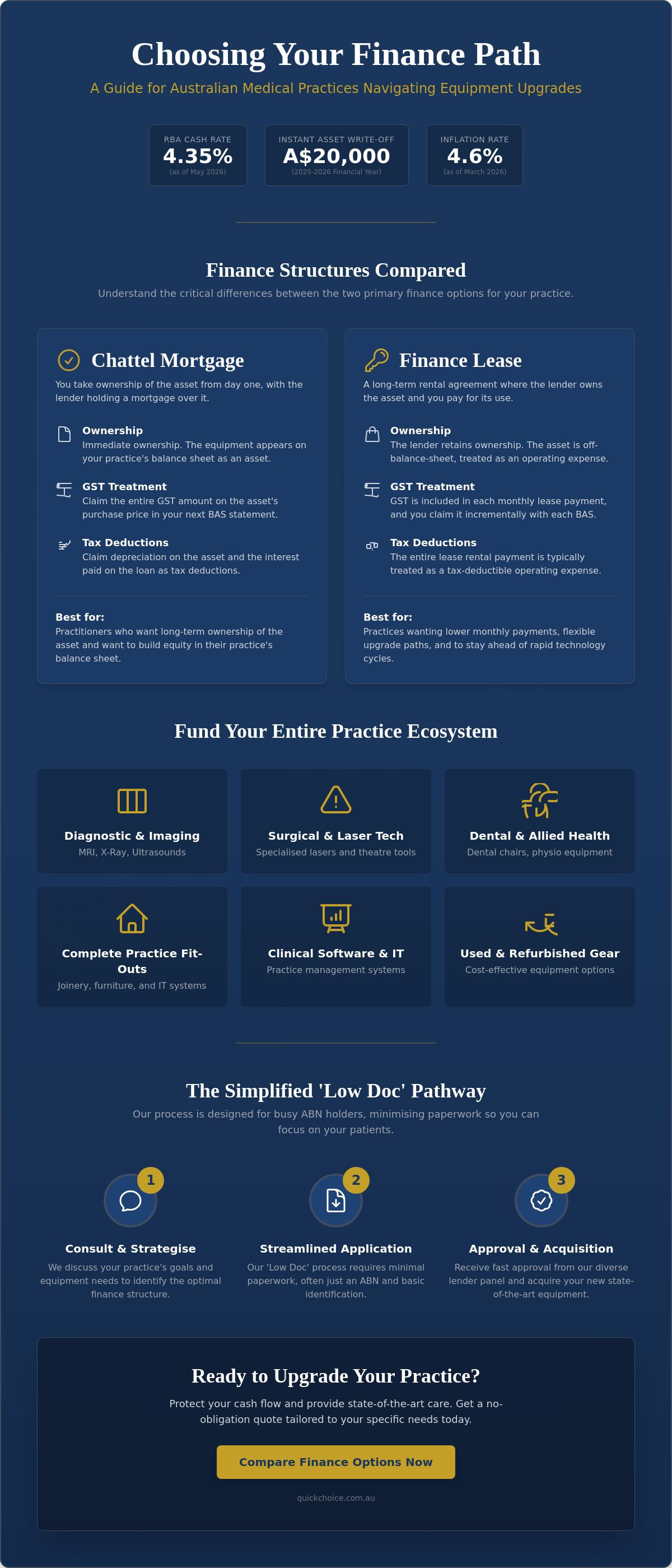
We understand that managing a private practice is a delicate balancing act of clinical excellence and business savvy. You can bridge the gap between outdated gear and modern standards by using strategic medical equipment finance to protect your cash flow. This specialist guide will show you how to capitalise on the A$20,000 instant asset write-off for the 2025-2026 financial year. We'll walk through the most effective ways to optimise your tax deductions and keep your monthly repayments manageable in an environment where inflation reached 4.6% in March 2026.
Key Takeaways
- Understand why modern practices are shifting from traditional asset ownership to flexible access models to stay ahead of rapid technology cycles.
- Compare the tax and GST implications of Chattel Mortgages versus Finance Leases to identify which structure aligns with your practice's specific financial goals.
- Explore how tailored medical equipment finance can fund your entire practice ecosystem, including clinical tools, fit-outs, and even used machinery.
- Discover the documentation requirements for ABN holders and how 'Low Doc' pathways can simplify the approval process for busy, self-employed specialists.
- Learn how a specialist broker navigates a diverse lender panel to secure more competitive, bespoke terms than a standard high-street bank.
What is Medical Equipment Finance and Why Does it Matter?
Medical equipment finance is a specialised asset funding solution designed specifically for healthcare professionals. It allows you to acquire essential tools, from high-end diagnostic imaging machines to dental chairs, without the burden of an immediate, heavy capital outlay. Instead of depleting your practice's cash reserves, you spread the cost over a set period, making the acquisition of technology a manageable monthly expense rather than a financial shock.
The Australian healthcare sector is currently witnessing a significant shift from 'ownership' to 'access'. In 2026, technology cycles are moving faster than ever. Owning a piece of equipment for ten years is no longer the goal for a progressive practice. Instead, practitioners prioritising growth focus on having access to the latest tools. This approach ensures your clinical standards remain high while avoiding the risk of owning obsolete machinery that is difficult to sell or maintain.
Patient trust is the lifeblood of any private practice. When patients walk into your clinic, they expect modern, efficient, and accurate care. Outdated equipment can subtly undermine that confidence. By utilising medical equipment finance, you ensure your practice always presents as a state-of-the-art facility. This isn't just about aesthetics; it's about providing the precise diagnostic and treatment outcomes that modern Australian patients demand.
The Core Benefits for Private Practitioners
Managing your cash flow is the most practical reason to consider financing. Large, lumpy capital outlays can cripple a practice's ability to respond to emergencies or hire new staff. By choosing a structured repayment plan, you preserve your working capital for day-to-day operations. Additionally, for the 2025-2026 financial year, small businesses with an aggregated turnover of less than A$10 million can capitalise on the A$20,000 instant asset write-off. This allows you to immediately deduct the full cost of eligible assets under that threshold, providing a significant boost to your tax position.
Flexibility is another major advantage. A finance lease or chattel mortgage provides clear upgrade paths. You don't have to wait years to save up for the next version of a laser or scanner. You simply transition into a new agreement, ensuring your practice stays at the forefront of medical innovation without a massive financial hurdle.
Common Scenarios for Finance
We see practitioners using finance in several key stages of their business journey. For example, a specialist setting up a brand-new practice in a high-growth area like Thornhill Park might use asset finance to fund the entire initial fit-out and clinical suite. This keeps their personal savings intact during the vulnerable early months of the business.
Established clinics in areas like Werribee often use finance to replace ageing diagnostic gear that has become unreliable or expensive to service. Finally, many practitioners use finance to expand their service offerings. If you want to add specialised digital imaging or a new surgical laser to your repertoire, finance allows you to start generating revenue from that new service immediately while the equipment effectively pays for itself through increased patient bookings.
Comparing Finance Structures: Leasing vs Chattel Mortgage
Selecting the right path for medical equipment finance often comes down to one fundamental question: do you want to own the asset or simply use it? While the goal is always to provide better patient care, the underlying financial structure changes how your practice manages tax, GST, and its balance sheet. Every ABN holder has a unique financial profile, so the "best" choice is rarely universal; it depends entirely on your specific cash flow needs and long term growth strategy.
The primary distinction lies in legal ownership. With a chattel mortgage, you own the equipment from the moment of purchase, while the lender secures the loan against the asset. In contrast, a finance lease functions more like a long term rental where the lender retains ownership, and you pay for the right to use the equipment. This difference dictates whether the asset sits on your balance sheet as a depreciating tool or appears as a monthly operating expense. If you're unsure which path fits your current expansion plans, you can compare tailored finance options to see the impact on your monthly budget.
GST handling is another critical area where these structures diverge. Under a chattel mortgage, you can generally claim the entire GST amount on the equipment's purchase price in your next Business Activity Statement (BAS). This provides a significant, immediate cash flow injection for practices on a cash accounting basis. With a lease, GST is charged on each individual monthly payment, spreading the tax credit over the entire term of the agreement.
Chattel Mortgage: The Choice for Ownership
A chattel mortgage is the most common structure for self employed practitioners who want to build equity in their practice. Because you own the asset from day one, you can take full advantage of the A$20,000 instant asset write-off if your practice turnover is under A$10 million. For assets exceeding this threshold, you can claim both the interest on the loan and the annual depreciation as tax deductions.
To keep monthly repayments manageable in an environment with a 4.35% cash rate, many practitioners opt for a balloon payment at the end of the term. This one off payment reduces your regular monthly overheads, allowing you to use that extra cash for staff training or practice marketing. At the end of the term, you pay the balloon amount and own the equipment outright with no further obligations.
Finance Leasing: Flexibility and Upgrades
Leasing is often the preferred route for high turnover technology that dates quickly, such as practice management servers or certain digital diagnostic software. Since you aren't committed to ownership, you avoid the risk of being stuck with obsolete gear. Lease payments are generally 100% tax deductible as an operating expense, provided the equipment is used solely for business purposes.
This structure offers ultimate flexibility when the agreement ends. You can choose to return the equipment and upgrade to the latest model; you can extend the lease; or you can offer to purchase the asset at its residual value. It's a streamlined way to ensure your clinic remains at the cutting edge of medical technology without the complexities of managing asset depreciation.
High-Tech Assets: What Equipment Can You Finance?
While many practitioners associate medical equipment finance strictly with heavy machinery like MRIs or X-ray units, modern funding solutions cover the entire practice ecosystem. You aren't limited to clinical tools alone. Whether you're acquiring a single used ultrasound or refurbishing an entire surgical suite, the right finance structure can encompass almost every physical and digital asset required to operate. This holistic approach ensures that your clinical standards and your patient experience remain equally high.
One of the most efficient strategies for busy practitioners is bundling multiple invoices from different suppliers. Instead of managing separate repayments for your dental chairs, sterilisation units, and waiting room furniture, you can consolidate these into a single monthly payment. This streamlines your bookkeeping and provides a clear view of your practice's overheads. Both brand-new and high-quality used equipment are typically eligible for finance, giving you the flexibility to choose the best value for your specific clinical needs.
Clinical and Diagnostic Technology
High-precision diagnostic gear is often the largest investment a clinic will make. This category includes essential imaging technology such as ultrasound machines, X-ray units, CT scanners, and MRI machines. Dental practices frequently utilise finance for specialised chairs, CAD/CAM systems, and advanced sterilisation units. For specialists, this extends to endoscopes, ventilators, and complex patient monitoring systems. By financing these high-tech assets, you ensure your clinic stays at the forefront of medical innovation without locking away your liquid capital in hardware that may be superseded in a few years.
Practice Infrastructure and Fit-outs
The "fit-out" category is essential for creating a professional environment that builds patient trust. This includes everything from office furniture and reception desks to the actual renovation costs of your surgery. Modern practices also rely heavily on digital infrastructure. You can finance servers, workstations, and even specialised medical software subscriptions. Telecommunications systems and practice management technology are also eligible, ensuring your administrative team has the tools they need to support your clinical work effectively. This comprehensive approach to medical equipment finance means you can build a functional, modern practice from the ground up while maintaining a healthy, predictable cash flow.
Navigating the Application: Documentation for ABN Holders
Self-employed practitioners in growth corridors like Western Melbourne often face unique hurdles when dealing with major banks. While your clinical expertise is unquestioned, lenders look at your ABN history to gauge business stability. Most specialist lenders prefer an ABN that has been active and GST-registered for at least two years. If you're a new practitioner starting a clinic in a developing suburb like Rockbank or Truganina, don't be discouraged. Some lenders offer specialised products for medical professionals even with a shorter ABN history, provided you can show a strong professional track record and a viable business plan.
The goal is to move your application from "submitted" to "approved" as quickly as possible. In a financial environment where the Reserve Bank of Australia has maintained the cash rate at 4.35% as of May 2026, lenders are diligent but remain eager to fund the healthcare sector. By presenting a clean, well-documented application, you demonstrate that your practice is a reliable investment. This preparation is the key to securing competitive terms that protect your cash flow while you grow your patient base.
The 'Low Doc' Advantage
In 2026, a 'Low Doc' application is the gold standard for efficiency. It allows you to secure medical equipment finance without providing years of tax returns or complex profit and loss statements. This pathway is specifically designed for established specialists who value their time and need to move fast. To qualify, you usually need a clear personal credit history and an ABN registered for at least 24 months. It's the most straightforward way to acquire high-tech assets, allowing you to lock in terms quickly before market conditions or inflation, which sat at 4.6% in March 2026, shift further.
Standard Requirements Checklist
Preparing a 'finance-ready' application is about proving your practice's reliability. Lenders want to see that your cash flow can comfortably support the new repayments. For a deeper dive into how this fits into your broader business strategy, explore our resource on commercial asset finance. To streamline your approval, ensure you have the following ready:
- Identification: 100 points of ID, including a current Australian driver’s licence.
- Business Verification: Verification of your ABN and GST registration status.
- Cash Flow Evidence: Business bank statements from the last three to six months to demonstrate consistent practice income.
- Equipment Details: A detailed quote or pro-forma invoice from your equipment supplier, including a full GST breakdown.
Having these documents organised doesn't just speed up the process; it positions you as a professional borrower. If you're ready to secure the gear your patients deserve, you can get a tailored quote for medical equipment finance today.
Why Partner with a Specialist Broker for Practice Growth?
Choosing the right funding path isn't just about finding a loan; it's about building a strategic partnership that understands the nuances of the healthcare sector. When you approach a single bank, you're restricted to their specific products and rigid criteria. A specialist broker, however, acts as your advocate across a diverse panel of lenders. This is particularly vital for medical equipment finance, where the technology is specialised and the tax implications are complex. We don't just look for a generic approval; we look for a solution that aligns with your practice’s specific trajectory.
Time is your most valuable asset. Between patient consultations and practice management, you don't have hours to spend comparing fine print or chasing bank managers for updates. A broker handles the heavy lifting, from initial research to final settlement. We can negotiate custom terms, such as 'stepped payments', which allow your repayments to start lower while a new piece of equipment begins generating revenue. This tailored approach ensures your growth remains sustainable and your cash flow stays protected during the transition period.
The Broker vs. Bank Debate
Brokers provide access to niche lenders that often don't deal directly with the general public. These lenders frequently offer more competitive rates or more flexible terms for medical professionals because they understand the inherent value and reliability of the healthcare industry. By comparing multiple quotes, we help you find the lowest effective interest rate and the most favourable structure for your ABN. We also consider seasonal cash flow dips, ensuring your repayment schedule doesn't become a burden during quieter periods of the year.
Your Local Partner in Melbourne’s West
Local knowledge makes a world of difference. We understand the unique business landscape of Melbourne’s West, from the rapid residential growth in Melton and Tarneit to the established clinical hubs in Werribee. If you're setting up a new clinic in Truganina or expanding a specialist centre in Hoppers Crossing, we know the local market conditions that banks might overlook. Our service moves at the speed of your practice, providing the personalised support you need to succeed in a competitive environment.
For a more comprehensive look at your options, read our Asset Finance for Self Employed pillar. We are here to transform a complex financial process into a straightforward step toward your practice's future. When you're ready to secure the latest technology while protecting your cash flow, organise a consultation with Quick Choice today.
Empower Your Practice with Strategic Funding
Upgrading your technology shouldn't feel like a financial burden. By choosing the right structure, whether it's a chattel mortgage for ownership or a flexible lease for rapid upgrades, you ensure your clinic remains competitive in 2026. You've seen how a well-prepared, 'finance-ready' application can unlock faster approvals, especially through 'Low Doc' pathways designed for busy ABN holders.
Navigating the complexities of medical equipment finance is much simpler with a specialist guide by your side. We provide expert brokerage specifically for self-employed specialists, offering you access to a wide panel of Australian lenders that understand the healthcare sector. Our team offers dedicated local service across Western Melbourne, including Werribee and Melton, ensuring you have a partner who understands your specific market.
Secure your practice's future with specialised medical equipment finance from Quick Choice. We are ready to help you focus on what matters most: delivering exceptional care to your patients.
Frequently Asked Questions
Can I get medical equipment finance with a new ABN?
Yes, securing finance with a new ABN is possible, particularly for medical professionals with a strong clinical background. While some lenders prefer two years of trading history, others offer specialised products for new practices. You'll generally need to provide a business plan or proof of professional registration to demonstrate the viability of your new venture.
What is the difference between a medical lease and a chattel mortgage?
The main difference lies in ownership and tax timing. A chattel mortgage gives you ownership from day one, allowing for a full GST claim on your next BAS. A medical lease is a rental-style agreement where the lender owns the asset and you pay for use, with GST applied to each monthly instalment. Your choice depends on whether you value immediate equity or long-term flexibility.
Is used medical equipment eligible for finance in Australia?
Used equipment is certainly eligible for finance, provided it meets the lender's criteria for age and condition. Most Australian lenders will fund assets from reputable suppliers, though some may require an independent valuation for private sales. This is a practical way to acquire high-quality gear while keeping your total medical equipment finance commitment lower.
How long does the approval process usually take for medical loans?
Most standard applications are processed within 24 to 48 hours. If you have your documentation ready, such as bank statements and supplier quotes, the approval can be very swift. More complex fit-out projects or high-value diagnostic suites might take slightly longer as lenders perform deeper due diligence on the practice's projected cash flow.
Are there tax benefits for financing medical equipment in 2026?
Yes, significant tax benefits remain available for the 2025-2026 financial year. Small businesses with an aggregated turnover under A$10 million can access the A$20,000 instant asset write-off for eligible gear. For assets over this threshold, you can typically claim deductions for both the interest paid on the loan and the annual depreciation of the equipment.
Can I bundle my practice fit-out and equipment into one loan?
You can absolutely bundle your clinical gear and practice fit-out into a single finance facility. This simplifies your administration by consolidating multiple supplier invoices into one manageable monthly payment. It's an efficient way to fund everything from dental chairs to waiting room furniture and IT infrastructure under a cohesive medical equipment finance strategy.
Do I need to provide property as security for medical equipment finance?
You generally don't need to provide residential or commercial property as security. In most cases, the equipment itself serves as the primary collateral for the loan. This asset-backed approach is ideal for self-employed practitioners who want to protect their personal assets while still accessing the capital needed to modernise their clinical services.
What happens if I want to upgrade my equipment before the finance term ends?
Upgrading before your term ends is a common practice in healthcare. You can typically trade in the old equipment and refinance the remaining balance into a new agreement for the latest technology. While early termination fees might apply, this path ensures your practice never falls behind the current standards of patient care due to ageing or obsolete tools.


