What if your business growth didn't have to wait for a perfect 1,200 credit score? For many self-employed Australians, the fear of a "no" from a big bank keeps essential machinery and vehicles out of reach. You might be wondering exactly what credit score for equipment finance australia lenders require in 2026, especially if you've dealt with late payments or the confusion of different reporting bodies like Equifax and Experian. It's frustrating to feel like a number on a spreadsheet rather than a hard-working professional with a viable business.
We understand that a credit report doesn't tell your whole story. This guide clarifies the exact benchmarks you need, including why a business score of 475 or a director’s score of 500 can still get you across the line. You'll discover how "Low Doc" alternatives and asset-backed lending provide a path to approval even without a flawless rating. We will break down current interest rates and the specific eligibility criteria that help ABN holders secure the gear they need to scale their operations with confidence.
Key Takeaways
- Understand how the three main reporting bodies in Australia track your business and personal credit history.
- Identify what credit score for equipment finance australia is needed for different tiers of lenders and how equipment age impacts your approval.
- Learn why your ABN history can be more influential than your credit score when applying for high-value machinery.
- Discover how to handle previous defaults and improve your eligibility before submitting your next application.
- Explore how specialised brokerage helps self-employed professionals bypass the rigid criteria of traditional big banks.
Understanding the Australian Credit Score Landscape for Business Owners
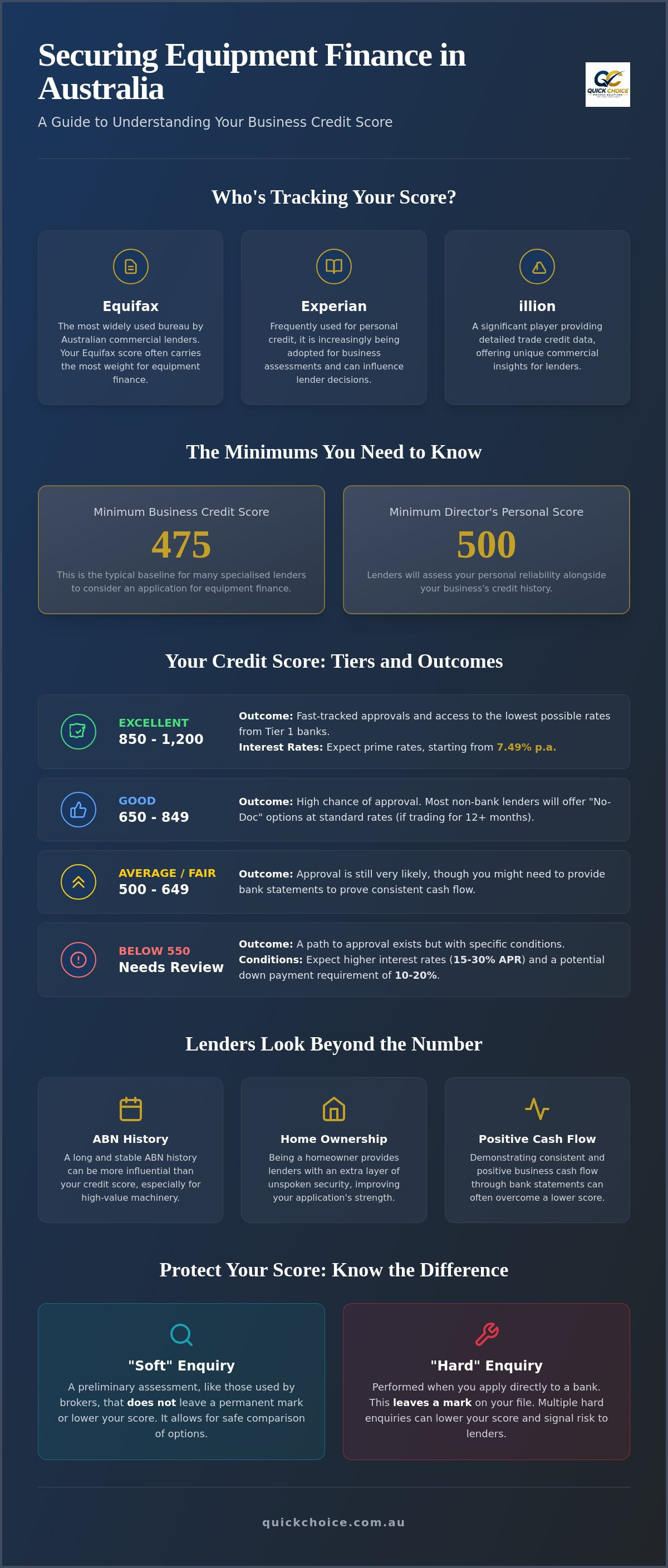
Your credit score is the digital pulse of your business. In Australia, this numerical representation typically ranges from 0 to 1,200; it serves as a snapshot of your financial reliability for lenders. While the concept of credit scoring in Australia follows global principles, the local market has its own nuances that self-employed professionals must master. Understanding what credit score for equipment finance australia lenders look for begins with knowing who is tracking your data and how they interpret your history.
Three primary bureaus dominate the landscape, each collecting data on your repayment history, credit applications, and any defaults:
- Equifax: This is the most widely used bureau by Australian commercial lenders and often carries the most weight.
- Experian: Frequently used for personal credit, it is increasingly being adopted for business assessments.
- illion: A significant player that provides detailed trade credit data and commercial insights.
For sole traders and small business owners, the line between personal and commercial credit often blurs. Lenders usually scrutinise your personal credit report alongside your ABN's commercial profile to get a full picture of your reliability. If your personal score is strong, it can often compensate for a younger business profile that hasn't built a long credit history yet.
By 2026, the shift towards Comprehensive Credit Reporting (CCR) has fundamentally changed how assessments work. Lenders no longer just look for "black marks" like defaults. They now see positive data, such as your history of making on-time payments over the last 24 months. This is excellent news for diligent business owners who might have an older blemish but have been consistent with their recent obligations.
Equifax vs Experian: Which Score Matters More?
Most Australian equipment finance providers lean heavily on Equifax for commercial assessments. It's the industry standard for business credit data. Discrepancies can occur between bureaus. You might have a stellar score on Experian but a lower one on Equifax due to a missed utility bill from years ago. We recommend checking all three reports before you start your application. This ensures there are no surprises that could stall your progress when you're ready to secure new machinery.
The Difference Between "Soft" and "Hard" Enquiries
Every time you apply for finance directly with a bank, they perform a "hard enquiry." This leaves a permanent mark on your file and can temporarily lower your score. If you shop around at five different banks in one week, you risk looking overextended to an automated system. At Quick Choice, we perform preliminary assessments that don't damage your file. This allows us to find the right match for your specific profile without the risk of lowering your standing before you've even secured your new gear.
The Magic Number: What Credit Score is Actually Required in 2026?
Many self-employed Australians believe they need a near-perfect credit history to secure business funding. This isn't the case. While a higher score certainly smooths the path, the minimum business credit score required for equipment finance is actually 475. If you're a company director, lenders typically look for a personal score of around 500. These benchmarks are lower than many expect, particularly if you're a homeowner, which provides lenders with an extra layer of unspoken security.
When asking what credit score for equipment finance australia lenders prefer, it's helpful to think in tiers. Reaching a score of 700 is the "Credit Sweet Spot." At this level, you move beyond simple approval and start qualifying for the most competitive interest rates, which currently start around 7.49% p.a. for premium applicants. If your score sits below 550, you can still find a path to approval, but you should prepare for higher interest rates, sometimes reaching 15% to 30% APR, and a potential down payment requirement of 10% to 20%.
Score Range Breakdown and Approval Likelihood
- Excellent (850-1,200): You're in the top bracket. Expect fast-tracked approvals and access to the lowest possible rates from Tier 1 banks.
- Good (650-849): You have a high chance of approval. Most non-bank lenders will offer "No-Doc" options at standard rates, provided you've been trading for at least 12 months.
- Average to Fair (500-649): Approval is still very likely, though you might need to provide bank statements to prove cash flow. Lenders in this tier often require a minimum score of 550 for no-doc equipment finance.
How Asset Type Influences Score Requirements
Lenders don't just look at you; they look at what you're buying. "Tier 1" assets, like a brand-new work ute or a common truck, are easier to finance even with a lower credit score. This is because these vehicles have high resale value and are easy to sell if the loan isn't repaid. The asset itself acts as the safety net.
Specialised industrial machinery or equipment older than 10 years faces much higher scrutiny. Because these items are harder to liquidate, a lender might demand a higher credit score or a 20% deposit to offset their risk. If you're unsure how your preferred gear fits into these categories, speaking with a specialist broker can help you identify the right lender for your specific asset and credit profile.
Beyond the Score: How Lenders Evaluate Self-Employed Applicants
While the number on your credit report is a critical starting point, it isn't the final word. Most non-bank lenders in Australia use a holistic assessment model. This means they look at your business's overall health rather than just a single digit. When considering what credit score for equipment finance australia lenders require, they often balance a lower score against other strengths, such as your time in business or your asset position. They want to see the person behind the ABN, not just the data point.
The "Time in Business" rule is one of the most powerful tools in your kit. If your ABN has been active for more than two years, you're seen as a stable entity. Even with a score on the lower end of the average range, a long-standing ABN suggests you've survived the initial high-risk period of starting a business. Similarly, being asset-backed (owning or mortgaging property in Australia) can bypass many traditional credit score hurdles. Lenders view property owners as more stable and committed, often reducing the score requirement for high-value equipment because the perceived risk of default is lower.
GST registration also plays a vital role in your profile. Being registered for GST signals to a lender that your turnover is at a certain level and that you're meeting your ATO obligations. It's a hallmark of business maturity. For many lenders, having an active GST registration for at least 6 to 12 months is a non-negotiable requirement that proves your business is a legitimate, trading entity.
Low Doc vs Full Doc Finance Options
For many busy sole traders, providing up-to-date tax returns is a hurdle. This is where Low Doc equipment finance becomes an essential resource. In these scenarios, lenders might rely more on your credit score and read-only access to your bank statements rather than detailed financials. If your score is on the borderline, opting for Full Doc finance by providing your most recent tax returns can often tip the scales in your favour, securing a lower interest rate and more flexible terms.
Industry-Specific Eligibility Factors
Lender appetite varies significantly by industry. Tradies working in growth corridors like Melton or Tarneit often find that lenders are eager to fund assets like excavators, trucks, and utes because the local construction and transport sectors are booming. If you can show existing contracts or a solid work history in these fields, it bolsters your application. A strong pipeline of work can sometimes outweigh a minor blemish on your credit report, proving to the lender that your cash flow is more than sufficient to cover the repayments.
Improving Your Eligibility and Navigating Low Credit Scenarios
If your credit file isn't where you want it to be, don't assume your application is doomed. Taking immediate steps to tidy up your report can significantly change how a lender perceives your risk level. While we've established that the minimum business score is often around 475, pushing that number higher through tactical cleanup can save you thousands in interest over the life of your loan. Lenders in 2026 are looking for stability, and showing proactive management of your credit history is a strong signal of reliability.
The distinction between "paid" and "unpaid" defaults is vital. An unpaid listing for a utility bill or an old credit card is often a deal-breaker for Tier 1 banks. However, once that debt is settled and marked as "paid" on your Equifax report, many specialised lenders will reconsider your application. If you operate under a PTY LTD structure, be prepared for the Director’s Guarantee. This means your personal credit standing remains relevant even if the business is the primary borrower. If your score is currently sitting in the 580 to 640 range, offering a larger deposit of 20% or more can often turn a "No" into a "Yes" because it reduces the lender's exposure and proves your skin in the game.
Tactical Credit Repair for Tradies
Start by requesting a copy of your report from Equifax and Experian. It's surprisingly common to find incorrect entries, such as a default for a telco bill you already settled or a debt that should have aged off your file after five years. Disputing these errors is a straightforward way to see an immediate bump in your score. You should also look for small utility defaults; these "nuisance" listings often go unnoticed but can drag down your rating. Maintaining a history of consistent BAS lodgements serves as powerful evidence to lenders that your business has the ongoing cash flow to service a new loan.
Alternative Lending Pathways
For those with more significant credit impairments, the path forward involves "Second Tier" or alternative lenders. These providers specialise in asset finance for self employed professionals who don't fit the rigid boxes of the big four banks. The trade-off is usually a higher interest rate, which can range from 15% to 30% APR for scores below 640. You might also consider structures like a Hire Purchase or a Lease to Buy arrangement, which can help manage cash flow while you build up your credit standing. If you're struggling to navigate these options alone, contact our team for a confidential assessment to see which pathway fits your current situation.
How Quick Choice Streamlines Equipment Finance for ABN Holders
Securing the right machinery or vehicle is about more than just numbers on a screen. While understanding what credit score for equipment finance australia lenders require provides a solid foundation, the way your application is presented determines your success. At Quick Choice, we move beyond the rigid, automated systems used by big banks. We act as your reliable specialist guide, translating your business's hard work into a compelling case for our panel of over 30 lenders. This personalised approach ensures that even if your credit score isn't perfect, your business's potential isn't overlooked.
Our deep roots in Melbourne’s West give us a unique advantage. We understand the specific challenges faced by tradies and contractors in Truganina, Melton, and Werribee. Whether you're an owner-driver needing a new prime mover or a landscaper looking for an excavator, we know which lenders have an appetite for your specific industry. We don't just submit an application; we match your unique credit profile to the lender most likely to offer a "Yes" with the most competitive terms available in 2026.
Our Process: From Enquiry to Asset Acquisition
We value your time because we know every hour spent on paperwork is an hour you aren't on the tools. Our process is designed for speed and clarity:
- The initial consultation: We start by understanding your business goals and cash flow needs, not just your credit score.
- Document collection made easy: We use secure, read-only technology to gather bank statements and BAS data, making it simple for busy contractors to provide what's needed.
- Finalising the deal: Once approved, we handle the settlement details with the dealer or private seller to get you onsite or on the road as quickly as possible.
Why Local Expertise Matters in 2026
The economic landscape in growth corridors like Rockbank, Aintree, and Caroline Springs is moving fast. Local knowledge allows us to speak the lender's language regarding regional demand and industry growth. This expertise is particularly valuable for newer businesses. We frequently help local entrepreneurs navigate the complexities of asset finance for startups australia, ensuring that a lack of trading history doesn't stall your momentum. We believe that every local business deserves a fair go at the equipment they need to thrive.
Don't let uncertainty about your credit report hold your business back from its next phase of growth. Our team is ready to provide the clarity and support you need to secure your next asset with confidence. Organise a credit pre-assessment with Quick Choice today and take the first step toward getting the gear your business deserves.
Secure Your Business Future with Confidence
You now have a clear roadmap for navigating the finance market in 2026. We've established that while your credit report is a key starting point, it's your overall business story that ultimately secures the deal. Whether it's leveraging your ABN longevity or providing a larger deposit for specialised machinery, there are multiple pathways to approval. Understanding what credit score for equipment finance australia lenders require is just the first step toward getting the tools you need to scale your operations.
Don't let a single number dictate your growth potential. Our specialist brokerage focuses on the unique needs of Australian sole traders, providing access to a wide panel of non-bank lenders who value practical results over abstract scores. With our local support across Melbourne’s West, we help you bypass the rigid barriers of traditional banking and find a tailored solution that works for you. Get a Professional Credit Assessment for Your Next Equipment Purchase and start your journey toward your next asset today. Your business has the momentum; we provide the capital to keep it moving.
Frequently Asked Questions
Can I get equipment finance with a credit score under 500 in Australia?
Yes, it's possible to secure funding with a score under 500, but your options will be more limited. While the absolute minimum business score is often around 475, sitting below the 500 mark usually requires a deposit of 20% to 30%. You should also expect interest rates to be higher, often ranging from 25% to 50% APR, to account for the increased risk to the lender.
How long does a default stay on my credit report for business lending?
A default remains on your credit report for five years from the date it was first listed. While the listing stays on your file for the full duration, lenders view a "paid" default much more favourably than an "unpaid" one. Clearing these old debts is a vital step when determining what credit score for equipment finance australia lenders will accept for your specific application.
Does a new ABN affect my ability to get equipment finance?
A brand-new ABN can make the process more challenging as most lenders prefer at least 6 to 12 months of trading history. If you've been trading for less than six months, you're often classified as a startup. In these cases, you'll likely need a stronger personal credit score or property ownership to prove your financial stability to a potential lender.
Will checking my own credit score lower it?
No, checking your own credit score is considered a "soft enquiry" and has no impact on your rating. You can check your file as often as you like to monitor for errors. It's only "hard enquiries," which happen when a lender performs a formal check during a loan application, that can cause your score to drop temporarily.
What is the best way for a sole trader to improve their credit score quickly?
The most effective method is to settle any outstanding defaults and ensure every bill is paid on time. Under the current Comprehensive Credit Reporting system, your positive payment history is now tracked. Consistently paying your phone, electricity, and existing loan accounts by the due date will steadily build your score over several months.
Is equipment finance easier to get than a standard business loan?
Generally, yes, equipment finance is more accessible than an unsecured business loan. Because the machinery or vehicle serves as security for the debt, the lender's risk is significantly lower. This security often allows lenders to be more flexible with credit score requirements and offer better interest rates than they would for a standard personal or business loan.
Do I need to provide property as security if my credit score is low?
You don't always need to provide property, but being a homeowner is a massive advantage. Lenders refer to this as being "asset-backed." If you own or are mortgaging a home, lenders are often willing to overlook a lower credit score or waive the need for a large cash deposit, as it signals long-term financial responsibility.
What documents do I need for a Low Doc equipment loan in 2026?
For a Low Doc application, you typically only need your ABN, proof of ID, and GST registration. Most lenders will also require read-only access to your business bank statements for the last 6 to 12 months. This allows them to verify your cash flow and turnover without needing full sets of accountant-prepared tax returns or financial statements.