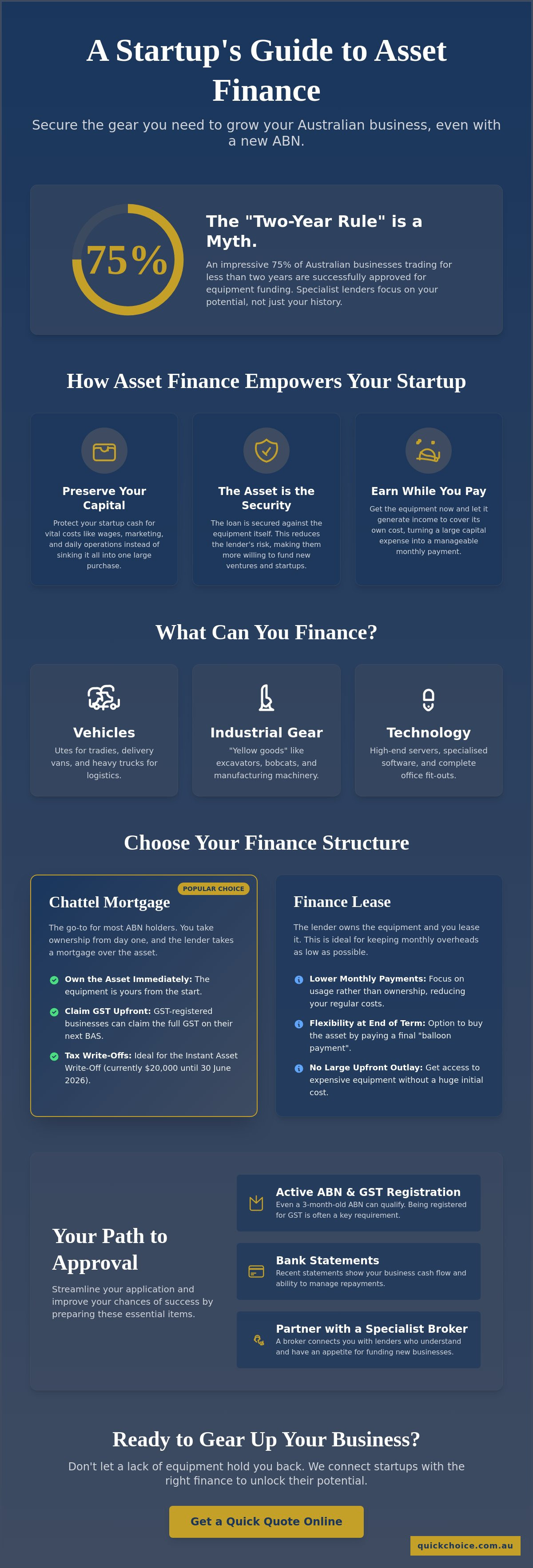
Did you know that 75% of Australian businesses trading for less than two years are successfully approved for equipment funding? While many founders believe they need a mountain of paperwork and years of history to qualify, the reality of asset finance for startups australia in 2026 is far more flexible. It's frustrating to be turned away by big banks simply because your venture is new, especially when you have the contracts ready and just need the gear to start earning.
You likely want to protect your startup capital for wages and marketing rather than sinking every dollar into a new vehicle or piece of machinery. We're here to show you exactly how to do that. This guide provides a clear path to securing essential tools even if your ABN is only three months old. We'll explore current interest rates, the June 30th instant asset write-off deadline, and the specific Low Doc options that help self-employed professionals get moving without the stress.
Key Takeaways
- Understand how asset finance works as a secured loan, allowing the equipment itself to act as collateral so you can preserve your startup's vital cash flow.
- Learn how to successfully navigate asset finance for startups australia even if your ABN is brand new, debunking the common myth that you need two years of trading history.
- Compare different finance structures like Chattel Mortgages and Hire Purchases to identify which option provides the best tax benefits and ownership outcomes for your specific venture.
- Discover the essential documentation you need to prepare, including GST registration and bank statements, to streamline your application and improve your approval chances.
- Find out why partnering with a specialist broker who understands the self-employed journey can connect you with lenders who have a genuine appetite for funding new businesses.
What is Asset Finance for Startups in Australia?
Starting a new business is an exercise in managing risk and momentum. For many founders, the biggest hurdle isn't a lack of talent or customers; it's the high cost of the tools needed to do the job. This is where asset finance for startups australia becomes a critical resource. Unlike a general business loan that might require years of profit history, asset finance is a specialised arrangement where the loan is secured by the item you're purchasing.
This structure falls under the broader definition of Asset-based lending. By using the equipment itself as collateral, the lender has a safety net. This is why specialist lenders are often willing to work with you even if your ABN has only been active for a few months. Traditional banks usually hesitate to fund anyone with less than two years of trading history because they rely heavily on past performance. Asset finance looks forward instead, focusing on the value of the asset and your potential to earn.
In rapidly growing areas like Tarneit, new ventures are popping up daily to service the expanding community. These businesses often need to scale quickly to meet demand. If a new landscaping business spent its entire startup capital on a single excavator, it wouldn't have the funds left to pay staff or cover insurance during those first few lean months. By choosing finance, they preserve that vital working capital for daily operations while the machine works on-site to pay for itself. It's a way to get the gear you need without draining the bank account you rely on for survival.
The Purpose of Startup Asset Finance
The primary goal is to transform what would be a "sunk cost" into a manageable monthly operating expense. It's a simple concept: you earn while you pay. Rather than waiting years to save up for a high-end delivery van, you get the keys now and use the revenue from those deliveries to cover the finance. Asset finance for startups australia acts as a tool that uses the equipment as collateral to reduce lender risk, making it one of the most accessible paths to growth for the self-employed.
Common Assets Financed by New Businesses
You aren't limited to just one type of gear. Most physical items that help your business generate income can be financed. Common examples include:
- Vehicles: This includes the classic Aussie ute for tradies, delivery vans for couriers, and heavy trucks for logistics startups.
- Technology: You can finance high-end servers, specialised software systems, and even complete office fit-outs.
- Industrial gear: This covers "yellow goods" like excavators and bobcats, as well as manufacturing machinery for local workshops.
Types of Finance Structures for New Australian Businesses
Choosing the right legal arrangement for your equipment is just as important as the equipment itself. The jargon can be overwhelming, but for most founders, the decision boils down to whether you want to own the asset immediately or keep your monthly overheads as low as possible. When exploring asset finance for startups australia, you'll typically encounter three main paths: Chattel Mortgages, Hire Purchases, and Finance Leases. Each has distinct implications for your balance sheet and your next tax return.
Chattel Mortgage: The Popular Choice
Ownership starts from day one with a Chattel Mortgage. This is the "go-to" structure for most ABN holders because it functions similarly to a traditional loan but with added tax perks. Under this arrangement, you take legal ownership of the asset at the time of purchase, and the lender secures the debt by taking a mortgage over the equipment. For a new trade business in Melton or Rockbank, this is often the best way to buy a high-spec ute or a mini-excavator. If you're GST-registered, you can usually claim the full GST amount back on your next Business Activity Statement (BAS). This provides a significant cash injection exactly when your startup needs it most. This structure also aligns perfectly with the $20,000 instant asset write-off threshold, which remains in place until June 30, 2026, for eligible small businesses.
Finance Leases and Hire Purchase
Leasing offers a path to lower monthly overheads by focusing on usage rather than ownership. In a Finance Lease, the lender buys the equipment and leases it back to you for a set period. You don't own the asset at the end of the term unless you choose to pay a "residual value" or "balloon payment." This is a pre-agreed lump sum that keeps your regular monthly costs down. It's a different story with a Hire Purchase. In that case, you "hire" the machinery until the final payment is made, at which point ownership transfers to you automatically. Both structures are valid Australian government funding options that help manage cash flow effectively.
Sub-contractors often prefer specific structures based on how they want to manage their tax efficiency and depreciation. While a lease might offer the lowest monthly commitment, a Chattel Mortgage allows you to claim depreciation and interest as deductions. Getting this right from the start ensures you aren't paying more than necessary while trying to build your venture. If you're feeling stuck between these options, it's worth chatting with a specialist at Quick Choice who understands the specific hurdles of asset finance for startups australia.
The "Two-Year Rule" Myth: Financing with a New ABN
One of the most persistent myths in the Australian business community is that you must wait two years before applying for any form of funding. This "two-year rule" often discourages founders before they even begin. In reality, asset finance for startups australia has evolved to support new ventures from their very first day of trading. Whether your ABN has been active for 24 months or 24 hours, there are specific pathways designed to get you the equipment you need without the long wait.
The Forbes Advisor guide to starting a business highlights that securing funding is a pivotal step in the early stages of any Australian venture. While traditional lenders might stick to rigid timelines, specialist asset finance providers look at the bigger picture. They understand that a new business needs tools to generate revenue, not just a long history of lodging tax returns. This shift in perspective is why the approval rate for businesses trading for less than two years sits at approximately 75% in 2026.
The transition from "Full Doc" to "Low Doc" has been a game-changer for the self-employed. In the past, you needed two years of certified tax returns to even get a foot in the door. Today, lenders are more interested in your current cash flow. By reviewing your Business Activity Statements (BAS) or recent bank transactions, they can see the actual health of your business in real-time. This modern approach to asset finance for startups australia acknowledges that a thriving new business shouldn't be held back by outdated administrative requirements.
Qualifying with a New ABN
Lenders view industry experience as a primary indicator of startup success. If you've spent a decade as a lead mechanic and decide to open your own workshop, that expertise carries significant weight. Your personal credit history also plays a vital role. When the business lacks a long financial track record, lenders rely on your personal reliability as a director to gauge risk. A clean credit file and a solid background in your chosen field can often bypass the need for years of business bank statements.
Low Doc vs No Doc Finance
For those who haven't yet lodged a tax return, "Low Doc" finance provides a streamlined alternative. Instead of years of profit and loss statements, you might provide recent bank statements or a "Letter of Intent" from a future client. Local tradies in Werribee often use these Low Doc options to get their utes on the road fast, using signed contracts for upcoming work as proof of their ability to service the loan. If you're specifically looking for a car or van, our Startup Business Vehicle Finance guide offers deeper insights into that process.
How to Prepare Your Startup for a Finance Application
Preparation is the bridge between a rejected application and a funded one. While we've discussed the flexibility of asset finance for startups australia, lenders still need to see a level of professional organisation. Setting up your ABN and GST registration correctly from day one is the first step. Even if you don't expect to hit the A$75,000 threshold immediately, being GST-registered signals to lenders that you're building a scalable business rather than a hobby.
You'll also need to gather clear proof of income. Since you likely don't have years of tax returns yet, your bank statements, paid invoices, and signed contracts become your most valuable evidence. For larger purchases, such as heavy machinery or specialised equipment, a simple business plan or a 12-month cash flow forecast can make a massive difference. It shows the lender exactly how the new asset will generate the revenue needed to cover its own costs.
Checking your personal credit score before any lender does is also vital. In the startup world, your personal financial reliability acts as a proxy for the business. Any defaults or late payments on personal cards or utilities can trigger a quick rejection. By knowing your position first, you can address any issues or provide context to your broker before the official application begins.
Essential Documentation Checklist
Having your paperwork ready saves time and reduces stress. Most lenders will require a standard set of documents to verify your identity and your business location. You should have the following prepared:
- Primary identification like your Australian drivers licence and Medicare card.
- Proof of your business location, such as a rates notice or a formal lease agreement for your premises in Aintree or Hoppers Crossing.
- Full details of the asset, including a formal quote or invoice from the dealer.
Managing Your Credit Profile
One of the biggest mistakes founders make is "shotgunning" applications to multiple lenders at once. Each of these creates a hard enquiry on your file, which can quickly lower your credit score and make you look desperate to lenders. Using a specialist broker allows for a "soft-touch" approach. We can assess your situation and match you with the right lender before a formal credit check is even lodged.
If you're in a rush to secure funding before a project starts, our Urgent Business Asset Finance checklist provides a step-by-step guide to the fast-track process. To get a clear picture of your options without damaging your credit file, you can speak with our team today and discover how asset finance for startups australia can work for your specific circumstances.
Why Startups Choose Quick Choice for Asset Finance
Founders in Western Melbourne face a unique set of challenges. Whether you are launching a logistics firm in Truganina or a specialised trade business in Laverton, the local landscape moves fast. You need a finance partner who understands that your ABN is a badge of ambition, not a reason for rejection. Quick Choice specialises in asset finance for startups australia, specifically catering to the self-employed professionals who keep our local economy running. We don't just see a new business; we see the potential for growth and the need for reliable tools to reach it.
Our strength lies in our extensive panel of lenders. While a single bank has one set of rigid rules, we have access to a wide range of providers, including many with a genuine appetite for "New ABN" applications. These lenders look beyond the lack of two years' trading history. They focus on your industry experience, your business plan, and the value of the asset you are purchasing. This tailored approach ensures that you get the right structure for your specific needs, allowing you to scale at the speed your market demands.
A Reliable Specialist Guide for Founders
We pride ourselves on being more than just a service provider. We act as your reliable specialist guide, translating complex finance jargon into plain Australian English. You won't find any confusing corporate-speak here. Instead, we offer clear explanations of how each choice affects your bottom line. Our commitment is to find a viable path forward even when big banks have said no. We value long-term partnerships, aiming to support you as your business evolves from a fresh startup into a thriving scale-up.
Getting Started with Your Application
The process begins with a simple, supportive conversation. We start with an initial consultation to gauge your eligibility and understand your goals. This allows us to provide a no-obligation assessment that protects your credit score. We avoid making multiple hard enquiries on your file, focusing instead on matching you with the right lender first. This methodical approach ensures your financial reputation remains intact while we secure the funding you need.
Ready to get your equipment on-site or your vehicles on the road? We invite you to contact the Quick Choice team for a localised quote. Discover how specialised asset finance for startups australia can provide the foundation your new venture needs to succeed in 2026 and beyond.
Launch Your Growth Strategy Today
Securing the right equipment shouldn't be a roadblock to your success. We have explored how the modern lending landscape has moved past rigid requirements, making asset finance for startups australia more accessible than ever for new ABN holders. By choosing Low Doc pathways and the right finance structure, you can protect your startup capital while putting the latest tools to work immediately. Whether you're based in Truganina or Werribee, your business deserves a funding partner that understands the local landscape and the unique needs of the self-employed.
Our team specialises in New ABN and Low Doc finance, providing the local Western Melbourne expertise you need to move with confidence. We pride ourselves on a fast, supportive application process that respects your time and your credit score. Don't let a lack of trading history hold your vision back. Secure your startup’s future with a tailored asset finance solution from Quick Choice today. We are ready to help you turn your startup goals into a scalable reality.
Frequently Asked Questions
Can I get asset finance if I just started my business yesterday?
Yes, you can secure funding even if your business is brand new. While traditional banks prefer a long trading history, specialist lenders offer "Day 1" products specifically for new ventures. These approvals often rely on your previous experience in the same industry and a solid personal credit score to offset the lack of business history.
What is the minimum ABN age required for startup equipment finance in Australia?
Many specialist lenders will consider your application once your ABN has been active for just 3 months. While some major banks still stick to a 12 or 24-month rule, the 2026 lending market is far more flexible. If you can show a steady monthly revenue of at least A$5,000, your options for asset finance for startups australia expand significantly.
Do I need a deposit for startup asset finance?
Not always. While providing a 10% or 20% deposit can lower your interest rate and monthly payments, 100% finance options are frequently available for startups. This is particularly common for vehicles and standard industrial machinery, allowing you to keep your initial capital for other vital setup costs like insurance or staff wages.
How do interest rates for startups compare to established businesses?
Startups generally pay a slightly higher rate to reflect the increased risk to the lender. In June 2026, business asset finance rates typically range from 5.5% to 15% per annum. Your specific rate will depend on your personal credit file, whether you are a homeowner, and the type of equipment you are purchasing for your new venture.
Can I finance second-hand or used equipment as a startup?
Yes, financing used assets is a popular way for new businesses to reduce their total debt. Lenders usually require the equipment to be no older than 10 to 12 years at the end of the finance term. Buying from a reputable dealer often makes the process smoother, though private sales can also be funded with a formal independent inspection.
What happens if I don’t have any tax returns yet?
You can apply for a Low Doc loan which doesn't require lodged tax returns or full financial statements. Instead, you provide alternative evidence of your business's health, such as recent bank statements or Business Activity Statements (BAS). This makes asset finance for startups australia highly accessible for founders who haven't reached their first end-of-financial-year milestone yet.
Is it better to lease or buy equipment for a new business?
The choice depends on whether you value ownership or lower monthly overheads. Buying through a Chattel Mortgage allows you to own the asset immediately and claim GST upfront, which is great for cash flow. Leasing typically offers lower monthly repayments but requires a "balloon" payment at the end if you decide you want to keep the equipment permanently.
How long does the approval process take for a new business?
Most startup finance applications are now processed within 24 to 48 hours. If you have your identification, ABN details, and an invoice for the asset ready, the process is very streamlined. Some non-bank lenders can even provide a formal approval and settle the funds within a single business day, getting you on the road or on-site faster.


