
What if your brand-new ABN was actually a launchpad for growth rather than a barrier to entry? Most new business owners believe that without years of tax returns, securing new abn equipment finance is an impossible task. You've probably felt that familiar knot of anxiety when thinking about credit rejection, or perhaps you're feeling stuck between confusing "Low Doc" and "No Doc" options. It’s a common frustration to have a clear vision for your startup but lack the historical paperwork that traditional banks demand.
We realise that you need the right gear to start generating revenue, not the other way around. This guide serves as your comprehensive template for 2026, showing you exactly how to secure essential assets while keeping your precious cash flow for daily operations. We will walk you through the specialised documentation strategies that bypass old-fashioned hurdles, explain how to access rates starting from 7.49% p.a. for certain assets, and show you why a fresh ABN is simply a prompt for a more tailored approach to funding.
Key Takeaways
- Learn why a trading history of less than 24 months doesn't have to stop your progress and how specialist funding fills the gap left by traditional banks.
- Discover how "Low Doc" and "No Doc" strategies allow you to secure essential assets like utes without the need for years of tax returns.
- Understand the advantage of using a specialist broker to access new abn equipment finance through private lenders who look beyond automated credit scores.
- Follow a practical five-step template to organise your application, focusing on your active ABN and a solid work pipeline of future contracts.
- See how local market knowledge in Western Melbourne’s industrial hubs, such as Hoppers Crossing and Melton, can streamline your path to asset ownership.
What is New ABN Equipment Finance?
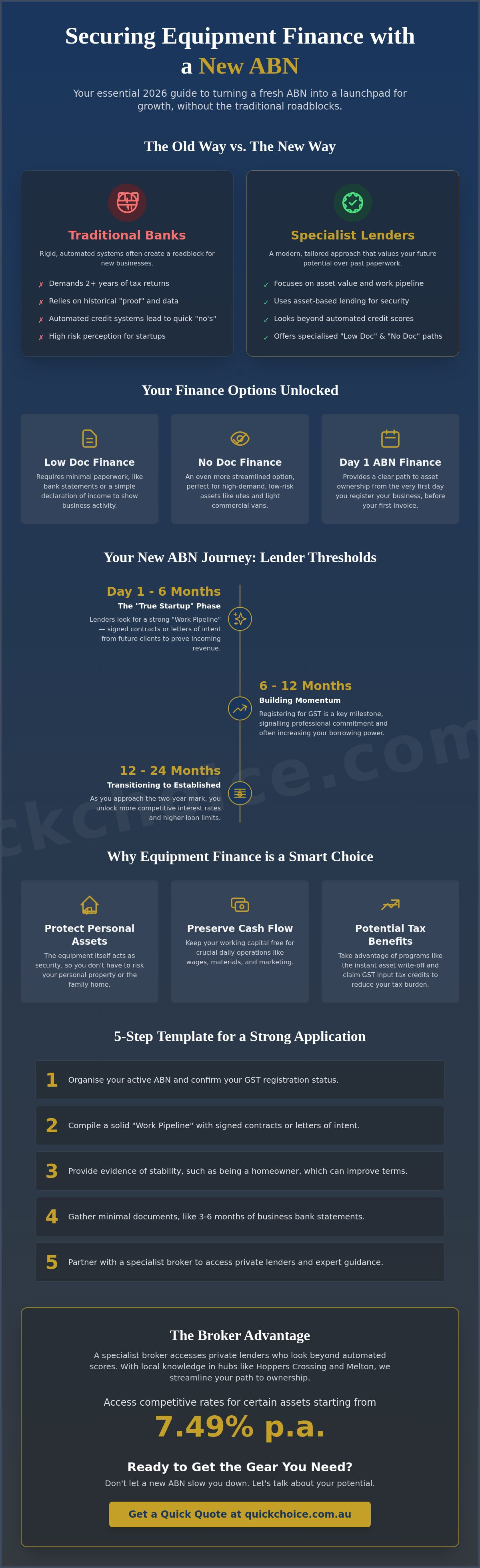
Securing new abn equipment finance is often the first major hurdle for a burgeoning Aussie business. In simple terms, this is a specialised category of asset finance designed for entities that have been trading for less than 24 months. While traditional banks typically demand two years of comprehensive tax returns and profit and loss statements, this startup-friendly alternative looks at different metrics to gauge your business's health.
Banks love data. They crave history and predictable patterns. When you approach a major branch with a fresh ABN, you lack the historical "proof" their automated credit systems require. This often leads to a quick "no" because the risk seems too high for their rigid algorithms. However, the modern lending market in 2026 recognises that your potential isn't always written in last year's ledger. The solution lies in asset-based lending, where the equipment itself provides the primary security for the loan. This shift in focus from your past paperwork to the value of the asset makes it possible to get the tools you need to start earning.
You will likely encounter several terms during your search. "Low Doc" options require minimal paperwork, such as bank statements or a simple declaration of income. "No Doc" finance is even more streamlined, often used for high-demand assets like utes or light trucks where the lender's risk is lower. For those who literally just registered their business, "Day 1 ABN finance" provides a path to ownership before you've even issued your first invoice.
The "New ABN" Thresholds in 2026
Lenders categorise startup risk into three distinct windows. From Day 1 to 6 months, you are in the "True Startup" phase. During this time, lenders often look for a "Work Pipeline," such as signed contracts or letters of intent from future clients, to prove you have revenue coming in. Once you hit the 6 to 12-month mark, your borrowing power often increases, especially if you have registered for GST. This registration signals a level of professional commitment that lenders value. Finally, as you move between 12 and 24 months, you begin transitioning toward "established" status, unlocking more competitive interest rates and higher loan limits.
Why Equipment Finance Beats a Standard Business Loan
Choosing a specialised equipment loan over a general business loan offers several strategic advantages for a new contractor. Because the asset acts as the security, you don't have to risk your personal property or the family home to get a start. This protection is vital during the early years of business. Additionally, you can often take advantage of tax benefits like the instant asset write-off and GST input tax credits, which help reduce your overall tax burden. Most importantly, it preserves your working capital. Instead of sinking your cash into a single piece of machinery, you keep that money available for wages, materials, and daily operations.
Low Doc and No Doc Options for New Businesses
When you're just starting out, the traditional requirement for two years of comprehensive financials feels like a catch-22. You need the gear to make the money, but you need the money to prove you're worth the gear. This is where new abn equipment finance shifts the focus from your past to your present potential. Instead of relying on outdated tax returns, modern lenders use alternative markers to assess your reliability and business viability.
Your personal credit score takes centre stage in this process. Since your business hasn't had time to build its own credit history, lenders look at how you've managed your personal finances as a proxy for your business conduct. A clean credit file is often the "golden ticket" for approval. Additionally, being a homeowner provides a significant boost. Lenders view property ownership as a sign of stability and financial responsibility, which often translates to more competitive terms and higher borrowing limits for your new abn equipment finance application.
Lenders are particularly receptive to "No Doc" applications when the asset in question is a high-demand vehicle, such as a ute or a light commercial van. These assets hold their value well, making them lower risk for the financier. By exploring various equipment finance options, you can find a structure that suits your specific cash flow needs without the headache of providing full financial statements.
Acceptable Documents for Low Doc Finance
While you won't need full tax returns, you'll still need to provide some basic evidence of your business activity. Lenders typically look for:
- Business bank statements: Usually covering the last three to six months to show consistent cash flow.
- Signed contracts: Evidence of future work or letters of intent from reputable companies you'll be subcontracting to.
- GST registration: Providing your latest Business Activity Statements (BAS) can significantly strengthen your case if you've been trading for more than six months.
The Trade-Off: Rates vs. Documentation
It's vital to understand that "No Doc" or "Low Doc" loans may carry a slightly higher interest rate than a traditional fully documented loan. This is simply a reflection of the lender taking on more perceived risk. However, the real question for a startup is the Return on Investment (ROI). If the new equipment allows you to take on a contract that pays significantly more than the monthly interest cost, the finance becomes a tool for profit rather than a burden. You can always review your finance options once you have twelve months of trading history, as many business owners choose to refinance to a lower rate once their ABN is more established.
Specialist Broker vs. Big Banks: The Comparison
Many new business owners naturally head to their local branch first. They assume a long-standing personal relationship guarantees an easy approval for new abn equipment finance. Unfortunately, big banks operate on rigid, automated credit scoring models. These systems are designed for established businesses with years of data. If your ABN is fresh, you're often flagged as high risk before a human ever looks at your application. A rejection from a major bank isn't just a setback; it leaves a permanent mark on your credit history that can complicate future attempts to find funding.
This is where the "Credit Protection" advantage of a broker becomes invaluable. When you apply directly to multiple banks, each one performs a "hard" credit enquiry. Too many enquiries in a short period can lower your credit score. A specialist broker acts as a buffer. We perform a single preliminary assessment and then strategically present your case to the lenders most likely to approve it. Whether you are leasing or buying equipment, having a professional advocate means your business story is told to a human underwriter who understands the context of your startup.
The Big Bank "Checklist" Problem
For most major lenders, two years of tax returns is a non-negotiable requirement. They simply aren't set up to manage the nuances of a new contractor or a self-employed professional. If you don't tick every box on their automated checklist, the answer is a swift "no." Instead of risking a rejection that damages your credit profile, exploring asset finance for startups australia provides a much more flexible path. Specialist lenders in this space are comfortable with newer ABNs because they focus on the asset's value and your current work pipeline rather than just your historical tax data.
The Quick Choice Broker Advantage
Working with a specialist gives you access to a panel of over 30 lenders, many of whom are private, non-bank entities that specialise in startup risk. We don't just look at numbers; we understand the local industries driving Western Melbourne, from construction in Truganina to logistics in Melton. This local expertise allows us to structure your finance with features that help a new business thrive. We can arrange balloon payments to lower your monthly costs or seasonal repayment schedules that align with your specific industry's cash flow. Our goal is to secure your new abn equipment finance in a way that supports your growth rather than stifling it.
The New ABN Application Template: 5 Steps to Success
Preparing a winning application for new abn equipment finance doesn't have to be a stressful ordeal. By following a structured template, you can present a professional case that gives lenders the confidence to say "yes." Most startups fail not because their business is weak, but because their paperwork is disorganised. We've distilled the process into five actionable steps to help you get the gear you need without the usual bank-led headaches.
- Step 1: Organise your vitals. Ensure your ABN is active and valid on the Australian Business Register. You'll also need your current Australian driver’s licence and basic identity documents ready to go.
- Step 2: Build your work pipeline. This is the most critical part for a new business. Gather any signed contracts, sub-contractor agreements, or letters of intent from future clients to prove your income potential.
- Step 3: Audit your credit. Check your personal credit file for any legacy issues or errors. Addressing a small mistake now prevents a major hurdle during the final approval stage.
- Step 4: Select a strategic asset. Pick equipment that holds its value. Lenders are much more comfortable financing a late-model ute or excavator than niche or highly specialised machinery.
- Step 5: Lodge with a specialist. Partner with a professional to submit an urgent business asset finance application. This ensures your file is presented to the right lender the first time.
Asset Selection Strategy
Lenders generally prefer "Primary Assets" like trucks, utes, and earthmoving equipment. These items are easy to resell, which reduces the lender's risk. If you're looking at used gear, keep the age in mind. Financing a 15-year-old truck is notoriously difficult for a startup because the maintenance risk is high. Buying through a licensed dealer is often the smoothest path, as lenders trust the valuation and title checks provided by established businesses. While private sales are possible, they often require extra inspections that can slow down the process.
Financial "Soft" Proofs
When you lack a two-year paper trail, "soft" proofs become your best friend. A simple letter from your accountant verifying your projected income can carry significant weight. Another powerful strategy is offering a deposit. Putting even 10% down "de-risks" the application and shows the lender you have "skin in the game." Don't forget to highlight your previous industry experience. If you've been a diesel mechanic for a decade and are now starting your own mobile repair business, that expertise is a valuable asset in the eyes of an underwriter. If you're ready to get started, you can request an equipment finance quote to begin your journey.
Local Expertise for Western Melbourne Startups
Local knowledge is often the deciding factor in a successful application for new abn equipment finance. While a faceless national lender might see a postcode as just another data point, we understand the economic heartbeat of Western Melbourne. We know that a startup in Truganina or a new contractor in Melton is part of one of Australia's fastest-growing industrial corridors. This geographical context allows us to present your business case with a level of detail that traditional banks simply can't match.
Our commitment to the west goes beyond phone calls and emails. We regularly conduct on-site visits to depots in Werribee or construction sites in Aintree to see your operations firsthand. By standing in your yard and looking at your gear, we gain a better understanding of your specific equipment needs. Whether you are operating out of the bustling industrial hubs of Tarneit or setting up shop in Hoppers Crossing, having a finance partner who knows the local terrain makes the entire process feel more like a collaboration than a transaction.
Supporting Local Tradies and Owner-Drivers
The Western suburbs are a powerhouse for the transport and construction sectors. We provide startup business vehicle finance tailored specifically for local couriers and owner-drivers who are just finding their feet. If you're involved in the massive residential developments in Rockbank or Thornhill Park, you need reliable earthmoving and construction finance that accounts for the unique demands of those projects. We help Melton startups compete with established firms by securing the same high-quality machinery that the big players use, ensuring you aren't held back by outdated or unreliable gear.
Your Partner for Long-Term Growth
Securing your first piece of equipment is just the beginning of our journey together. We view ourselves as a long-term partner dedicated to helping you scale your fleet as your turnover grows. Our team conducts regular reviews of your finance structures to ensure they still align with your business goals and cash flow requirements. As your ABN ages and your credit profile strengthens, we look for opportunities to refine your arrangements. We are always available for a local chat in Caroline Springs or Taylors Lake to discuss your next move. Our goal is to ensure that your new abn equipment finance is the foundation for a business that thrives for decades, not just a temporary fix for today's needs.
Empower Your Startup’s Future
Launching a new venture is a bold move, and you shouldn't let a lack of financial history hold you back. We have explored how specialised documentation strategies and asset-based lending can bypass the rigid requirements of traditional banks. By focusing on your current work pipeline and the value of your equipment, you can secure the tools you need to thrive from day one.
Our team focuses on supporting ABN holders with less than two years of trading history. We are local experts in the Western Melbourne corridor, from Truganina to Melton, and we provide access to a panel of over 30 non-bank lenders. This means you get a bespoke solution for new abn equipment finance that considers your unique story rather than just an automated credit score. We take the complexity out of the application process so you can stay focused on your operations.
Get a tailored quote for your new business equipment today and take the first step toward building your business credit history while keeping your cash flow intact. You have the vision and the drive; we have the expertise to help you secure the gear. Let's get your business moving.
Frequently Asked Questions
Can I get equipment finance with a 1-day old ABN?
Yes, you can secure funding with a 1-day old ABN through specialised "Day 1" lending programs. These products are designed for new contractors who have significant industry experience or a signed work contract ready to go. While traditional banks usually hesitate, specialist lenders focus on the value of the asset and your potential to generate revenue from the moment you start trading.
What is the maximum I can borrow with a new ABN?
New ABN holders can typically access up to $150,000 in unsecured business loans or over $1 million for secured equipment finance. The final limit depends on the type of asset you are purchasing and your personal credit profile. For high-value machinery, lenders often look for a deposit or a strong work pipeline to mitigate the risk associated with a fresh business entity.
Do I need to be registered for GST to get equipment finance?
You don't strictly need to be registered for GST to qualify, although it can improve your borrowing power. Lenders often view GST registration as a sign of professional commitment and business scale. If you aren't registered, you might find that some lenders apply stricter terms or require more than three months of bank statements to verify your turnover.
What interest rates should a new ABN holder expect in 2026?
In June 2026, fixed interest rates for new abn equipment finance typically start from 7.49% and can range up to 15.00% p.a. Your specific rate will depend on factors like your credit score, the age of the equipment, and whether you are a homeowner. Asset-backed borrowers, such as those with equity in a home, generally secure rates at the lower end of this scale.
Can I finance used equipment with a new ABN?
Yes, you can finance used equipment as long as the asset meets the lender's age and condition criteria. Most financiers prefer "Primary Assets" like trucks, utes, or excavators because they have a clear resale market. Financing a used vehicle from a licensed dealer is generally simpler than a private sale because the dealer handles the necessary title and valuation paperwork.
How long does the approval process take for new businesses?
The approval process is remarkably fast, often taking between 24 and 48 hours for Low Doc applications. If you have your ABN details, identification, and recent bank statements ready, many specialist brokers can provide a preliminary decision on the same day. This speed ensures you can secure the gear needed to meet upcoming contract deadlines without delay.
Will a new ABN loan require a personal guarantee?
Most equipment loans for startups will require a personal guarantee from the directors or the sole trader. Since the business lacks a long-term trading history, the lender needs assurance that the individuals behind the ABN are committed to the repayments. This is a standard requirement for almost all startup asset finance in Australia and helps you build your business credit history.
What happens if I have a "Low Doc" application but no property security?
If you don't own property, you can still secure a Low Doc loan, though you may face slightly higher interest rates or be asked for a larger deposit. Lenders will rely more heavily on alternative proofs such as your business bank statements or an accountant's letter. This path ensures you can still access new abn equipment finance without having to use a home as security for the debt.


