

What if the biggest barrier between your startup and the road isn't your lack of trading history, but a common myth about how long you've been in business? You've likely felt the sting of a major bank rejection or the pressure to provide your family home as security just to get a work vehicle. Securing startup business vehicle finance shouldn't feel like an exhausting uphill battle when you have contracts to fulfil and immediate revenue to generate.
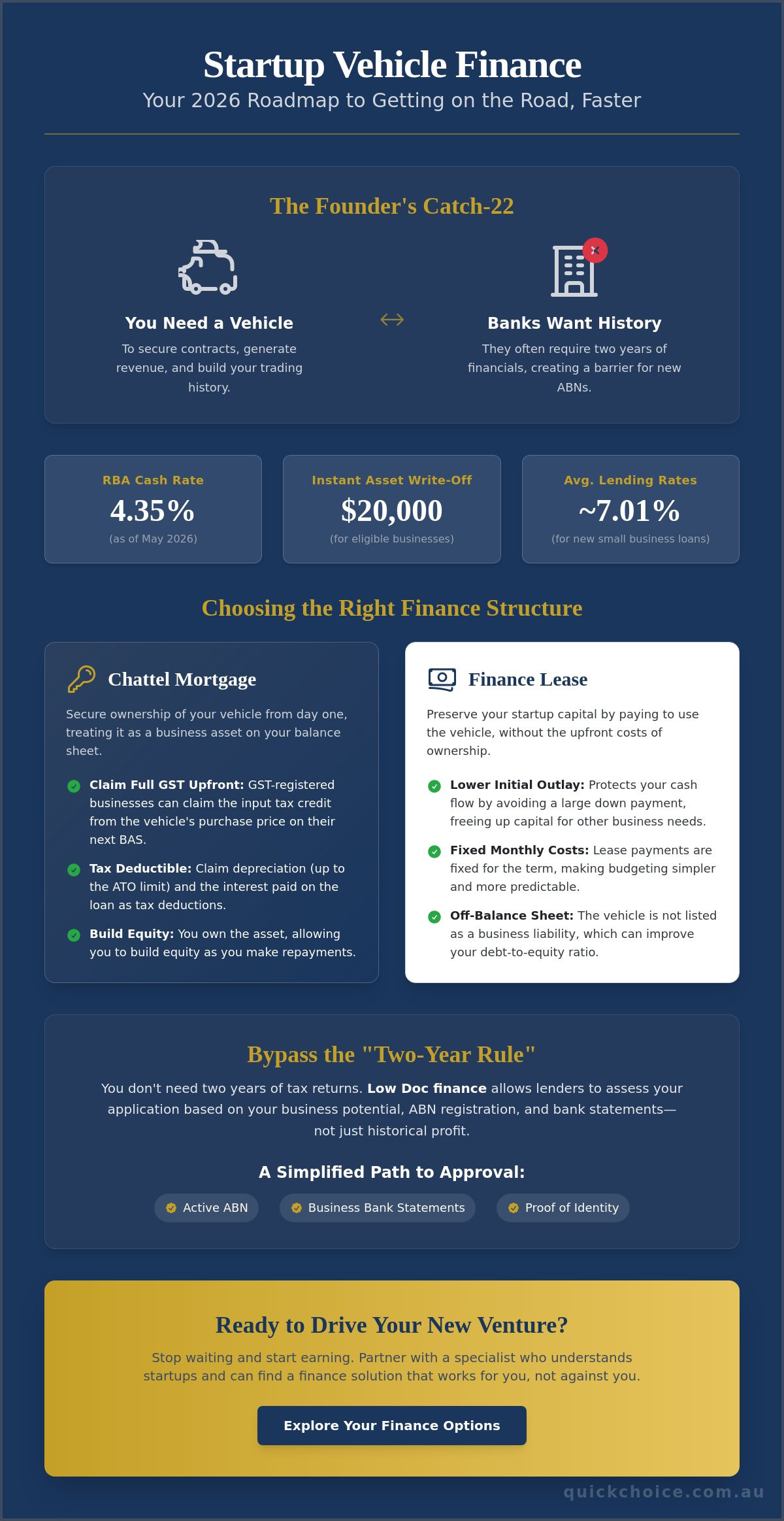
We understand that in 2026, with the RBA cash rate sitting at 4.35%, every financial commitment needs to be strategic. This guide reveals how Australian founders are bypassing traditional hurdles to get behind the wheel of a reliable asset today. You'll learn how to navigate the $20,000 instant asset write-off, compare the tax benefits of chattel mortgages versus leasing, and find lenders who value your future potential over your past paperwork. We will also clarify how to claim GST input tax credits upfront so you can protect your cash flow from day one.
Key Takeaways
- Understand why 2026 market conditions favour flexible brokerage over rigid bank lending for new ABN holders.
- Compare chattel mortgages and leasing to identify which structure best supports your startup’s cash flow and tax position.
- Overcome the "two-year rule" hurdle by discovering Low Doc options that simplify startup business vehicle finance for newer businesses.
- Learn the specific documentation needed to secure approval, with a practical roadmap for founders in Melbourne’s growth hubs like Melton and Truganina.
- Discover the benefits of working with a specialist guide to navigate asset finance for the self-employed without the usual bank-related stress.
The Startup Vehicle Finance Landscape in Australia (2026)
Launching a new venture in Australia requires more than just a great idea; it requires the physical tools to get the job done. For many new ABN holders, startup business vehicle finance acts as a specialised asset-backed facility designed to bridge the gap between a business plan and a functional operation. Unlike personal car loans, this is a commercial arrangement where the vehicle itself serves as security. This structure allows founders to access capital even when they don't have years of tax returns to show a bank manager. It's about turning a liability into a revenue-generating asset from day one.
The 2026 market has shifted significantly toward digital-first applications and streamlined approvals. With the Reserve Bank of Australia cash rate holding at 4.35% as of May 2026, lenders have become more selective about who they fund. While major banks often retreat to rigid criteria during these cycles, flexible brokerage models have stepped in to fill the void. These specialists understand that a new courier or tradie needs a reliable van or ute to start earning. They look at the contract potential and the asset's value rather than just a historical spreadsheet. Understanding your vehicle finance options is the first step in ensuring your capital isn't tied up in a depreciating asset while you're trying to scale.
Why Startups Struggle with Traditional Lenders
Most big banks still cling to the "Two-Year Rule," a policy that requires businesses to show two full years of profitable trading history before they'll consider an application. This creates a frustrating paradox for new founders. You need the vehicle to generate the profit, but the bank wants the profit before they'll fund the vehicle. Their risk assessment models often penalise fresh ABNs because they lack the data points found in established financial histories. This leaves a massive gap between your vision for growth and the bank's conservative spreadsheet requirements, which rarely account for the future potential of a well-run startup.
The Economic Impact of the Right Workhorse
Waiting to "save up" for a vehicle can be a costly mistake in a competitive market. Every day you spend without a reliable workhorse is a day of lost opportunity and potential contract forfeiture. A new ute or van reduces maintenance downtime during that critical first year, ensuring you're on the road instead of in the workshop. When you calculate the return on investment, the ability to fulfil larger, more lucrative contracts far outweighs the cost of the finance. Small business lending rates for new loans averaged around 7.01% in early 2026 according to RBA data, making strategic startup business vehicle finance a viable path to immediate revenue growth.
Choosing the Right Structure: Chattel Mortgage vs. Leasing
Selecting the right framework for your startup business vehicle finance is as critical as the vehicle itself. You need to align your repayment schedule with the expected lifespan of the van or ute. If a vehicle is likely to be retired or upgraded in four years, your finance term should reflect that timeline. Consulting the Australian Government business finance guide can help you understand general funding principles, but the specific choice between a chattel mortgage and a lease often comes down to your GST status and cash flow priorities. It's about finding a balance that supports your growth without overextending your weekly budget.
In 2026, the $20,000 instant asset write-off remains a vital tool for small businesses with an aggregated turnover under $10 million. This allows for immediate deductions on eligible assets first used or installed by 30 June 2026. To keep monthly costs manageable, many startups opt for a balloon payment at the end of the term. These final payments can represent up to 40% of the vehicle's value. This structure significantly lowers your ongoing monthly commitment while you're still building your customer base and establishing consistent revenue streams.
Chattel Mortgage: Ownership from Day One
With a chattel mortgage, your business takes ownership of the vehicle from the moment of purchase. This is often the preferred path for GST-registered sole traders in Melbourne’s West because it allows you to claim the full GST input tax credit on the purchase price in your next Business Activity Statement. It's a transparent, asset-backed loan where the vehicle sits on your balance sheet. This allows you to claim both the interest on the loan and the depreciation of the asset, up to the ATO car limit of $69,674 for the 2025-2026 financial year.
Finance Leasing: Preserving Your Capital
Finance leasing prioritises capital preservation over ownership. The lender retains the title, and you make lease payments that are typically fully tax-deductible if the vehicle is used for business purposes. This is an excellent choice for founders who need to stay at the cutting edge of technology or vehicle safety. When the lease ends in 2029, you can choose to make a final payment to own the vehicle or simply upgrade to the latest model. If you're unsure which path fits your growth plan, seeking bespoke asset finance for the self-employed can provide the clarity you need to move forward with confidence.
The "Two-Year Rule" Myth: How Startups Qualify Sooner
Many founders believe they're stuck in a waiting game. They think they need two years of tax returns before they can even consider startup business vehicle finance. This is a myth that holds back far too many ambitious Australians. While major banks might stick to this outdated rule, the broader market has evolved to support new ventures. If you have an active ABN and a clear plan, you can often secure funding much sooner than you think. For a deeper dive into these requirements, you can explore our guide on asset finance for self employed professionals.
Lenders in 2026 are increasingly looking at real-time data rather than historical paperwork. They understand that a new business needs tools to generate the very profit the banks want to see. By shifting the focus from years of trading to the quality of the asset and the strength of the founder, specialized lenders have created a more inclusive path for startups. It's about demonstrating your current momentum rather than just your past history.
Low Doc Finance for New ABN Holders
Low Documentation (Low Doc) finance is the primary pathway for businesses that haven't reached that two-year milestone. Instead of demanding historical tax returns, lenders focus on your current performance. They typically look for an active ABN, often for at least six months, and recent Business Activity Statements (BAS) to prove your turnover. Many lenders will also request three to six months of business bank statements to verify cash flow.
Since your business doesn't have a long track record, your personal financial behaviour becomes a proxy for the business's reliability. A clean personal credit history is your most valuable asset during this phase. It signals to the lender that you're a responsible borrower, even if your company is still in its infancy. This streamlined approach removes the traditional obstacles that often stop new founders from getting on the road.
The Importance of Asset Quality
Lenders aren't just looking at you; they're looking closely at the vehicle. In the world of startup business vehicle finance, the asset itself acts as the security. This is why lenders categorise vehicles into "Tier 1" and "Tier 2" assets. A brand-new Toyota HiLux or a late-model Ford Ranger is considered Tier 1. These vehicles have high resale value and a liquid market, which reduces the lender's risk.
If you're trying to finance a 15-year-old van with high kilometres, you're making the application harder for yourself. Lenders see older vehicles as higher risk because their value drops quickly and they're harder to sell if the loan isn't repaid. Choosing a newer, reliable workhorse doesn't just reduce your maintenance downtime; it significantly improves your chances of a fast approval. Focus on assets that hold their value to show the lender their security is well-protected.
Preparing Your Startup for Approval: A Local Melbourne Guide
If you're building a trade or delivery business in growth hubs like Werribee, Melton, or Truganina, time is your most precious resource. You don't have months to wait for a traditional bank's bureaucracy. Securing startup business vehicle finance requires a "Fast-Track" mindset. This means being prepared before you even step into a dealership. Local knowledge is invaluable here. A specialist who understands the specific demands of Melbourne's western suburbs can help you position your application for success while others are still stuck in the paperwork phase.
Success in the 2026 market depends on how quickly you can move from an idea to an operational asset. Lenders are looking for founders who are organised and ready to hit the road. By following a structured roadmap, you can bypass common delays and secure the ute or van you need to start fulfilling contracts. For a complete list of requirements, review our urgent business asset finance checklist to ensure nothing is missed during your preparation.
Step 1: Organise Your Digital Paperwork
Start by ensuring your ABN and GST registration are active and correctly reflect your current business structure. Lenders will verify this immediately. You should also prepare a simple six-month cash flow forecast. This doesn't need to be a complex accounting document; it just needs to show how the vehicle will help you earn. Have your Victorian driver's licence and proof of residency ready to go. Digital copies are essential for the modern, streamlined application processes favoured by competitive lenders in 2026.
Step 2: Review Your Credit Footprint
Your personal credit history carries significant weight for a new venture. Check for any old defaults or overlooked bills that could hinder your application. If you have several recent enquiries because you've been "shopping around," be ready to explain them. A professional broker review is highly beneficial at this stage. We can identify potential red flags before they reach a lender's desk, protecting your credit score from unnecessary hits and ensuring your startup business vehicle finance application is as strong as possible.
Step 3: Consult a Local Asset Finance Specialist
A broker in Tarneit or Hoppers Crossing understands your local market better than a distant call centre. They know the types of vehicles that thrive in our local industries and which lenders are currently active in the Melbourne market. Choosing a specialist gives you access to a panel of over 30 lenders, which is a massive advantage over the single-product approach of a big bank. You need someone who can articulate your business plan to a lender in a way that highlights your future potential. If you're ready to get started, you can apply for asset finance for the self-employed through our streamlined local process.
Partnering with Quick Choice to Drive Your New Venture
Finding the right partner for your startup business vehicle finance is about more than just securing a competitive rate. It's about finding a guide who understands the unique pressures of the Australian self-employed market. At Quick Choice, we don't see you as a series of numbers on a spreadsheet. We see the ambition behind your new venture and the practical need for a reliable asset to drive your revenue. Our role is to remove the obstacles that traditional lenders put in your way, acting as a supportive collaborator in your business growth.
We specialise in asset finance for the self-employed, providing a bespoke service that adapts to your specific industry needs. Whether you're a courier scaling your fleet or a tradie needing your first high-spec ute, we focus on the potential of your business rather than just your trading history. Our team takes pride in being a reliable specialist guide, ensuring that the process of getting on the road is straightforward, transparent, and entirely manageable.
Why Quick Choice is the Preferred Partner
Our roots are firmly planted in the Western Melbourne business hub, with a deep focus on supporting founders in Truganina, Werribee, and surrounding growth corridors. We understand the local economy and the specific challenges faced by businesses in these areas. While big banks often ignore "difficult" cases due to a lack of long-term data, we lean in with empathy and expertise. We combine streamlined digital technology with a warm, human consultative touch. This means you get the speed of a modern application process without losing the personalised advice that ensures your startup business vehicle finance structure aligns with your long-term goals.
Your Next Steps to Getting on the Road
Taking the first step is simple and carries no obligation. Our enquiry process is designed to gauge your eligibility quickly, providing you with a clear picture of your options without a high-pressure sales pitch. During your first consultation, our team will listen to your business plan and help you organise the necessary documentation for a successful application. We focus on building a partnership that lasts well beyond the initial approval, supporting your venture as it grows from a startup into an established success.
Start your journey today and secure the vehicle your business needs without the stress of bank queues.
Drive Your Business Forward with Confidence
You now have the roadmap to bypass outdated bank rules and understand which finance structure best suits your 2026 goals. By focusing on asset quality and organising your digital paperwork, you can fast-track your approval and start earning sooner. Securing startup business vehicle finance is a strategic move that turns a necessary tool into a powerful revenue driver for your new venture.
Since 2017, we've proudly served Melbourne’s Western suburbs as specialists in New ABN and Low Doc finance. We provide access to a wide panel of specialist Australian lenders who value the ambition of self-employed professionals. You don't need to tackle the complexity of asset finance alone. Speak with a Quick Choice specialist about your startup vehicle needs today and get the expert guidance you need to hit the road. Your business has incredible potential, and the right vehicle is the key to unlocking it.
Frequently Asked Questions
Can I get vehicle finance with a brand new ABN?
Yes, you can secure startup business vehicle finance with a brand new ABN through specialised Low Doc pathways. While traditional banks often require two years of trading history, specialist lenders focus on your personal credit score and the value of the vehicle itself. You will typically need to provide an active ABN and recent bank statements to demonstrate your business's current activity and identity.
What is the minimum deposit required for startup vehicle finance?
Many lenders offer zero-deposit options for commercial vehicles, allowing you to preserve your startup's capital for other operational costs. However, providing a deposit can improve your chances of approval and lower your ongoing monthly repayments. Lenders view a deposit as a sign of financial commitment, which can be particularly helpful if your business has only been trading for a few months.
Is a Chattel Mortgage better than a lease for a new sole trader?
A Chattel Mortgage is often the preferred choice for sole traders who want immediate ownership and the ability to claim the full GST input tax credit upfront. Finance leases are generally better if you prefer to keep the asset off your balance sheet or want the flexibility to upgrade to a newer model every few years. Your decision should depend on your specific tax strategy and cash flow requirements.
Do I need to be a homeowner to get business vehicle finance?
No, being a homeowner is not a mandatory requirement for most commercial asset finance applications. While property ownership can sometimes lead to more competitive interest rates, many lenders provide "non-property backed" loans specifically for startups and renters. These lenders prioritise your business's ability to service the debt and the resale value of the work vehicle you are purchasing.
How long does the approval process take for a startup?
Approval for startup business vehicle finance can often be secured within 24 to 48 hours when you have your digital paperwork ready. This streamlined process is significantly faster than the weeks of bureaucracy often found at major banks. Once you receive formal approval and sign the documents, you can often take delivery of your new workhorse within just a few business days.
Can I finance a second-hand vehicle for my new business?
Yes, you can finance used vehicles, provided they meet the lender's age and kilometre requirements. Most lenders prefer vehicles that are less than five to seven years old to ensure they maintain sufficient resale value as security for the loan. Financing a quality second-hand van or ute can be an excellent way for a new founder to reduce their initial debt levels.
What happens if my startup’s revenue is seasonal?
You can often work with a specialist broker to structure your repayments so they align with your business's peak revenue periods. This flexible approach ensures that your financial obligations remain manageable during quieter months when cash flow might be tighter. It's a proactive way to protect your business's longevity while still accessing the equipment you need to grow.
Will a business vehicle loan help me build my business credit score?
Yes, a commercial vehicle loan is a highly effective tool for establishing and building a strong credit profile for your new venture. By making consistent, on-time repayments, you demonstrate to the credit reporting bureaus that your business is a reliable borrower. This positive history makes it much easier to secure larger amounts of asset finance for equipment or fleet expansion in the future.


