
Did you know that 68% of Australian small businesses currently use asset finance to keep their operations running? While most sole traders rely on these tools to grow, many fall into traps that drain their bank accounts before the first repayment is even due. Understanding the common mistakes to avoid when financing equipment is the difference between a business that thrives and one that hits a financial wall. You've likely felt the frustration of big bank red tape or the anxiety of a seasonal dip making those monthly payments feel like an impossible burden.
It's exhausting trying to decipher the latest ATO rules on the $20,000 instant asset write-off while you're just trying to get through your daily workload. We'll show you how to secure the gear you need while protecting your cash flow and maximising your tax position through 2026. This checklist breaks down why the lowest interest rate isn't always the best deal and explains how to choose a finance structure that actually works for your specific trade.
Key Takeaways
- Look beyond the monthly repayment figure to understand the total cost of ownership, including balloon payments and ongoing maintenance costs.
- Discover why a Chattel Mortgage is often the preferred choice for self-employed Australians and how to select the right structure for your ABN.
- Identify the critical mistakes to avoid when financing equipment, such as overlooking the current $20,000 Instant Asset Write-off eligibility requirements.
- Learn to use asset finance as a strategic tool to manage cash flow volatility, ensuring your business remains resilient through seasonal shifts.
- Prepare your business for a smooth approval process by organising your ABN details and reviewing your internal cash flow from the last six months.
Navigating the Pitfalls of Equipment Finance in 2026
Equipment finance acts as a strategic engine for Australian sole traders looking to scale. It allows you to acquire the tools you need today while spreading the cost over time. However, the financial environment in May 2026 presents new challenges that weren't as prevalent in previous years. With the official RBA cash rate sitting at 4.35%, lenders have tightened their criteria and adjusted their margins. This means the mistakes to avoid when financing equipment are no longer just minor inconveniences; they can actively stall your business momentum or lead to unnecessary cash flow strain.
While the temptation to "DIY" your finance through a standard online portal is high, this often leads to missed tax benefits or rigid terms that don't account for the seasonal nature of your work. A specialist broker understands that speed is essential, but they also ensure that your financial security isn't sacrificed for a quick approval. They act as a buffer between you and the "red tape" of major institutions, tailoring a solution that fits your specific trade rather than offering a one size fits all product.
Why Self-Employed Australians Face Unique Risks
Independent contractors in industries like construction or transport often deal with "lumpy" income. One month brings a windfall, while the next might be quiet due to weather or project delays. Big banks often struggle to look past this volatility, treating a sole trader's application with the same rigid metrics as a PAYG employee. This is why seeking specialised asset finance for self employed professionals is vital. It moves the focus away from personal credit scores and onto the strength of your business operations and the value of the machinery itself. Without this nuance, you risk a rejection that can stay on your credit file for years.
The Long-Term Impact of a Poor Finance Choice
Choosing the wrong loan structure can have a "domino effect" on your future ambitions. If you commit to a high interest, short term contract that eats up too much of your monthly revenue, your ability to secure a home loan or lease a new warehouse in 2027 could be compromised. Beyond the interest rate, there is a significant "opportunity cost" when capital is tied up in inefficient debt. Part of making an informed choice involves understanding finance leases and how they differ from chattel mortgages in terms of ownership and balance sheet impact. In the Australian context, asset-backed lending is a credit arrangement where the equipment you are purchasing serves as the primary security for the loan, providing you with more flexibility than unsecured business debt.
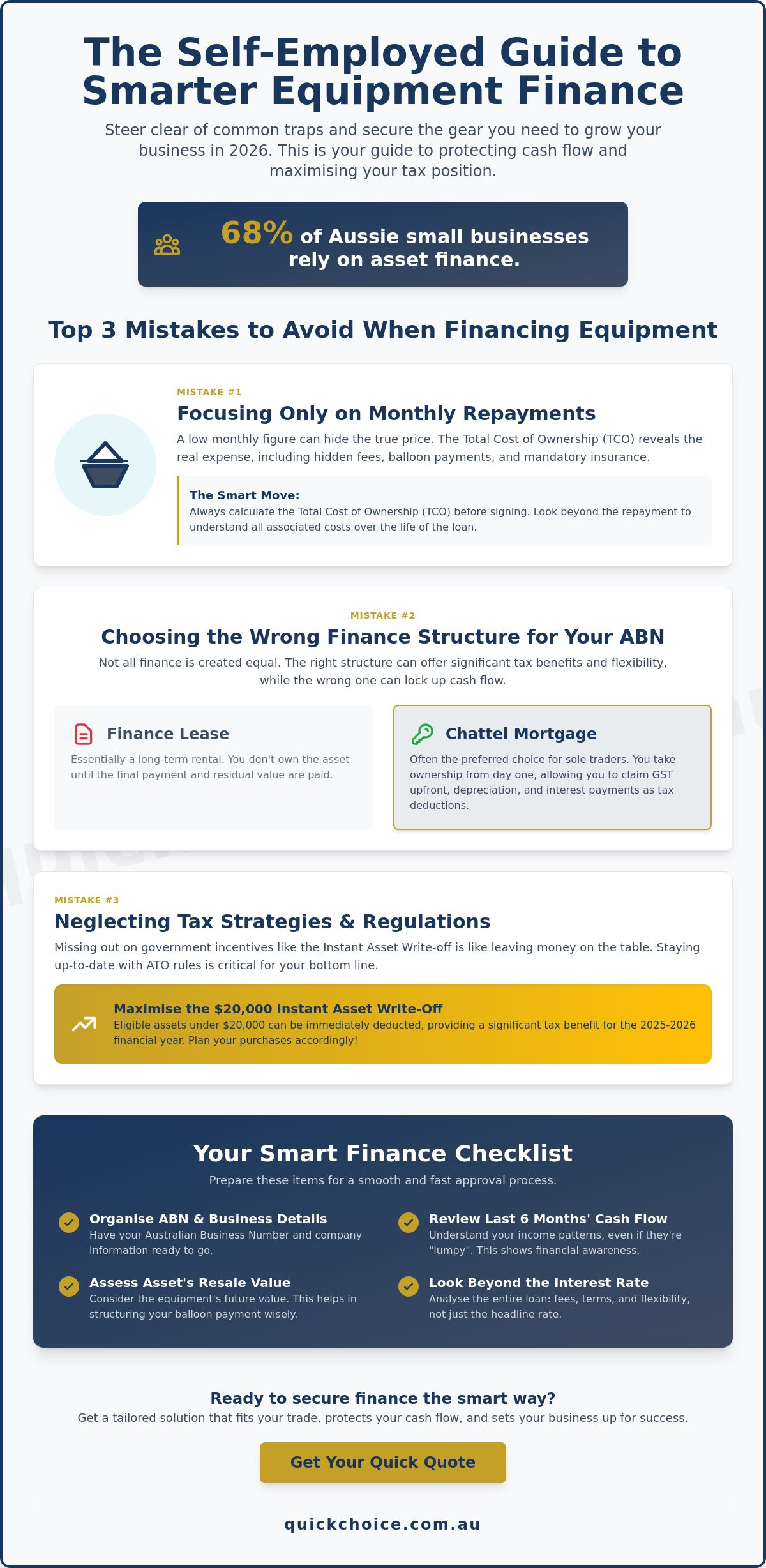
Mistake #1: Focusing on Monthly Repayments Instead of Total Cost
A low monthly figure is incredibly seductive when you're balancing a tight budget. It feels like a safe bet for your cash flow, but prioritising the repayment amount over the total cost is one of the most common mistakes to avoid when financing equipment. Lenders often use these "headline" figures to distract you from the true price of the loan. By the time you factor in high entry fees and a massive final payment, that "bargain" might be the most expensive debt on your books.
True financial clarity comes from looking at the Total Cost of Ownership (TCO). This includes the interest, but it also accounts for mandatory insurance, registration, and the maintenance required to keep the asset operational. For example, some "cheap" finance products come with rigid insurance requirements that cost significantly more than a standard policy. Following Australian Government advice on leasing vs. buying can help you decide which path offers the best long-term value for your specific ABN.
The Reality of Balloon Payments
A balloon payment, often called a residual value, is a lump sum you owe at the end of your loan term. While it keeps your monthly costs down, it means you don't actually own the equipment until that final check clears. Understanding how asset finance works is essential for managing this end-of-term reality. When deciding on a balloon percentage, consider these factors:
- Asset Lifespan: Will the equipment still be valuable and functional when the balloon is due?
- Resale Value: Can you sell the asset for more than the residual amount?
- Tax Strategy: Does a higher residual fit with your accountant's plan for depreciation?
Hidden Fees and the "Fine Print" Trap
The "fine print" is where many great deals go to die. You might find origination fees ranging from 1% to 3% of the loan amount, or monthly account-keeping fees that add hundreds of dollars over a five-year term. Recognising these hidden charges is a key part of identifying mistakes to avoid when financing equipment. Always ask your lender for a "Key Facts Sheet" to see these costs laid out clearly. If you're unsure about the structure, seeking specialist asset finance for the self-employed ensures you're getting a transparent deal tailored to your industry. Look out for early exit penalties too; if your business grows faster than expected and you want to upgrade, a "cheap" loan might charge you thousands just to leave early.
Mistake #2: Choosing the Wrong Finance Structure for Your ABN
Selecting the wrong legal structure for your loan is one of the most technical mistakes to avoid when financing equipment. In Australia, the way your finance is documented changes how you claim GST and how the debt appears on your balance sheet. For a self-employed tradie or a transport operator, picking a structure that doesn't align with your cash flow can lead to a messy tax season. It's not just about getting the gear; it's about how that gear sits within your business's financial framework.
A Chattel Mortgage is currently the dominant choice in the market, accounting for 52% of all equipment finance loans. Under this arrangement, you take ownership of the asset from the day of purchase, and the lender takes a "mortgage" over it as security. This is particularly popular because it allows most businesses to claim the full GST amount on the purchase price in their next BAS. If you operate heavy vehicles out of industrial hubs like Truganina, this upfront GST injection can be a massive boost to your working capital.
Chattel Mortgage vs. Leasing: A 2026 Comparison
The right choice depends on whether you want to own the asset eventually or simply pay for its use. While a Chattel Mortgage suits those wanting ownership, a finance lease or operating lease might be better for those who prefer to upgrade regularly. You can see how commercial asset finance structures vary significantly depending on your specific industry goals.
| Feature | Chattel Mortgage | Finance Lease |
|---|---|---|
| Ownership | You (from start) | Lender (option to buy later) |
| GST Treatment | Claimed upfront | Claimed on repayments |
| Balance Sheet | Asset and Liability | Liability |
Matching the Loan Term to the Asset Life
One of the more subtle mistakes to avoid when financing equipment is stretching the loan term beyond the useful life of the asset. You don't want to be paying off a three year laptop over a five year term; you'll be stuck with debt for a piece of tech that is already in a landfill. If you are investing in specialised machinery for a workshop in Melton or Aintree, align your loan maturity with your planned upgrade cycle. This ensures that when the equipment is ready for the scrap heap, your loan is already paid in full, leaving your credit clear for the next acquisition.
Mistake #3: Neglecting Tax Strategies and 2026 Regulations
Tax time often triggers a scramble for new gear, but rushing into a purchase without a plan is one of the biggest mistakes to avoid when financing equipment. For the 2025-2026 financial year, the Australian Taxation Office (ATO) has confirmed the instant asset write-off threshold is $20,000. This allows eligible small businesses with an aggregated turnover under $10 million to immediately deduct the full cost of assets below this value. While this is a powerful incentive, it shouldn't be your only reason for signing a contract. If the machinery doesn't actively help you grow or save time, the tax deduction won't make up for the cash flow you've lost on repayments.
We understand that being self-employed often means your tax returns aren't always up to date. This shouldn't automatically disqualify you from upgrading your tools. Low-documentation (Low Doc) finance options are specifically designed for this scenario, allowing many business owners to secure funding without providing full, audited financial statements. It's a practical way to maintain momentum even when your paperwork is still being processed by your accountant. If you're ready to see how a tailored structure can work for your ABN, you can explore our asset finance for self employed options to find a solution that fits your current situation.
Maximising Depreciation and Interest Deductions
Beyond the initial write-off, you need to consider the long-term tax benefits of your loan. The interest component of your repayments is generally tax-deductible, which lowers the effective cost of your finance over the life of the agreement. For assets exceeding the $20,000 threshold, you'll likely use general depreciation rules to spread the deduction over the asset's useful life. Primary producers can also access specific tax concessions for capital expenditure on items like water facilities or fencing, providing significant relief for those in the agricultural sector.
Timing Your Purchase for Maximum Benefit
Many tradies in growing hubs like Rockbank or Tarneit wait until the June 30 deadline to sign a deal. While the end-of-financial-year rush offers some incentives, it also brings the risk of supply chain delays. If your equipment isn't "ready for use" by midnight on June 30, you can't claim it in that tax year. Planning your acquisition earlier in the year leads to better finance rates and ensures your gear is on-site and working when you need the deduction most. Avoid the common mistakes to avoid when financing equipment by consulting your accountant early to ensure your purchase timing aligns with your projected income for the year.
The Self-Employed Checklist: Securing Finance the Smart Way
Success in business often comes down to preparation. After identifying the potential mistakes to avoid when financing equipment, the next step is to follow a structured process that guarantees you the best possible outcome for your ABN. This checklist isn't just about paperwork; it's about building a financial profile that lenders trust. By taking these steps now, you'll avoid the last minute stress that often leads to poor decision making.
- Step 1: Organise your ABN and GST registration. Ensure your details are current on the Australian Business Register. Lenders look for a clean, active ABN as the first sign of a legitimate operation.
- Step 2: Review your internal cash flow. Look back at your last six months of bank statements. Lenders in 2026 want to see that you can comfortably manage repayments even during your quieter periods.
- Step 3: Protect your home. Many sole traders mistakenly believe they must use their house as collateral. You should explore asset finance without property security to keep your family home separate from your business machinery.
- Step 4: Engage a specialist. Partner with a broker who understands the local industrial landscape in areas like Werribee and Melton. They know which lenders are currently "appetised" for your specific trade.
Why a Specialist Broker Beats a Big Bank
Walking into a local bank branch often feels like fitting a square peg into a round hole. Banks only have one set of products, and if you don't fit their rigid PAYG-style criteria, you're out of luck. A specialist broker, however, provides access to over 30 different lenders. This competition works in your favour, allowing you to sidestep the common mistakes to avoid when financing equipment. We take the time to understand the unique needs of sub-contractors in Tarneit and Hoppers Crossing, presenting your application in a way that highlights your business's strengths. Quick Choice streamlines this entire process, handling the heavy lifting so you don't have to spend your nights buried in spreadsheets.
Ready to Upgrade Your Gear?
Don't let the fear of red tape or complex tax laws stop you from growing your business. Avoiding costly errors is easy when you have a reliable guide by your side. By seeking professional advice, you'll save hours of time on paperwork and gain the confidence that your finance structure is working for you, not against you. This allows you to stay on the tools and focus on the work that actually generates income. If you're ready to take the next step toward your new equipment, organise a quick chat with the Quick Choice team today and let's get your business moving.
Build Your Business Foundation with Confidence
Building a successful business requires more than just hard work; it demands smart financial decisions that protect your future. By understanding the total cost of ownership and selecting the right structure for your ABN, you've already taken the most important steps toward sustainable growth. You now know that the mistakes to avoid when financing equipment often hide in the fine print or rigid bank policies. The real advantage comes from aligning your equipment needs with the 2026 tax regulations while maintaining a healthy cash flow through the year.
You don't have to manage this complex process alone. As specialists in self-employed finance, we provide access to a wide panel of Australian lenders to find the bespoke solution that fits your specific trade. Our local experts serve business owners from Werribee to Melton, ensuring you get the supportive, high-touch service you deserve without the corporate red tape. Get a quick quote for your next equipment purchase and let's get your business moving forward with confidence. Your new gear is waiting, and we're here to help you secure it today.
Frequently Asked Questions
What is the biggest mistake sole traders make with equipment finance?
The most common error is prioritising a low monthly repayment figure over the total cost of the loan. This is one of the primary mistakes to avoid when financing equipment, as it often masks expensive balloon payments and high effective interest rates. By focusing only on the immediate cash flow, you might end up paying significantly more over the life of the asset than you originally anticipated.
Can I get equipment finance if my tax returns aren't up to date?
You can still secure funding through Low Doc (low documentation) finance options even if your tax returns are overdue. Many lenders in 2026 are willing to assess your application based on your Business Activity Statements (BAS) or recent bank statements. This approach allows self-employed professionals to maintain their momentum without waiting for a completed tax return from their accountant.
Is it better to lease or buy equipment for a new business in 2026?
Buying via a Chattel Mortgage is often preferred by new businesses because it allows you to claim the full GST amount on the purchase price upfront. However, leasing can be a better fit if you want to preserve your initial capital and don't require immediate ownership. Your choice should depend on whether your priority is an immediate tax benefit or maintaining maximum liquidity.
How does a balloon payment affect my GST claim?
A balloon payment doesn't change the amount of GST you can claim at the start of a Chattel Mortgage. You're still entitled to claim the GST on the total purchase price in your next Business Activity Statement. This provides a helpful cash injection for your business, even though a portion of the loan principal is deferred until the end of the term.
Do I need to provide my house as security for a Bobcat or Ute loan?
You generally don't need to use your home as collateral for standard equipment loans. Asset finance is typically secured by the machinery or vehicle itself, which protects your personal property from business risks. This "asset-backed" structure is a key reason why many tradies prefer specialised finance over traditional unsecured business loans that might require property as backing.
What documents do I need for a Low Doc equipment loan?
To qualify for a Low Doc loan, you'll typically need an active ABN that has been registered for at least six months. Most lenders will also require a copy of your driver's licence and recent bank statements to verify that your monthly revenue meets their minimum standards. This streamlined process is designed to get you back on the tools faster by reducing the administrative burden.
How long does the equipment finance approval process usually take?
The approval process is remarkably efficient in 2026, with many lenders providing a decision within 24 to 72 hours. If you have your ABN details and bank statements ready, the transition from application to settlement can happen in just a few business days. This speed is essential for sub-contractors who need to replace broken gear or secure a new machine for an upcoming project.
Can I finance used equipment from a private seller?
Financing used equipment from a private seller is definitely possible, though it involves a few more checks than buying from a dealer. Lenders will usually require an independent valuation or a mechanical inspection to confirm the asset's condition. They'll also perform a PPSR check to ensure there's no existing finance owing on the equipment before they release the funds.