
What if your contract's run card was more valuable than a pile of tax returns when applying for your next delivery vehicle? Being an owner-driver is one of the most rewarding ways to run a business in Australia, but traditional banks often make you feel like a second-class citizen because you don't have a standard payslip. You're out there every day meeting the demands of a last-mile delivery market now valued at over $4.14 billion, yet the struggle to secure competitive courier van finance australia wide remains a major roadblock for many ABN holders.
We understand that you need a partner who looks at your future potential, not just your past paperwork. This guide promises to help you discover the most flexible and tax-effective finance structures specifically tailored for sole traders. We'll show you how to bypass the confusion of high interest rates and bank delays so you can get on the road quickly with repayments that match your income cycle. We'll explore the latest low-doc loan requirements for 2026, the specific benefits of chattel mortgages, and the new regulatory changes, such as the SMS Sender ID Register, that will impact your operations this year.
Key Takeaways
- Learn why specialised commercial asset finance is essential for owner-drivers with fluctuating income who need more flexibility than a standard car loan offers.
- Explore the specific tax benefits of various finance structures, including how a Chattel Mortgage can help you claim GST on the purchase price upfront.
- Discover the pathway to securing courier van finance australia wide through Low Doc options that don't require you to have your most recent tax returns finalised.
- Get a clear comparison of the 2026 vehicle market to see how different models like the Toyota HiAce or Ford E-Transit fit within strict lender age limits.
- Understand the advantage of partnering with a local specialist who can align your repayments with your specific delivery contract income and regional requirements.
Navigating the 2026 Delivery Landscape: Why Specialist Courier Van Finance Matters
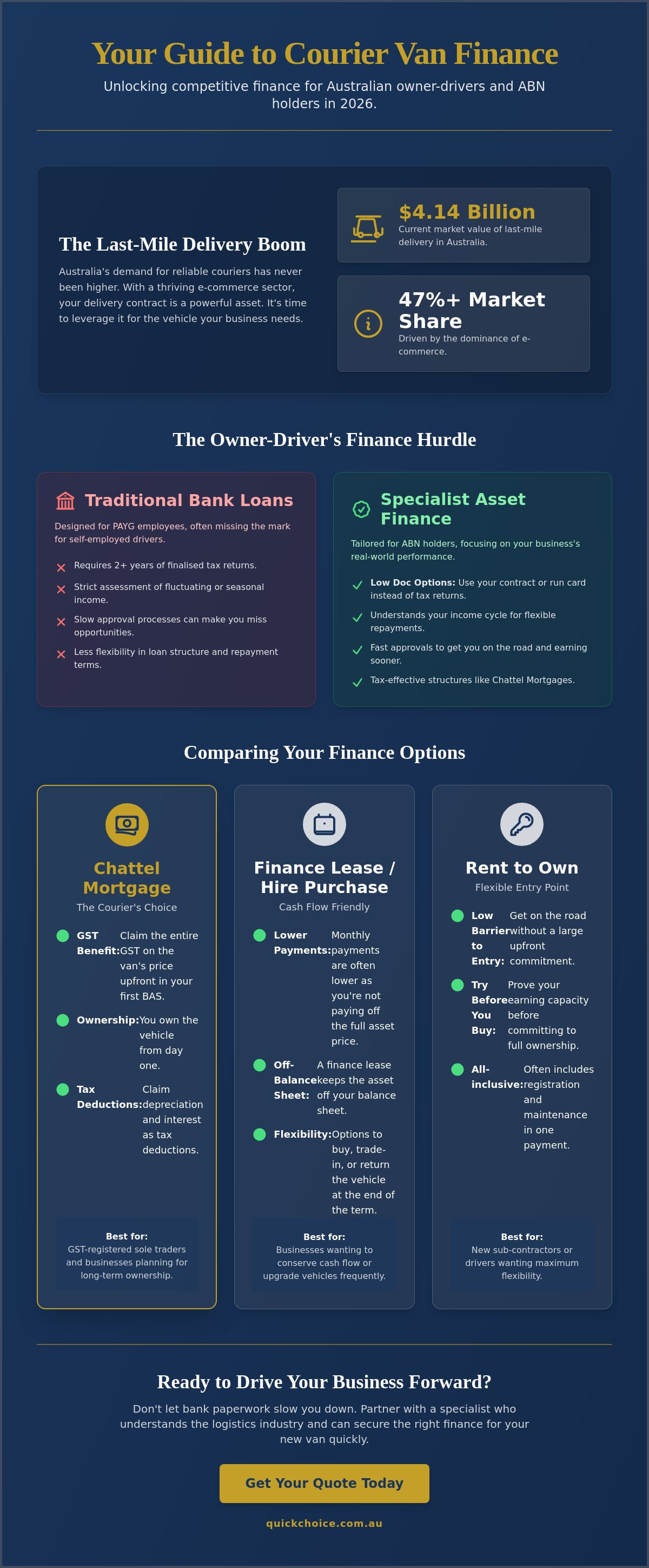
The Australian last-mile delivery market has reached a staggering value of USD 4.14 billion in 2026. This growth isn't just a figure on a spreadsheet; it's visible on the ground in high-growth logistics corridors like Truganina, Tarneit, and Rockbank. As e-commerce continues to dominate, accounting for over 47% of the market, the demand for reliable owner-drivers has never been higher. Scaling your business to meet this demand requires more than just a driver's licence. It requires a strategic approach to courier van finance australia wide to ensure your fleet is modern, efficient, and cost-effective.
For many sole traders, the initial instinct is to head to a local bank for a standard car loan. These consumer products are designed for salaried employees with predictable payslips. They often fail to account for the unique financial realities of a delivery professional. Choosing a specialised commercial asset loan instead allows you to preserve your vital cash flow. Rather than tying up your working capital in a depreciating asset, you can use tailored finance to get on the road while keeping your cash reserves for fuel, maintenance, and growth. This is the core benefit of understanding asset-based lending, where the vehicle itself provides the security for the loan.
The Shift in Last-Mile Logistics
The evolution of online shopping has fundamentally changed what a modern delivery contract looks like. With same-day delivery segments expanding at a CAGR of 6.06%, the pressure for efficiency is immense. Lenders now recognise that a solid delivery contract with a major carrier is a significant strength in your application. Your run card and contract stability can often carry more weight than a traditional credit score. Courier van finance is a specialised commercial funding tool designed to help ABN holders acquire delivery vehicles by leveraging the asset's value rather than relying on traditional personal income evidence.
Why Banks Often Say No (and Why We Say Yes)
Traditional lenders often hesitate when they see seasonal income fluctuations or a "new business" status. If you haven't been trading for two years or don't have current tax returns ready, a big bank will likely reject your application. This is where a specialist broker becomes your most valuable partner. We act as a bridge, translating your business success and contract stability into a language that commercial lenders understand. At Quick Choice, we focus specifically on asset finance for the self-employed. We know that in the fast-paced world of Melbourne's western suburbs, you need a partner who values your time and understands the specific needs of the logistics industry.
Comparing the Best Finance Options for Australian Delivery Drivers
Selecting the right vehicle is only half the battle. The structure of your courier van finance australia wide determines how much money stays in your pocket each month. For owner-drivers, the choice usually comes down to three primary paths: a Chattel Mortgage, a Finance Lease, or a Hire Purchase. Each has unique tax implications, especially regarding how you handle GST. If you're registered for GST, a Chattel Mortgage often allows you to claim the entire GST amount on the van's purchase price in your very first Business Activity Statement (BAS) after purchase. This can provide a massive boost to your working capital during those critical first months on a new run.
For those just starting out or working as new sub-contractors, "Rent to Own" models offer a flexible entry point. These arrangements often have lower barriers to entry, allowing you to prove your earning capacity before committing to long-term ownership. Regardless of the path you choose, incorporating a balloon payment is a smart way to keep your business lean. By deferring a portion of the loan until the end of the term, you reduce your monthly commitments, ensuring your repayments align comfortably with your contract income. Getting the right advice early can save you thousands over the life of your loan. You might want to speak with a specialist to see which structure fits your current tax position.
Chattel Mortgage: The Tradie and Courier Favourite
Ownership from day one is a major advantage for most delivery professionals. With a Chattel Mortgage, the van belongs to your business, and the lender simply takes a "mortgage" over it as security. This structure is ideal for those looking to take advantage of depreciation and interest as tax deductions. When setting up this loan, we often recommend structuring the balloon payment to match the expected resale value of your van. This ensures you aren't left with a debt higher than the vehicle's worth when it's time to upgrade. For a deeper dive into the general rules surrounding these loans, check out our guide on asset finance for self employed professionals.
Finance Leasing vs. Operating Leases
The difference between "using" and "owning" is the core of the leasing debate. In a finance lease, the lender buys the vehicle and leases it to you for a set period. At the end, you can often pay a residual and take ownership. An operating lease is different; it's more like a long-term rental. This often suits drivers who prefer to upgrade their van every three years to stay under warranty and maintain a professional image. Operating leases can offer "off-balance sheet" benefits, meaning the van doesn't appear as a liability on your books, which can be helpful if you're looking to secure other types of business funding simultaneously.
Overcoming the Paperwork Hurdle: Low Doc Loans for ABN Holders
One of the biggest obstacles for owner-drivers is the traditional bank's demand for two years of finalised tax returns. If you're currently working through the 2025/2026 financial year and haven't had your accountant sign off on your latest figures, you might think your options for courier van finance australia wide are limited. This is where Low Doc (Low Documentation) finance becomes a vital tool. It's specifically designed for self-employed professionals who have a profitable business but don't have the traditional paperwork ready for a standard assessment.
Instead of relying solely on tax returns, Low Doc lenders look at alternative evidence of your business's health. This approach acknowledges that your bank statements and Business Activity Statements (BAS) often tell a more current story of your success than a tax return from eighteen months ago. We work with lenders who accept various proofs of income, such as your last six months of bank statements, recent BAS, or a simple letter from your accountant confirming your earning capacity. This flexibility ensures you don't miss out on a contract because you're waiting for your paperwork to catch up with your growth.
The Power of the ABN
The length of your ABN registration plays a significant role in the interest rate you'll secure. For example, as of June 2026, ABN holders with only three months of registration can access rates starting from 9.2%. However, once your ABN has been active for two years, those rates can drop significantly to around 5.7%. While "No Doc" options exist for those with almost no paperwork, they typically carry higher interest rates. Taking the time to organise your bank statements to show consistent delivery income can move you from a "No Doc" to a "Low Doc" category, saving you thousands in interest over the term of your loan.
Strategies for New Sub-Contractors
If you're just starting out, your delivery contract is your most powerful asset. Securing a letter of intent from a major courier company like Australia Post or Toll can act as a guarantee of future income for many lenders. This is a strategy we frequently use for low doc truck loans for owner drivers, and it works just as effectively for van finance. Lenders are also more inclined to approve applications for drivers based in high-demand logistics hubs like Melton or Werribee. They recognise that the sheer volume of last-mile delivery work in these areas provides a natural safety net for your business's cash flow.
Selecting the Right Workhorse: Matching Finance to Your Vehicle Type
The van you choose is your mobile office and your primary tool for generating revenue. In 2026, the Australian market offers a diverse range of vehicles, each suited to different contract types. The Toyota HiAce remains a staple for its legendary reliability, while the Mercedes-Benz Sprinter is the preferred choice for those needing maximum volume. We're also seeing a massive surge in the Ford E-Transit as urban delivery routes transition toward sustainability. When choosing between these models, it's vital to consider how the vehicle's age and type will impact your courier van finance australia application.
Lenders generally offer the most competitive rates for new vehicles, but used vans are still a viable option for many owner-drivers. Most commercial lenders have a "year-end" rule, typically requiring the vehicle to be no older than 12 years at the conclusion of the finance term. This means if you're looking at a five-year loan, the van usually needs to be seven years old or newer at the time of purchase. You can also bundle the cost of your "fit-out" into the loan. This includes essential business equipment like shelving, refrigeration units, and professional branding, allowing you to get a quote for your van fit-out that covers the entire ready-to-work price.
Small Vans vs. Large Pantechs
The Gross Vehicle Mass (GVM) of your chosen workhorse dictates the type of finance structure you'll need. Standard delivery vans typically fall under a 4.5-tonne GVM, allowing them to be financed as light commercial vehicles. However, if your contract requires a larger pantech or a vehicle with a heavy-duty lift, you may move into the realm of heavy vehicle lending. These larger assets often have different depreciation schedules and lender requirements. For those scaling up to larger vehicles, our guide on self employed truck finance provides specific strategies for pantech and light truck owners.
The Electric Van Revolution in 2026
Switching to an electric vehicle (EV) for your delivery run is now more financially viable than ever. The Australian government has introduced significant incentives, including exemptions or reductions in Fringe Benefits Tax (FBT) for eligible zero-emission work vehicles. When calculating your total cost of ownership, the higher upfront price of an EV is often offset by drastically lower fuel and maintenance costs over a four-year period. Green asset finance can reduce monthly interest costs by rewarding your commitment to zero-emission logistics. We help you navigate these specialised rates to ensure your move to a sustainable fleet is as profitable as it is professional.
Driving Your Business Forward with Quick Choice’s Asset Finance Expertise
Success in the courier industry often hinges on who you have in your corner. While we've explored the technical side of courier van finance australia wide, the practical reality is that you need a partner who understands your local route. Quick Choice isn't a distant, faceless lender. We are specialists embedded in the heart of Melbourne's western logistics corridor. We know the difference between a local parcel run in Rockbank and a heavy-duty contract originating out of Laverton or Aintree. This local insight allows us to present your application to lenders with the specific context they need to approve your loan quickly.
Our process is designed to match the speed of your business. We know that every day your van isn't on the road is a day of lost revenue. From our initial consultation to having the keys in your hand, we aim for a turnaround in as little as 24 to 48 hours. We don't just secure a loan; we build a foundation for your future. Whether you're an individual owner-driver starting your first run or an established operator looking to add a fifth vehicle to your fleet, our goal is to be your long-term collaborator. We take pride in seeing our clients grow from a single van to a full-scale delivery fleet.
Your Local Finance Partner in Western Melbourne
Being close to major distribution centres in Truganina and Hoppers Crossing gives us a unique perspective. We understand the contract requirements of the major carriers operating in these hubs. This means we can often anticipate the documentation a lender will ask for before they even ask. For busy drivers, we offer total flexibility. We can meet you on-site at a depot or handle the entire application digitally while you're between drops. As your business evolves, we are ready to assist with more than just vans. We have extensive expertise in trailer finance for owner operators who are ready to scale into heavier transport loads.
Ready to Get on the Road?
Securing competitive and flexible finance shouldn't be the hardest part of your job. By choosing a specialised broker, you gain access to structures that protect your cash flow and maximise your tax position. You deserve a finance partner who values your contract as much as you do. Take the first step toward growing your delivery business with a team that understands the Australian owner-driver landscape inside and out. Organise your courier van finance with Quick Choice today and experience a streamlined, professional approach to asset finance.
Scaling Your Delivery Business in 2026
Securing the right vehicle is the most significant investment you'll make as an owner-driver. We've seen how choosing a specialised structure like a Chattel Mortgage can provide immediate tax advantages, while Low Doc options ensure that a lack of current tax returns won't stand in your way. By matching your finance to your specific vehicle type, whether it's a traditional diesel workhorse or a modern electric transit, you position your business for long-term profitability in a competitive market. Taking the time to align your repayments with your contract income is the smartest move you can make for your cash flow.
At Quick Choice, we've been specialists in asset finance for the self-employed since 2017. As local experts serving Melbourne’s western logistics hubs, we provide you with access to a wide panel of commercial lenders specifically for ABN holders. We don't just find you a loan; we help you manage courier van finance australia wide so you can focus on the road ahead. Your next contract is waiting, and we're here to help you secure the equipment you need to deliver it. Apply for Courier Van Finance with Quick Choice today and let's get your business moving. You've got the drive, and we've got the expertise to back you every kilometre of the way.
Frequently Asked Questions
Can I get courier van finance with a new ABN in Australia?
Yes, you can secure finance with a new ABN, though your options depend on how long you've been registered. Lenders often consider applicants with an ABN active for as little as three months. While interest rates for newer businesses are typically higher than for established operators, your delivery contract acts as a powerful supporting document. For example, in 2026, rates for a three-month ABN can start around 9.2%, while those with two years of history may access rates as low as 5.7%.
What is the difference between a car loan and a courier van chattel mortgage?
A car loan is a consumer product designed for salaried employees, whereas a chattel mortgage is a commercial loan tailored for business use. With a chattel mortgage, your business takes ownership of the van from day one, allowing you to claim the GST on the purchase price in your next Business Activity Statement. This structure is specifically designed to support the cash flow of self-employed drivers and offers different tax depreciation benefits compared to personal finance products.
Do I need a deposit for courier van finance in 2026?
No, a deposit isn't always mandatory for courier van finance australia wide. Many lenders offer 100% finance to ABN holders who have been trading for at least two years or who are asset-backed. However, if you are a new sub-contractor or have a shorter ABN history, providing a deposit can help reduce your monthly repayments. It may also assist in securing a more competitive interest rate from certain commercial lenders who view a deposit as a sign of lower risk.
Can I finance a used delivery van from a private seller?
Yes, you can finance a used delivery van from a private seller, though the process involves a few extra steps compared to buying from a dealership. Lenders usually require an independent vehicle inspection or a formal valuation to confirm the van's worth. They also perform a PPSR check to ensure the vehicle is free of any existing debt. This ensures the asset you're buying is a sound investment for both you and the finance provider before funds are released.
How much can I borrow for a delivery vehicle without providing tax returns?
Borrowing limits for low-doc loans vary, but many lenders offer up to $150,000 for a single vehicle without requiring full tax returns. Some specialised commercial lenders may extend this limit higher if you have a strong ABN history and clear bank statements. The key is providing alternative proof of income, such as recent Business Activity Statements, to demonstrate that your business can comfortably manage the monthly repayments without the need for finalised financial statements.
Is the interest on my courier van loan tax-deductible?
Yes, the interest on your courier van loan is generally tax-deductible when the vehicle is used for business purposes. Because a delivery van is a core business asset, you can usually claim the interest component of your repayments and the vehicle's depreciation as legitimate business expenses. We always recommend consulting with your accountant to understand how these deductions apply to your specific tax bracket and business structure to ensure you're maximising your courier van finance australia benefits.
What happens if I have a bad credit history but a steady delivery contract?
You can still secure finance with a less-than-perfect credit history, particularly if you have a steady contract with a reputable courier company. Specialist lenders often place more value on your current earning capacity and the strength of your delivery run than on past credit issues. Providing a letter of intent from your contractor can significantly strengthen your application by showing a guaranteed source of income that will be used to cover the loan repayments.
How long does the approval process take for a self-employed van loan?
The approval process for a self-employed van loan is remarkably fast when you work with a specialist broker. Most applications are assessed and approved within 24 to 48 hours. Once you provide the necessary documents, such as your ABN details and recent bank statements, we move quickly to secure a formal offer from our panel of lenders. This speed ensures you don't lose out on a vehicle or a new contract opportunity while waiting for bank paperwork.