
What if your new truck or excavator could pay for its own monthly instalments while your bank balance stayed untouched? For many of the 2.7 million trading businesses in Australia, equipment isn't just a cost; it's the engine that drives revenue. You've likely wondered, how does asset finance work when you don't have a standard payslip to show a big bank? It's a common frustration for ABN holders who feel overlooked by traditional lenders but still need to scale their operations to meet demand.
We understand that choosing between a chattel mortgage and a finance lease can feel overwhelming when you're busy running a business. This guide simplifies the process, showing you how to secure essential tools without draining your working capital. You'll learn how to leverage the $20,000 instant asset write-off and identify the right structure to maximise your tax benefits. We'll provide the clarity you need to get your equipment on the road and start earning sooner.
Key Takeaways
- Understand how to separate business equipment debt from personal finances to protect your credit and improve your borrowing power.
- Learn exactly how does asset finance work through a streamlined process that moves from your initial supplier quote to final approval.
- Compare structures like chattel mortgages and finance leases to identify which option aligns with your specific GST and ownership goals.
- Explore "Low Doc" finance pathways that allow you to secure equipment quickly without the need for extensive tax returns or BAS history.
- Discover the benefits of using a specialist brokerage to access tailored lending solutions that big banks often overlook for self-employed Australians.
What is Asset Finance and Why is it Essential for Australian Small Businesses?
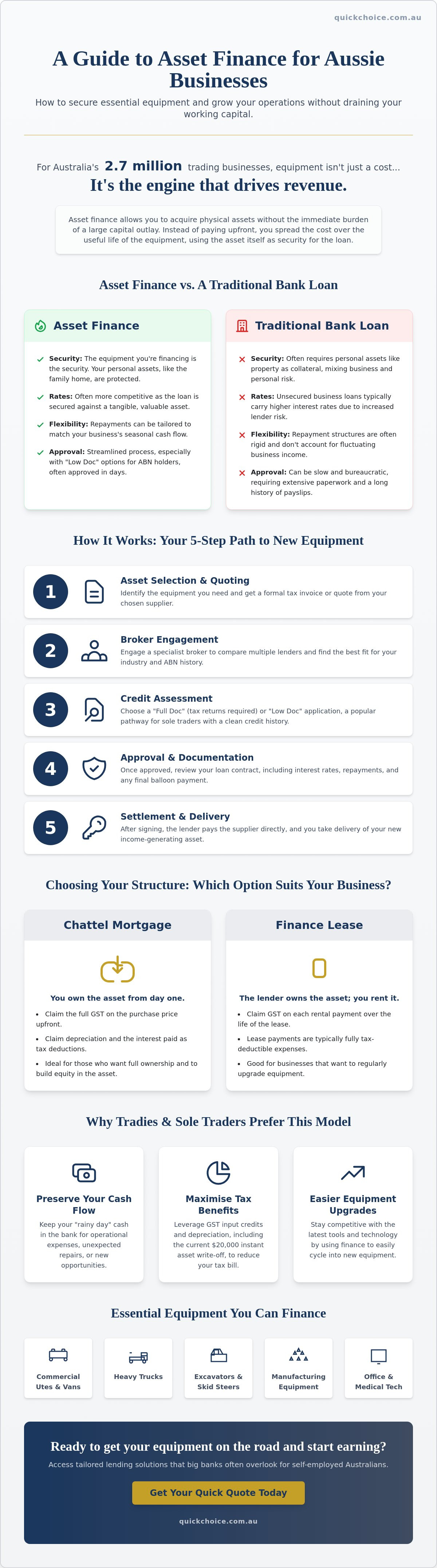
Asset finance is a strategic funding solution that allows your business to acquire physical assets without the immediate burden of a large capital outlay. Instead of paying the full purchase price upfront, you spread the cost over the useful life of the equipment. This is a specialised form of asset-based lending where the value of the machinery or vehicle itself provides the security for the loan. Understanding how does asset finance work is the first step toward growing your business without compromising your liquidity.
This model differs significantly from a personal car loan or an unsecured business loan. Personal loans rely heavily on your individual credit score and regular payslips, which can be a hurdle for the self-employed. Unsecured business loans often carry higher interest rates because the lender has no collateral to claim if things go wrong. Asset finance bridges this gap by using the asset as security, which generally results in more accessible approvals and lower rates for ABN holders.
The primary benefit is the preservation of your "rainy day" cash. By keeping your capital in the bank, you maintain a buffer for operational expenses, unexpected repairs, or sudden opportunities. Many Australian businesses use this to fund a variety of essential items:
- Commercial utes, vans, and heavy trucks.
- Construction machinery like excavators and skid steers.
- Specialised manufacturing or medical equipment.
- High-end office technology and hardware.
The Difference Between Asset Finance and a Traditional Bank Loan
Traditional bank loans are often rigid and slow. They may require a lien over your family home or other personal property to secure the funds. Asset finance is different because the equipment acts as the collateral. Because the lender has a tangible asset to secure the debt, they can often offer more competitive interest rates than you would find with a standard business loan. You also gain access to flexible repayment structures. You can often tailor your payments to match your specific seasonal cycles, providing a level of agility that big banks rarely offer to sole traders.
Why Tradies and Sole Traders Prefer This Model
For most Australian tradies, your gear is what generates your income. It makes sense to align your repayments with the revenue that the equipment produces. This keeps your daily cash flow steady and predictable. Understanding how does asset finance work also reveals significant tax advantages. Depending on your business structure, you might be able to claim GST input tax credits upfront and benefit from depreciation or the current A$20,000 instant asset write-off. This model also makes it simpler to upgrade your equipment regularly, ensuring you always have the most efficient tools to stay ahead of your competition.
The Mechanics: How Asset Finance Works Step-by-Step
To truly understand how does asset finance work, you need to view it as a logical sequence designed to protect your time and your capital. The process is more streamlined than a standard home mortgage, often taking only a few business days from your initial enquiry to the moment you take delivery. It begins with your business needs and ends with a productive asset ready to generate income.
- Step 1: Asset Selection and Quoting. You identify the specific equipment you need. Obtain a formal tax invoice or quote from the supplier, ensuring it includes any delivery costs or specialised fit-outs.
- Step 2: Broker Engagement. Engaging a specialist asset finance broker allows you to compare multiple lenders without multiple hits to your credit file. Your broker assesses which banks have the best "appetite" for your specific industry and ABN history.
- Step 3: Credit Assessment. You choose between a "Full Doc" application, requiring complete tax returns, or a "Low Doc" pathway. Low Doc is a popular choice for sole traders who have been trading for at least 12 to 24 months and have a clean credit history.
- Step 4: Approval and Documentation. Once the lender gives the green light, they issue a loan contract. You review the interest rates, monthly repayments, and any "balloon" payments at the end of the term.
- Step 5: Settlement. After you sign the documents, the lender moves to settlement. This is the final stage where funds are transferred to the vendor, allowing you to collect your equipment.
Choosing the Right Equipment for Your Business Goals
The age and origin of your equipment play a massive role in your finance options. Lenders generally prefer new assets or used equipment that will be no more than 12 years old at the end of the loan term. While buying from a dealership is straightforward because they handle the registration and GST paperwork, private sales are also possible. If you choose a private seller, your broker will need to perform extra due diligence, such as a PPSR search, to ensure the asset is free from existing debt. Always verify that the equipment is fit for purpose before signing, as the finance contract is binding once settlement occurs.
The Settlement Process: From Paperwork to Ignition
Settlement usually takes place within 24 to 48 hours of the lender receiving your signed documents. A key detail in how does asset finance work is that the lender pays the supplier directly. You won't see the cash hit your business account; instead, the lender settles the invoice on your behalf to ensure the security is properly established. Before this happens, you must provide proof of comprehensive insurance with the lender noted as the interested party. This protects both your business and the financier's interest from day one, ensuring you can get on the road or the job site with total peace of mind.
Comparing the Structures: Which Asset Finance Type Suits You?
Selecting the right structure is just as vital as choosing the right piece of equipment. While you now understand the basic steps of how does asset finance work, the specific contract type you sign determines your tax position, ownership rights, and monthly obligations. In Australia, the four primary structures serve different business needs based on your cash flow and long-term growth plans.
- Chattel Mortgage: The most common choice for small businesses where you own the asset from day one.
- Finance Lease: A rental-style agreement where the lender owns the asset and you pay for its use.
- Commercial Hire Purchase (CHP): A structure where you gain ownership only after the final payment is made.
- Operating Lease: Best for assets with a high risk of becoming obsolete, such as IT hardware or specialised medical tech.
Chattel Mortgages: The Tradie’s Favourite for 2026
Recent industry data shows that chattel mortgages account for 52% of all asset finance loans in Australia. This popularity stems from the significant cash flow advantages it offers to ABN holders. Under this structure, you take ownership of the equipment immediately while the lender takes a mortgage over the chattel as security. This allows you to claim the full GST amount on the purchase price as an input tax credit in your next Business Activity Statement (BAS). Furthermore, you can leverage the A$20,000 instant asset write-off, which remains available for businesses with a turnover under A$10 million until June 30, 2026. These depreciation benefits directly offset your taxable income, making it a powerful tool for reducing your end-of-year tax bill.
Leasing vs Buying: A Quick Decision Framework
Deciding between a lease and a purchase often comes down to how long you intend to keep the asset. If you are looking at a long-term investment you plan to use for a decade, a chattel mortgage is usually the superior choice. However, if you prefer to keep equipment off your balance sheet to maintain a better debt-to-equity ratio, a finance lease may be more appropriate. It's a flexible way to manage your fleet without the long-term commitment of ownership.
When reviewing your options, pay close attention to "balloon payments" or "residual values." These are lump sums due at the end of your term, which is typically five years for most Australian business loans. A larger balloon payment reduces your monthly repayments today but requires a plan for that final cost. You might choose to pay it out, refinance the remaining amount, or sell the asset to cover the balance. Understanding these mechanics ensures you select a structure that supports your daily cash flow while protecting your future profits.
Asset Finance for the Self-Employed: Eligibility and ABN Requirements
Many sole traders worry that their self-employed status is a barrier to growth. The truth is that lenders have specific products designed for ABN holders that don't require the same paperwork as a standard home loan. If you've been trading for at least two years, you'll generally have access to the widest range of lenders and the most competitive rates. However, if your ABN is newer, perhaps between 6 and 12 months, options still exist. Lenders in this space often look for "replacement" assets or a deposit to mitigate the risk of a shorter trading history.
Understanding how does asset finance work for newer businesses requires looking at "Low Doc" pathways. These products allow you to secure funding without providing full tax returns or profit and loss statements. Instead, lenders focus on your ABN longevity, your credit score, and your bank statements to verify cash flow. Being GST registered is another major advantage. Many financiers view GST registration as a sign of a mature, revenue-generating business; this can often open doors to more favourable terms and higher lending limits.
Understanding Low Doc and No Doc Options
Low Doc finance is a game-changer for independent professionals. You'll typically only need to provide your ABN, a few months of bank statements, and a self-declaration of income. This streamlined approach removes the stress of waiting for your accountant to finalise last year's returns. While there's a small trade-off, you might encounter slightly higher interest rates compared to a full documentation loan, most business owners find this a fair exchange for the speed. It allows you to grab an opportunity or replace broken gear without a month-long wait for approval.
Common Objections: "Will the Bank Reject Me?"
The fear of rejection is real for sub-contractors and sole traders. Big banks often have rigid criteria that don't account for the unique nature of self-employment. Specialist brokers play a vital role here by presenting your "case" to lenders who specialise in your specific industry. If you're in transport or construction, certain lenders have a higher appetite for your equipment because they understand its resale value. Your credit score remains a factor, but a specialist can help explain minor blips or highlight your business's strengths to secure an approval. If you're ready to see which options fit your current ABN status, you can apply for asset finance for the self-employed today.
How does asset finance work when your industry is considered "high risk"? It comes down to the quality of the asset and your repayment history. Lenders are much more comfortable with a well-maintained vehicle or a piece of machinery that has a clear purpose in your daily operations. By focusing on these strengths, you can overcome the hurdles that often stop a traditional bank application in its tracks.
Making it Happen: How Quick Choice Streamlines Your Finance
We've walked through the mechanics, the structures, and the eligibility. Now, it's time to put those tools to work for your business. Choosing a specialist brokerage over a traditional bank is often the difference between a fast approval and a frustrating rejection. While big banks use rigid algorithms that often penalise the self-employed, we take a high-touch approach. We understand that your tax returns might not tell the whole story of your business's success. By handling the complex paperwork and lender negotiations, we ensure you stay on the tools while we secure your next vehicle or machine.
Our role is to demystify the question: how does asset finance work for my specific ABN? We don't offer generic advice. Instead, we match your business profile with lenders who have a proven appetite for your industry, whether that's transport, earthmoving, or specialised trades. This bespoke approach ensures that the finance structure you choose today supports your growth for years to come.
Bespoke Support for Western Melbourne Business Owners
Western Melbourne is a powerhouse of industrial growth. If you operate out of the Truganina or Tarneit industrial hubs, you need a partner who understands the local landscape. We support business owners in Werribee, Melton, and Caroline Springs who are looking to scale their operations. Our team knows the unique challenges Victorian tradies face, from seasonal fluctuations to the specific equipment requirements of local infrastructure projects. You can dive deeper into the specifics of asset finance for self employed in our comprehensive 2026 guide.
From Application to Approval: Your Next Steps
Getting started is a straightforward process. During our initial consultation, we'll discuss your equipment needs and your current business goals. Have your ABN and a supplier quote ready to go. For urgent equipment needs in 2026, we utilise a fast-track process designed to move from application to settlement in as little as 24 to 48 hours. This efficiency ensures you don't miss out on a contract because you lack the right gear. Understanding how does asset finance work in practice means knowing that the right partner handles the admin so you can focus on the job. Organise your finance with Quick Choice today and experience a partnership built on reliability and local expertise.
Drive Your Business Forward with Confidence
You've seen how asset finance protects your cash flow while letting you use the latest equipment to grow your revenue. By choosing the right structure, like a chattel mortgage, you can claim GST upfront and leverage the A$20,000 instant asset write-off to lower your tax bill. Understanding how does asset finance work gives you the confidence to bypass rigid bank requirements and find a solution that fits your actual trading history. It transforms equipment from a massive upfront expense into a manageable monthly tool that pays for itself.
At Quick Choice, we're specialists in supporting ABN holders and self-employed professionals who need a faster, more reliable way to fund their gear. Our team provides deep local expertise across Western Melbourne suburbs and gives you direct access to a wide panel of commercial lenders. We handle the heavy lifting of the application process so you can stay focused on your clients. Get a Tailored Asset Finance Quote from Quick Choice today and let's get your new equipment on the road. Your next stage of growth is well within reach.
Frequently Asked Questions
How does asset finance differ from a standard business loan?
Asset finance is specifically secured by the equipment you are purchasing, whereas a standard business loan is often unsecured or tied to real estate. Because the lender has the asset as collateral, they can typically offer lower interest rates and a faster approval process. This makes it a more efficient choice for acquiring vehicles or machinery compared to general-purpose business funding.
Can I get asset finance if I have only just started my ABN?
Yes, you can secure finance with a new ABN, though your choice of lenders might be narrower than an established business. Some specialised lenders offer "New ABN" products for those trading for as little as six months, often requiring a small deposit or proof of prior industry experience. A broker helps identify which financiers have the highest appetite for newer ventures.
What is a balloon payment and should I include one in my contract?
A balloon payment is a pre-set lump sum due at the end of your loan term that lowers your monthly repayments. It’s a useful tool for managing daily cash flow, but you must have a plan to pay it out, refinance, or sell the asset when the term ends. Most Australian sole traders find that a five-year term with a balloon payment provides the best balance.
Is the interest on asset finance tax-deductible for sole traders?
The interest portion of your repayments is generally tax-deductible provided the asset is used for business purposes. If you choose a chattel mortgage, you can also claim depreciation and GST credits, which can significantly reduce your taxable income. It’s always best to verify your specific eligibility with a qualified accountant to ensure you're maximise your end-of-year returns.
What happens if I want to sell the equipment before the finance is paid off?
You can sell the equipment at any time, but the outstanding loan balance must be settled with the lender first. Since the financier holds a registered interest on the Personal Property Securities Register (PPSR), the title isn't clear until the debt is paid. Once you pay the payout figure, the lender releases their security, and you can transfer ownership to the buyer.
Do I need to provide my house as security for asset finance?
No, you typically don't need to use your family home as security because the asset itself serves as the collateral. This is a fundamental part of how does asset finance work for self-employed Australians, as it keeps your business debt separate from your personal property. It provides a safer way to grow your fleet or workshop without putting your personal residence at risk.
How long does the approval process typically take for self-employed applicants?
Approvals for self-employed applicants generally take between 24 and 48 hours when you have your documentation ready. If you opt for a Low Doc pathway, the process is even faster because the lender requires fewer financial statements. Having your ABN details and a formal supplier quote ready before you apply will ensure you get a decision as quickly as possible.
Can I finance used equipment from a private seller?
Yes, you can finance used equipment from a private seller, provided the asset meets the lender's age and condition criteria. The process involves a few extra steps, such as an inspection and a PPSR search to ensure the item is free of existing debt. Your broker will coordinate with the seller to verify their details and ensure the funds are transferred securely.


