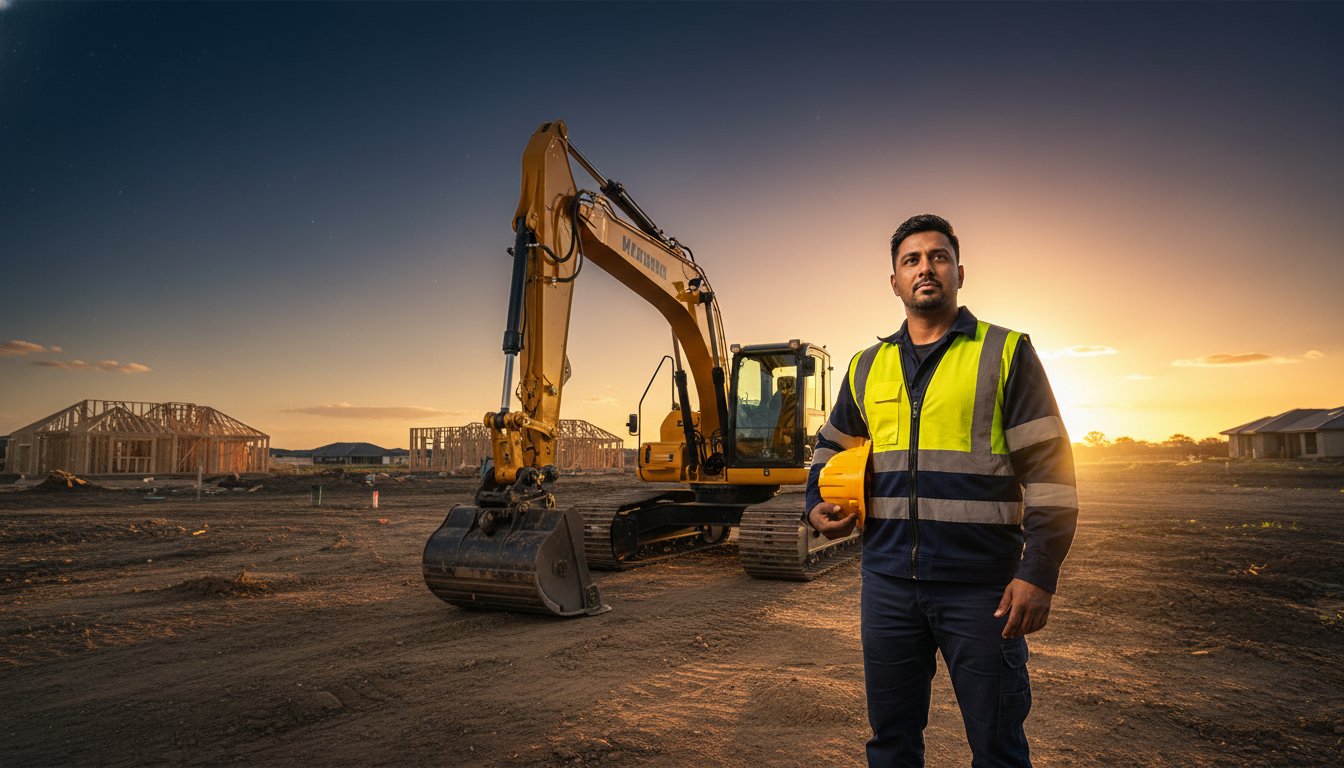
Imagine standing on a job site in Melbourne’s West, watching a lucrative contract slip through your fingers because your current gear isn't up to the task. You know you need that new excavator or delivery van today, but the thought of digging through two years of tax returns just to satisfy a bank's red tape feels like a second full-time job. It's a common frustration for self-employed professionals who have the cash flow but lack the "perfect" paperwork banks demand. Working with specialist low doc equipment finance brokers can change that story by focusing on your business's current performance rather than its historical filing cabinets.
We understand that for an ABN holder in 2026, speed is just as important as the interest rate. With the RBA cash rate sitting at 4.35% as of May, finding a lender who balances cost with convenience is essential. This guide breaks down how to secure approvals for up to $250,000 using alternative documentation like BAS or bank statements. You'll learn how to manage the latest 2026 lending trends, understand why "alt-doc" is the new industry standard, and find the right local partner to get your equipment on-site without the typical bank delays.
Key Takeaways
- Learn why low doc finance is a strategic tool for business growth in 2026, helping you bypass the slow approval times of traditional lenders.
- Understand the essential documentation you actually need, such as an active ABN and BAS, to secure asset finance without providing years of tax returns.
- Discover how low doc equipment finance brokers access specialist non-bank lenders to protect your credit score while finding competitive rates.
- Gain local insights into securing machinery for projects across Melbourne’s West, from the industrial hubs of Melton to the growing precincts in Werribee.
- Explore a streamlined three-step process designed to move your application from a quote to having gear on the ground with minimal interruption to your workday.
What is Low Doc Equipment Finance for the Self-Employed?
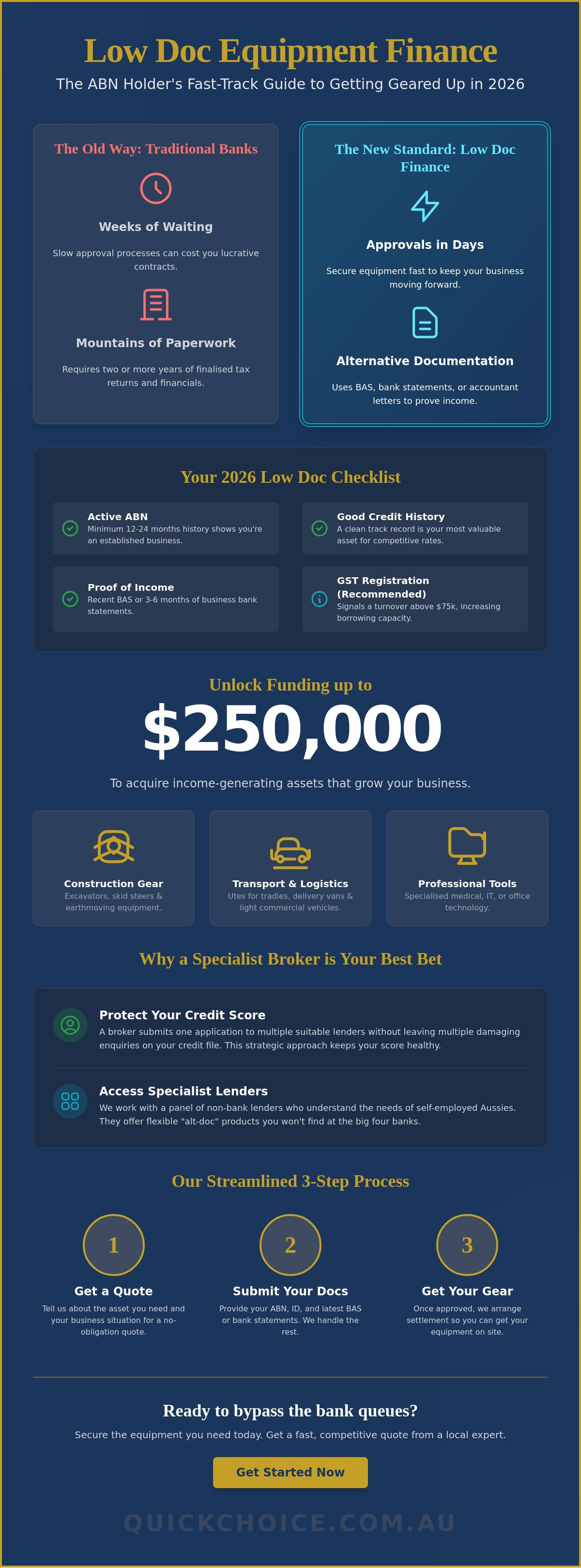
Low doc finance is a streamlined credit pathway that allows ABN holders to secure business machinery without providing two years of full tax returns. In the current 2026 market, where the RBA cash rate was adjusted to 4.35% in May, business owners are looking for ways to move faster than traditional banks. While full-doc loans might offer slightly lower rates, the time lost waiting for an approval can cost more in missed contracts. Expert low doc equipment finance brokers help you navigate this by using alternative proofs of income, such as Business Activity Statements (BAS) or bank statements, to secure funding.
It's vital to distinguish "Low Doc" from "No Doc." While the industry is shifting towards the term "alt-doc" to reflect alternative income verification, it doesn't mean no documentation at all. You still need to prove your capacity to repay, but you do so through modern methods like digital accounting feeds. One common structure used is a What is a Finance Lease?, which allows you to use the equipment while paying it off over time; this keeps your cash flow free for daily operations.
The Role of the ABN and GST Registration
Having an active ABN for at least 12 to 24 months is your most valuable asset when applying. This history proves you have a track record of trading and aren't just a "start-up" in the eyes of a lender. Being GST registered is another significant plus. It signals to lenders that your turnover exceeds $75,000, which often increases your borrowing capacity. For established sole traders, this registration can be the difference between a quick approval and a request for more data. Lenders view a GST-registered business as a more stable entity, often leading to more flexible terms.
Common Assets Funded via Low Doc Pathways
Self-employed professionals in Melbourne’s West use these pathways to acquire a diverse range of equipment. Most low doc approvals in 2026 are available for amounts up to $250,000, making it a powerful tool for scaling operations quickly. Typical assets include:
- Construction Gear: Excavators, skid steers, and earthmoving equipment for civil contractors.
- Transport: Light commercial vehicles, utes for tradies, and delivery vans for logistics businesses.
- Professional Tools: Specialised medical equipment or high-end office technology for service-based firms.
By focusing on the asset's ability to generate income, lenders are often more willing to provide finance based on the strength of your business's current performance rather than its historical filing cabinets.
Eligibility and Documentation: What You Actually Need
One of the biggest misconceptions about low doc loans is that they require no proof of income at all. In reality, lenders still have a legal obligation under the National Consumer Credit Protection Act to ensure you can afford the repayments. While tax returns are skipped, bank statements often tell the story of your business's health and cash flow. Skilled low doc equipment finance brokers use these statements to build a compelling case for your approval, proving that your business is thriving even if your latest tax documents aren't yet finalised.
In 2026, your credit history has become the most critical factor in securing a competitive rate. Because regulators like APRA assign a higher risk weight to low doc loans, lenders look for borrowers with a clean track record. A strong credit score signals that you are a reliable partner, which can help offset the lack of traditional financial statements. If you've maintained a solid repayment history on previous assets or your commercial lease, you're already halfway to an approval.
Property ownership is another factor that often surfaces during the application. While owning a home or an industrial unit in Melbourne’s West can sometimes lead to lower interest rates, it isn't a mandatory requirement. Lenders simply use it as a "strength" indicator. If you're currently renting your business premises or home, you can still access high-quality finance options by demonstrating consistent turnover.
The "Low Doc" Checklist for 2026
To keep your application moving quickly, you should have a few core items ready. Most specialist lenders will ask for:
- ABN and ID: Proof of an active ABN for at least 12 months and current Australian identification.
- Activity Statements: Your most recent Business Activity Statements (BAS) to verify turnover.
- Asset Details: A formal quote or invoice from the supplier detailing the machinery or vehicle you intend to purchase.
Asset Finance without Property Security
A major advantage of this pathway is that the equipment itself usually serves as the primary security for the loan. This means you don't have to tie up your family home or other personal assets to grow your business. This structure is particularly popular among contractors who want to keep their business and personal liabilities separate. You can read more about how this works in our guide to asset finance without property security.
If you're unsure which documents best represent your current income, speaking with a specialist can help clarify your options and speed up the process.
Why a Specialist Broker Beats the Big Banks
Walking into a major bank branch in Werribee often feels like trying to fit a square peg into a round hole. Bank managers are bound by rigid algorithms that often struggle to interpret the fluctuating income of a sole trader. They see a complex tax structure and see risk, whereas low doc equipment finance brokers see a thriving business with specific needs. Working with a specialist provides a buffer between your business and these restrictive bank policies, ensuring your application is presented to lenders who actually want your business.
One major advantage of using a broker is protecting your credit score. Every time you approach a bank directly, they perform a "hard" credit pull. If they decline your application and you move to the next bank, multiple hits can quickly damage your rating. A broker acts as a single point of entry. We assess your scenario first, then target the specific lender on our panel most likely to approve your request. This "single application" strategy keeps your credit file clean while we do the heavy lifting in the background.
In the 2026 market, having a reliable specialist guide is about more than just paperwork. It's about having someone who understands that a contractor in Melton has different cash flow patterns than a consultant in Taylors Lake. We advocate for you, explaining the nuances of your income that a computer program might miss.
Access to Niche Lenders
Brokers provide access to a hierarchy of lenders that you simply can't reach on your own. While Tier 1 banks remain conservative, Tier 2 and specialist non-bank lenders thrive in the "alt-doc" space. These lenders often find the "sweet spot" between competitive interest rates and documentation ease. Because we maintain deep relationships with these credit teams, we can often secure fast decisions. They trust our assessment of your business, which can turn a week-long wait at a bank into a 48-hour approval elsewhere.
Navigating the 2026 Interest Rate Environment
With indicative low doc rates currently ranging from 7.49% to 11.50% p.a., the lowest headline rate isn't always the best deal. A slightly higher rate with no early exit fees or a more flexible balloon payment might actually cost you less over the life of the loan. We help you compare these structures to ensure your weekly cash flow remains healthy. If you're deciding between different funding types, it helps to understand the trade-offs of an asset finance vs business loan structure before you sign on the dotted line.
Serving Melbourne’s West: Local Expertise in Werribee and Beyond
The industrial landscape of Melbourne’s West is evolving at a rapid pace. From the massive logistics precincts in Truganina to the residential boom in the Tarneit growth corridor, business owners face unique challenges that a generic call centre simply won't understand. Local low doc equipment finance brokers provide a distinct advantage by knowing exactly what is happening on the ground in hubs like Melton and Werribee. We recognise that a contractor working on the massive developments in Aintree or Thornhill Park needs their gear on-site yesterday to keep up with tight project timelines.
We take pride in supporting the local tradie community across Hoppers Crossing and Taylors Lake. Whether you're a sole trader needing a new kitted-out ute or a civil contractor looking for a second excavator, we speak your language. For busy contractors in Rockbank who are constantly on the move, we offer the flexibility of digital applications or face-to-face visits. We can meet you at your home office or even on a worksite during a lunch break. This personalised approach ensures that your finance application doesn't become another chore that gets pushed to the weekend.
Industry Focus: From Construction to Logistics
Our expertise covers the diverse range of businesses that drive the economy in the West. We specialise in financing for owner-drivers and couriers operating out of the busy Truganina distribution centres, where reliable transport is the lifeblood of the business. In the Tarneit and Aintree growth corridors, we assist landscaping and earthmoving businesses in securing the specialised machinery needed for large-scale residential projects. Even for new hospitality ventures in Caroline Springs, we provide pathways for kitchen fit-outs and specialised equipment that traditional banks might find too "niche" to fund without extensive paperwork.
The "Quick Choice" Local Advantage
Choosing a local partner means you're working with someone who understands the Victorian contract market and the specific demands of local councils. We aren't just processing data; we're helping you build your business in the community we share. Our goal is to provide fast turnaround times so you never miss out on a contract because you were waiting on a lender's approval. If you're ready to get your next piece of machinery on the ground, contact our Melbourne West team today for a straightforward conversation about your options.
Streamlining Your Application with Quick Choice
Securing the right machinery shouldn't feel like an uphill battle against a mountain of paperwork. We've refined a three-step process designed to get you from an initial quote to having "gear on the ground" with minimal disruption to your daily operations. First, we have a brief conversation to understand your specific equipment needs and business goals. Second, we identify the most suitable lender from our specialist panel. Finally, we manage the entire submission and settlement process. This methodical approach ensures that you avoid common mistakes to avoid when financing equipment, such as choosing a structure that doesn't align with your long-term cash flow.
We also value the relationship you have with your tax professional. Our team can integrate directly with your accountant to ensure your asset finance structure supports your specific tax requirements. Whether it's coordinating the timing of a purchase or ensuring the finance type matches your depreciation strategy, we act as a bridge between your financial goals and the lender's requirements. Our supportive tone and clear communication aim to make this potentially complex journey feel straightforward and manageable.
Preparation for Fast Approval
While we handle the heavy lifting, having a few items ready before you pick up the phone can significantly speed up your approval. Ensure your ABN has been active for the required period and have your most recent BAS or bank statements organised. Before we submit your application to any lender, we perform a thorough review of your credit profile. This proactive step allows us to address any potential hurdles before they become an issue, protecting your credit score from unnecessary hits. For a deeper dive into how these structures work, you can explore our pillar guide on asset finance for self employed.
Ready to Grow Your Business?
Quick Choice is here to remove the obstacles standing between you and your business's next phase of growth. We believe that every self-employed professional in Melbourne’s West deserves access to the tools they need to succeed without being penalised for a complex tax structure. Choosing the right low doc equipment finance brokers means choosing a partner who values your time and understands the local market. The right equipment is an investment in your operational success and long-term stability. If you're ready to secure your next asset with confidence, reach out for a no-obligation consultation today and let's get your business moving.
Take the Next Step Toward Your Business Goals
The path to acquiring new machinery shouldn't be blocked by outdated bank requirements or endless paperwork. As we have explored, low doc finance in 2026 is a sophisticated tool that leverages your current business performance to secure the assets you need for growth. By choosing to work with specialist low doc equipment finance brokers, you gain access to a broad panel of niche lenders who understand the unique rhythm of self-employed life in Melbourne’s Western growth corridors. Our local expertise ensures your application is positioned for speed and success.
Whether you are operating out of a logistics hub in Truganina or a construction site in Werribee, having the right gear is essential for your operational success. Our team provides a fast, supportive service tailored to busy contractors who value their time. We are here to simplify the process and ensure you don't miss out on vital local contracts due to financing delays. Get a quick quote on your next business asset with Quick Choice and let's get your equipment on-site where it belongs. Your business has the momentum; we provide the fuel to keep it moving forward.
Frequently Asked Questions
What is the maximum I can borrow on a low doc equipment loan in 2026?
You can generally borrow up to $250,000 on a low doc equipment loan in 2026. This threshold allows most self-employed professionals to secure heavy machinery or commercial vehicles without providing full tax returns. While some specialist lenders may consider higher amounts, staying within this limit often results in a faster approval process. It is a practical ceiling that balances the needs of growing businesses with the lender's risk requirements.
Do I need to be a property owner to qualify for low doc finance?
No, you do not need to be a property owner to qualify for low doc finance. While owning property can sometimes result in a lower interest rate, many lenders approve applications based solely on business cash flow and credit history. This allows renters or those with separate personal assets to still access essential gear. Experienced low doc equipment finance brokers can help you identify lenders who focus on your business turnover rather than your real estate status.
Can I get low doc finance if my ABN is less than two years old?
Yes, you can often secure finance with an ABN that is less than two years old, provided it has been active for at least 12 months. Some start-up friendly lenders consider applications with even less history, though they may require a larger deposit or additional proof of income like three months of bank statements. Having a GST registration also significantly improves your chances if your business has been trading for a shorter period.
How much higher are the interest rates for low doc compared to full doc?
Interest rates for low doc loans are typically 1.25% to 5% higher than traditional full doc loans. In May 2026, indicative low doc rates range from 7.49% to 11.50% p.a., whereas established businesses with full financials might see rates starting from 6.25% p.a. This premium reflects the higher capital risk weight of 100% assigned to these loans by APRA. The extra cost is often offset by the speed and convenience of the approval.
What happens if I have a default on my credit file?
Having a default on your credit file makes the process more complex, but it isn't necessarily an automatic decline. Specialist non-bank lenders often look at the story behind the default, such as whether it was a small utility bill or a larger commercial dispute. If the default is paid or you can demonstrate a strong recent repayment history, we can often find a pathway. It is best to be transparent about your credit history from the start.
Is a low doc loan the same as a chattel mortgage?
No, a low doc loan refers to the documentation required, while a chattel mortgage is the legal structure of the loan. Most low doc equipment finance is actually structured as a chattel mortgage, where you own the asset from day one and the lender takes a mortgage over it as security. This structure is highly popular because it often allows for GST input tax credit claims and depreciation benefits for eligible businesses.
Can I buy used equipment from a private seller using low doc finance?
Yes, you can purchase used equipment from a private seller, though lenders usually require an independent valuation or inspection first. This ensures the asset is worth the purchase price and provides security for the loan. Private sales often involve a few extra steps, such as verifying that the seller has clear title to the gear. low doc equipment finance brokers manage these details to ensure the funds are transferred securely to the seller.
How long does the approval process typically take with Quick Choice?
The approval process typically takes between 24 and 48 hours once we have received your alternative documentation. Because we understand the urgency of local contracts in Melbourne’s West, we work directly with credit teams to bypass the standard bank queues. Our goal is to move you from the initial quote to having your gear on the ground as quickly as possible, ensuring you don't miss out on important business opportunities.


